










Pakka says 500-plus tonnes a month sell ahead of PM4 start-up
Key highlights
- Pakka says equivalent flexC base grades exceeding 500 tonnes a month are already selling ahead of PM4.
- Pakka equates the 500-plus-tonne monthly run-rate to about 17% of PM4 capacity.
- PM4 is scheduled to start in December 2026, after October 2026 start-up of the recovery boiler and 15-megawatt turbine.
- Wrap & Carry revenue was Rs 292.83 crore in FY26, while CHUK revenue was Rs 62.97 crore.
powered by IRIS
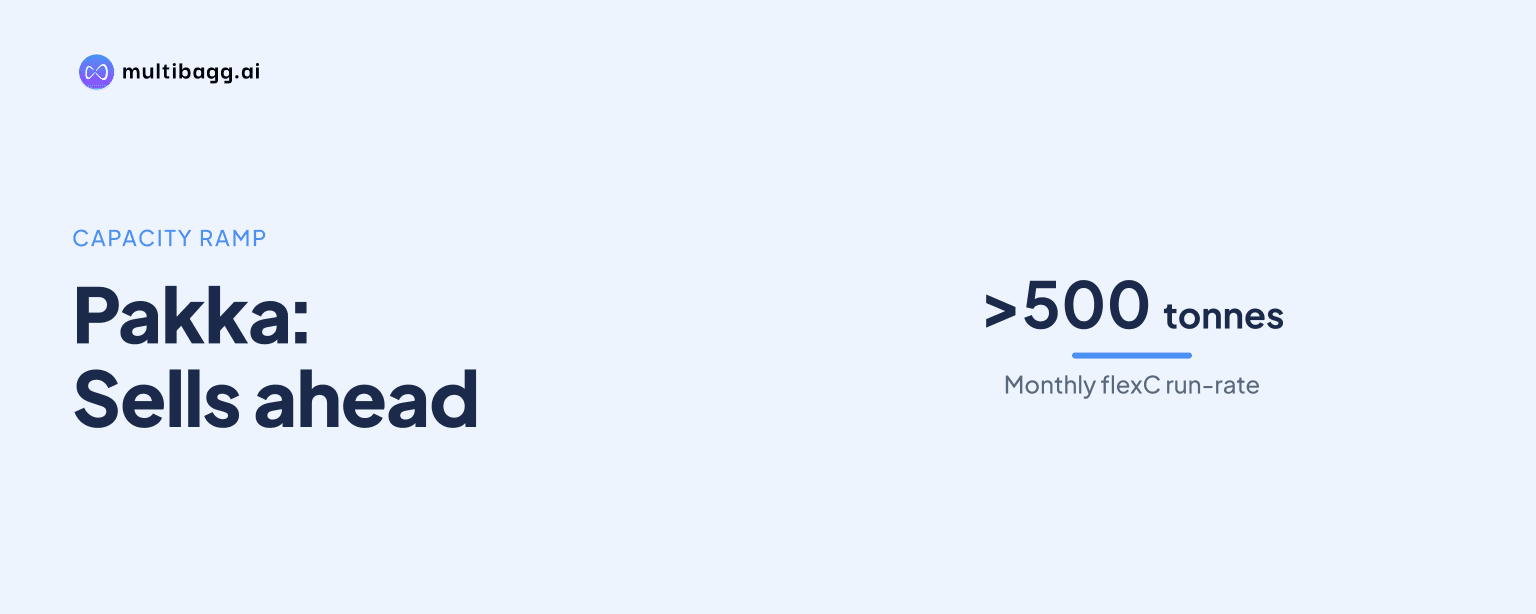
Pakka says equivalent flexC base grades exceeding 500 tonnes a month are already selling ahead of Paper Machine 4 (PM4), a run-rate it equates to about 17% of the new machine’s capacity before its scheduled December 2026 start-up. The disclosed volume is an early market-seeding indicator rather than reported PM4 production.
Know Pakka inside out
Results, valuation, peers and who's buying, in one view.
What has Pakka sold ahead of PM4 start-up?
Pakka says equivalent flexC base grades exceeding 500 tonnes a month are already selling before PM4 starts in December 2026. The company describes the volume as equivalent grades already in the market, rather than output from PM4, which remains scheduled for start-up under Project Jagriti.
The market preparation includes pilot trials completed in Europe and a partner reveal at the plant. Pakka recorded both actions as delivered in its second-quarter commitments update, and its third-quarter FY27 commitment is to launch flexC base to partners and distributors.
Pakka does not disclose customer names, order duration, pricing, revenue, or the split of the 500-plus tonnes between individual grades. The presentation therefore establishes a monthly market run-rate, but does not provide a disclosed order book or a flexC base revenue contribution.
How much of PM4 capacity does the volume represent?
Pakka states that more than 500 tonnes a month represents about 17% of PM4 capacity. This comparison indicates that equivalent grades have a market presence equal to roughly one-sixth of the new machine’s capacity before PM4 has begun producing specialised flexC base paper.
The presentation does not state PM4 capacity in tonnes per month or tonnes per annum. Because Pakka uses “500+” tonnes and “about 17%”, the figures are not an exact utilisation forecast and do not say that 17% of future PM4 output is contracted.
PM4 is one part of Project Jagriti, whose pulp-mill expansion was marked completed. The recovery boiler and 15-megawatt power turbine started up in October 2026 and were stabilising, while PM4 was scheduled to start up in December 2026.
What applications will flexC base support?
Pakka says PM4 will enable in-house production of specialised flexC base paper at scale for release liners, labels, heat-sealable bags, tea or sugar sachets, food and confectionery pouches, and seed or medical packaging. These are the initial application areas listed in the product-development presentation.
The product belongs to Pakka’s Flexible Packaging vertical, which the company describes as fibre-based material under development and customer trials. The broader flexC material is intended for formats including snacks, confectionery, sachets and tea, with development in advanced stages and customer trials underway.
Pakka distinguishes flexC base from the finished flexible-packaging structure. Its third-quarter FY27 commitments include launching flexC base to partners and distributors while separately advancing development of a non-metallised flexC structure, showing that base-paper commercialisation and final-structure development are separate workstreams.
The presentation sets out four stages from concept and research and development through product development, customer trials and commercialisation. The European pilot trials and the 500-plus-tonne equivalent-grade run-rate show activity beyond internal development, but Pakka does not state that every listed application has completed customer qualification.
Got a follow-up? Ask IRIS
How does flexC fit Pakka’s existing business?
Pakka positions flexC as an extension of its integrated chain from agricultural residue and bagasse-based inputs through pulping, paper, coating and value addition. Its company overview lists 130 tonnes per day of pulp capacity and 39,600 tonnes per annum of paper capacity across operations in Ayodhya, Noida and Bangalore.
The programme also extends beyond Pakka’s largest reported segment, Wrap & Carry. Wrap & Carry generated Rs 292.83 crore in FY26 and represented 82% of segment revenue, down from Rs 351.35 crore in FY25 and Rs 350.12 crore in FY24.
Wrap & Carry revenue fell by Rs 58.52 crore between FY25 and FY26, while CHUK revenue rose by Rs 8.28 crore to Rs 62.97 crore. CHUK sells bagasse-based tableware, delivery containers, drinkware and ancillary products, whereas flexC targets flexible material applications such as pouches and sachets.
What milestones remain for flexC base?
Pakka must commission PM4 in December 2026, launch flexC base to partners and distributors in the third quarter of FY27, and advance the non-metallised flexC structure. These are management’s stated commitments, and the company says PM4 is intended to provide specialised flexC base paper manufacturing at scale.
Project Jagriti stabilisation remains a disclosed operational requirement because the recovery boiler and 15-megawatt turbine were still stabilising after their October 2026 start-up. Pakka’s stated plan is to commission and stabilise the project, progressively increase capacity utilisation, and use expanded capacity to support its next phase of growth.
Pakka also plans to strengthen the Material Science Centre in Bangalore during the third quarter of FY27. The centre was reported as established in the second-quarter update, but the presentation does not provide a flexC revenue target, PM4 utilisation target, customer-conversion target, or profitability timetable.
Conclusion
Pakka’s disclosed 500-plus-tonne monthly equivalent-grade run-rate is an early commercial marker for flexC base before PM4 begins operating. At about 17% of PM4 capacity, it links market seeding to the scale of the planned machine, while European pilot trials and the plant partner reveal show progress through product-development and launch preparation.
The next disclosed events are PM4’s scheduled December 2026 start-up, the third-quarter FY27 flexC base launch to partners and distributors, and further work on the non-metallised flexC structure. Project Jagriti’s boiler and turbine stabilisation, subsequent capacity utilisation, and any later disclosure on customer conversion or flexC revenue remain the key matters to watch.