










Pearl Global earmarks Rs 900-950 crore capex through FY30
Key highlights
- Pearl Global has earmarked Rs 900 crore to Rs 950 crore of capex from FY27 to FY30, with capitalisation expected by FY29.
- Bangladesh backward integration accounts for Rs 350 crore to Rs 375 crore of Pearl Global's planned outlay.
- Pearl Global's Rs 225 crore of Bangladesh-focused CWIP is expected to be capitalised in Q3 and Q4 FY27.
- Pearl Global shipped 43.6 million pieces in H1 FY27 versus 37.1 million pieces in H1 FY26.
powered by IRIS
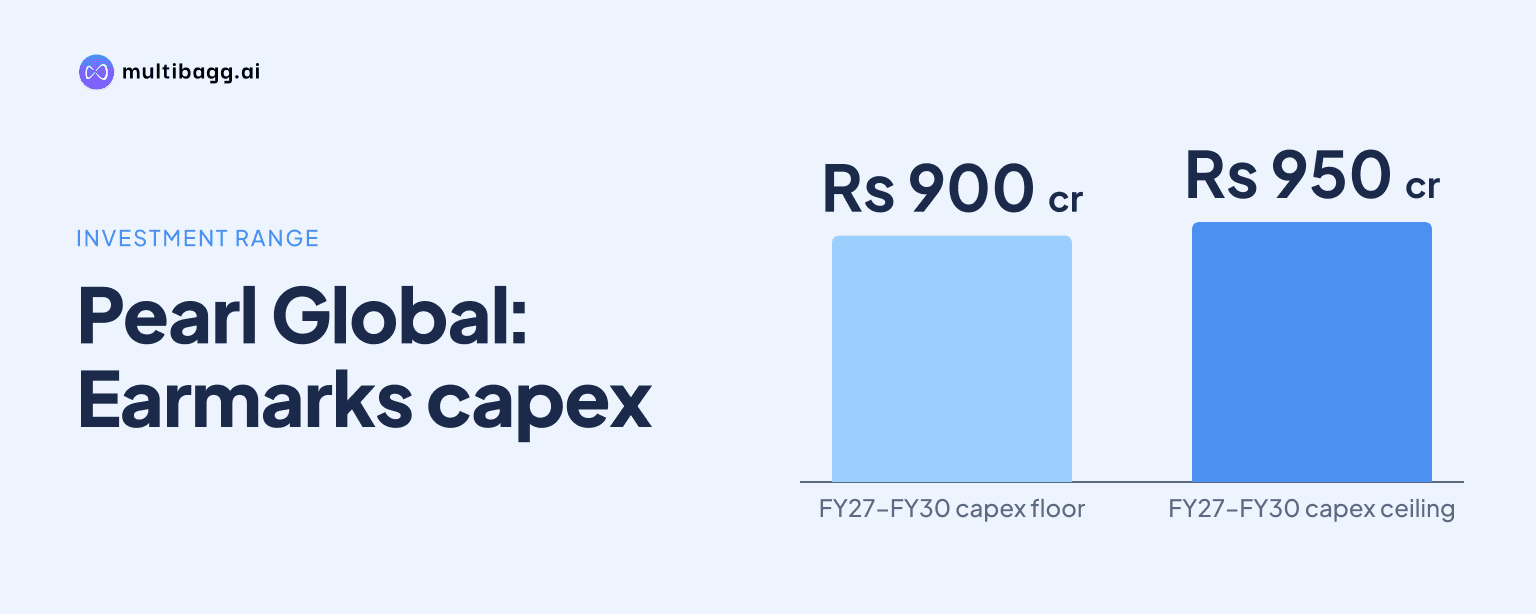
Pearl Global Industries Limited has earmarked Rs 900 crore to Rs 950 crore of capital expenditure from FY27 to FY30, led by Rs 350 crore to Rs 375 crore for Bangladesh backward integration. Management expects the whole programme to be capitalised before or by FY29, while its Bangladesh knitting and processing unit is planned to operate from the beginning of 2028.
Know Pearl Global Industries inside out
Results, valuation, peers and who's buying, in one view.
What is Pearl Global's capex plan through FY30?
Pearl Global's plan is a Rs 900 crore to Rs 950 crore capital-expenditure programme from FY27 to FY30, although management expects all of it to be capitalised before or by FY29. The outlay includes capital work already in progress, capacity expansion across geographies and a Bangladesh knitting and processing project.
Capital work in progress, or CWIP, stood at Rs 225 crore on September 30, 2026, primarily relating to Bangladesh operations. Management expects this existing CWIP to be capitalised in Q3 and Q4 FY27, making it the earliest disclosed part of the wider investment programme to move into fixed assets.
How is Pearl Global allocating the Rs 900-950 crore outlay?
Pearl Global is assigning its largest identified allocation, Rs 350 crore to Rs 375 crore, to Bangladesh backward integration. This range is larger than the Rs 325 crore to Rs 350 crore allocated for capacity expansion across geographies, making Bangladesh the principal specifically identified destination within the plan.
The geographical capacity-expansion allocation includes Rs 100 crore that management expects to capitalise in FY27. The remaining Rs 225 crore to Rs 250 crore has been approved for growth opportunities across geographies and is planned for implementation during the following two financial years. Management did not disclose a country-level split for this amount.
The Rs 225 crore of CWIP, the Rs 325 crore to Rs 350 crore expansion allocation and the Rs 350 crore to Rs 375 crore backward-integration allocation add up to the stated Rs 900 crore to Rs 950 crore programme. Vietnam capex remained under evaluation after land acquisition was completed, while no Vietnam amount was included in the call.
When will Pearl Global's Bangladesh assets operate?
Pearl Global expects the Bangladesh knitting and processing unit to be operational at the beginning of 2028, while the first phase of 10 tonnes of knitting capacity has already started operating. Management said commitments for the Rs 350 crore to Rs 375 crore backward-integration project would begin in FY27.
The company also inaugurated a Bangladesh garment-manufacturing unit during Q2 FY27, adding annual capacity of 7 million pieces at optimum utilisation. It began operating a washing and laundry facility in September 2026, creating three disclosed Bangladesh projects: garment capacity, washing and laundry, and knitting and processing.
The new assets follow higher group shipments in H1 FY27. Pearl Global shipped 43.6 million pieces in H1 FY27, compared with 37.1 million pieces in H1 FY26, an increase of 6.5 million pieces. Management reported growth across locations but did not quantify the contribution from Bangladesh, India, Vietnam, Indonesia or Guatemala.
Got a follow-up? Ask IRIS
Why is Pearl Global investing in Bangladesh backward integration?
Pearl Global is investing in Bangladesh backward integration to add knitting, processing and washing capabilities to its garment-manufacturing base. Management said customers had shown substantial interest in the three Bangladesh projects, but it did not disclose project-level revenue, margin, utilisation or cost-saving targets.
Bangladesh is also facing a wage revision process. Management said the Bangladesh prime minister had asked the wage board committee for an early recommendation and implementation by early December 2026, with arrears to be paid in January. Pearl Global said it had factored in an increase, but management did not quantify the eventual wage rise or its financial effect.
As of the day before the November 6, 2026 call, all five of Pearl Global's owned Bangladesh factories were operating fully, according to management. The company said it had temporarily stopped operations near facilities when disturbances occurred nearby, allowing workers to leave, while its newly opened Bangladesh facility had continued to operate smoothly.
How does the capex plan fit Pearl Global's financial position?
Pearl Global's capex plan follows H1 FY27 consolidated revenue of Rs 3,330 crore, up 31.1% year on year, and adjusted earnings before interest, tax, depreciation and amortisation, or EBITDA, of Rs 348 crore, up 47.7%. Adjusted EBITDA margin rose 120 basis points to 10.5%, while profit after tax increased 63.6% to Rs 225 crore.
Funding and cash conversion are relevant to the investment timetable. Long-term loans rose Rs 61 crore between March 31, 2026 and September 30, 2026 to fund Bangladesh capex, while short-term borrowings increased Rs 210 crore for working capital. Cash and bank balances were Rs 534 crore excluding about Rs 70 crore earmarked for letters of credit, and liquid and mutual-fund investments were about Rs 104 crore.
Working-capital days were 56 on September 30, 2026, after receivable days increased to 50 from 30 because of heavy festive shipments near quarter-end and deferred factoring. Management expects receivable days to normalise in Q3 and Q4 FY27, which it said should improve free-cash-flow generation in H2 FY27.
Management has also set an EBITDA-margin roadmap of 12% to 14% through FY30, compared with 10.5% in H1 FY27. That range is management's stated target, not a disclosed result of the capex plan, and Pearl Global gave no return-on-capital target or full-programme funding mix.
Conclusion
Pearl Global's Rs 900 crore to Rs 950 crore programme concentrates spending in Bangladesh through Rs 350 crore to Rs 375 crore of backward integration, alongside Rs 225 crore of existing CWIP and a new 7-million-piece garment unit. The plan combines extra garment capacity with knitting, processing and washing capabilities, while the company expects capitalisation to conclude by FY29.
The next disclosed milestones are capitalisation of Rs 225 crore of CWIP in Q3 and Q4 FY27, the start of backward-integration commitments in FY27 and the planned beginning-2028 operation of the processing unit. Management's expected Q3 and Q4 FY27 receivables normalisation and the Bangladesh wage-board process due by early December 2026 are additional matters that could affect cash generation and execution.