










Pearl Global Expects Limited Effect From 15% Bangladesh Wage Rise
Key highlights
- Pearl Global expects Bangladesh’s wage increase to be about 15%, possibly slightly higher.
- About two production days were lost across three Bangladesh factories, according to management.
- Management said Bangladesh wages are about 50% below India’s and efficiency is about 20% to 25% higher.
- Pearl Global’s new Bangladesh facility has capacity of seven million pieces and was about 20% operational.
powered by IRIS
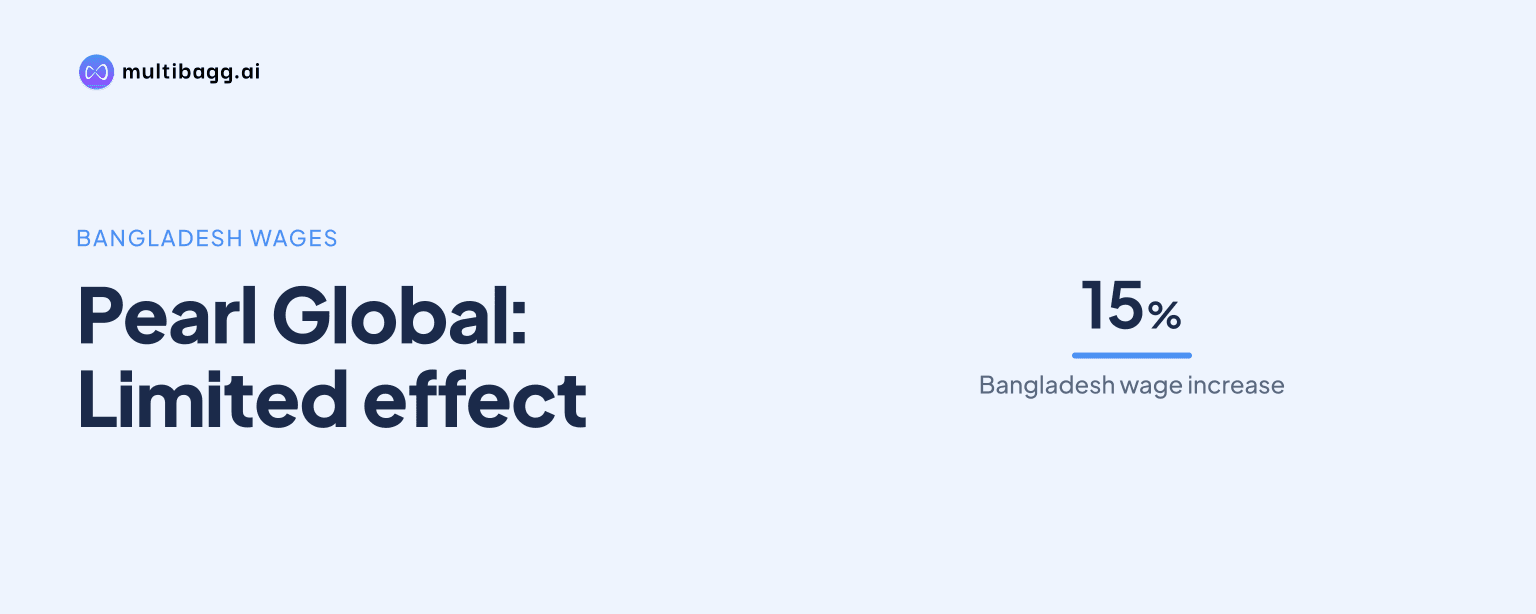
Pearl Global Industries Limited expects Bangladesh’s mandated wage increase to be about 15% or slightly higher, but management said the effect should be limited by above-minimum pay, currency movement and productivity measures; only three factories had lost about two production days as of the November 6, 2026 call.
Know Pearl Global Industries inside out
Results, valuation, peers and who's buying, in one view.
What Bangladesh wage increase does Pearl Global expect?
Pearl Global expects a Bangladesh wage increase of about 15%, potentially a little above that level. Management gave this estimate after an analyst cited worker demands to increase wages from 12,000 to 30,000 and noted that similarly high demands had been made in 2023. Management said the final outcome remained uncertain.
An analyst also discussed a scenario in which wages rose to about 18,000, implying an increase of roughly 40%. The analyst estimated that wages accounted for 17% of total cost and that Bangladesh represented about half of wage cost, producing a potential 3% to 3.5% cost effect if all other variables remained unchanged. Management agreed with that arithmetic under the stated constant-cost assumption.
Pearl Global said a statutory wage revision would affect its payroll, but it does not expect its own wage adjustment necessarily to match the full change in the legal minimum. Management said its workers already earn much more than the minimum wage, without disclosing either current pay levels or the size of that premium. The 15%-plus expectation is therefore management’s view rather than a confirmed wage settlement.
Why does Pearl Global expect Bangladesh to remain viable after a wage rise?
Pearl Global expects Bangladesh to remain viable because wages there are about 50% lower than in India and the local ecosystem delivers efficiency that management estimated at about 20% to 25% higher. Management said these two factors create a substantial production advantage even if the wage increase exceeds 15%.
Management also said Bangladesh retained an advantage over Cambodia in both available capacity and wages. It did not expect business to become unviable or migrate rapidly following a higher minimum wage, though it acknowledged that other sourcing countries could compete more effectively if Bangladesh’s benchmark cost increases.
Pearl Global’s assessment is also tied to its order mix. Management said it does not compete only in the lowest-end commodity apparel segment and serves customers through infrastructure and value-added services. On that basis, management expects Bangladesh to remain one of Pearl Global’s largest manufacturing locations over the next three to five years.
The company has invested in Bhaluka and operates in the Gazipur and Bhaluka areas. Management said customers with facilities approved in both India and Bangladesh are gradually placing some programmes in India, often starting with one or two out of 10 programmes, while continuing to expand Bangladesh production. This indicates diversification rather than a stated plan to replace Bangladesh capacity.
How much Bangladesh production has Pearl Global lost?
Pearl Global reported about two lost production days across three Bangladesh factories. Management said it did not expect Pearl Global or its customers to face an impact if conditions improved after the November 6, 2026 earnings call, making that assessment conditional on the disruption not worsening.
The reported disruption occurred while an analyst noted that Pearl Global’s factories were mainly in Gazipur and Bhaluka, whereas unrest had occurred in Mirpur. Management said the company had been ahead of schedule and had delivered some goods early around the holiday period, which it described as part of its value-added service to customers.
The operational loss of roughly two days differs from the broader wage risk because it was limited to three factories and a defined period. Pearl Global did not provide a revenue, shipment-volume or profit impact from those lost days. It instead said its earlier production and delivery planning had allowed it to avoid a visible customer impact so far.
Got a follow-up? Ask IRIS
How does Pearl Global plan to offset higher Bangladesh wages?
Pearl Global plans to use taka depreciation, productivity improvements and customer-cost discussions to offset part of any wage increase. Management said its Bangladesh costing for the third and fourth quarters already included some allowance for a wage revision, although it did not disclose the percentage incorporated into those forecasts.
Management said the taka had been held around 124 to 125 per US dollar over the previous year and cited an economic expectation that it could depreciate further against the dollar. According to management, such depreciation could offset a substantial part of any wage increase beyond the amount already included in costing, while productivity gains could provide an additional offset.
The company also argued that customer pricing will reflect Bangladesh’s role as a low-cost apparel sourcing centre. Management said customers have limited immediate alternatives if Bangladesh’s cost benchmark rises, though it did not promise a price recovery or quantify the extent of any customer contribution. The ultimate effect therefore depends on the final wage decision, currency movement, productivity and commercial negotiations.
Management’s comments distinguish its offset plan from realised results. It agreed that the analyst’s estimated 3% to 3.5% impact would follow if wages rose by about 40% and all other factors stayed unchanged. Its argument was that those factors are unlikely to remain unchanged, particularly the exchange rate and factory productivity.
What is Pearl Global’s Bangladesh capacity ramp-up plan?
Pearl Global has started operations at a new Bangladesh facility with annual capacity of seven million pieces, of which about 20% was operational on November 6, 2026. Management said it was adding workers, training them and opening lines progressively rather than bringing the entire facility into operation at once.
Management expects the seven-million-piece facility to reach full capacity over the following six to eight months. It did not disclose utilisation at older Bangladesh factories, the investment amount for the new site or the number of workers still to be hired. The timing means the ramp-up will occur while the wage revision remains unresolved.
Pearl Global contrasted this expansion with a separate India ramp-up. India capacity utilisation was about 68% to 69% in the first half, as new facilities hired and trained workers. Management said India utilisation could be somewhat higher by year-end, but it continued to present Bangladesh as central to its medium-term manufacturing footprint.
Conclusion
Pearl Global’s stated position is that a Bangladesh wage rise of about 15% or more is a manageable cost risk, not an immediate threat to its production base. Its case rests on workers already being paid above the minimum, Bangladesh wages about 50% below India’s, and efficiency estimated at 20% to 25% higher than India’s, alongside only about two lost days across three factories.
The next developments to watch are the final Bangladesh wage decision, movement in the taka from around 124 to 125 per US dollar, and the new seven-million-piece facility’s progress from about 20% operations to full capacity over six to eight months. Management also said third- and fourth-quarter Bangladesh costing already included some wage increase, making those periods relevant for assessing whether the planned offsets materialise.