










Pelatro targets lower cost per revenue dollar from FY28
Key highlights
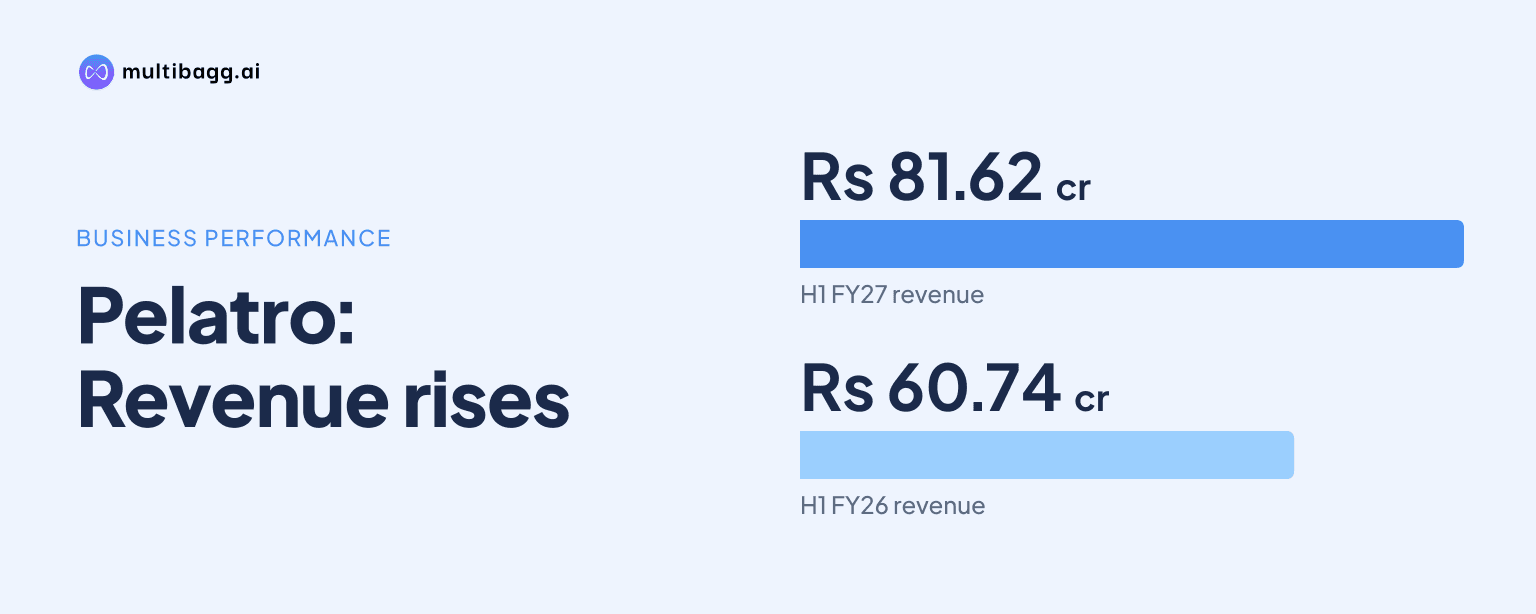
- Pelatro reported FY27 H1 revenue from operations of Rs 81.62 crore, compared with Rs 60.74 crore in FY26 H1.
- Pelatro says AI-led development should lower cost per dollar of revenue, with the impact visible in FY28.
- Pelatro reported FY27 H1 EBITDA of Rs 18.27 crore and an EBITDA margin of 22.38%.
- The CVM Division reported a FY27 H1 EBITDA margin of 22.92%, versus 20.16% for the Estel Division.
powered by IRIS
PELATRO says its artificial intelligence (AI)-enabled software-development initiatives will lower cost per dollar of revenue and increase profitability, with the impact visible in FY28. The presentation identifies large language model (LLM) coding, LLM-based model development, an AI deployment console and automated support auto-correction as the mechanisms behind that timing.
Know Pelatro inside out
Results, valuation, peers and who's buying, in one view.
What AI products has Pelatro launched for telecom customers?
Pelatro has launched its mViva Revenue Acceleration Platform™, which includes AI Agents, Co-Pilot and Zero Touch Campaigning™. Zero Touch Campaigning is described as fully automated, LLM-based end-to-end campaign orchestration, while Pelatro says the platform captures the full capabilities of generative AI and agentic AI.
The launched product features are separate from the internal development-cost programme whose financial impact Pelatro says will be visible in FY28. AI Agents are designed to analyse, plan, act and learn, while Co-Pilot is designed to suggest, collaborate, automate and improve. Pelatro says the increasingly AI-based offering should support continued product leadership and higher growth, which is an expected business impact rather than a reported financial result.
The mViva platform is part of Pelatro's CVM Division portfolio, where the Revenue Acceleration Platform™ supports contextual campaign management, data monetization, contextual loyalty management, unified communications, customer data management and managed services. Its Customer Data Platform is intended to provide a Customer 360° view for data-driven decision-making.
How will Pelatro use AI to reduce development costs?
Pelatro plans to apply LLM tools to coding and to development of models, alongside an AI-based deployment console in the implementation function. Its listed initiatives also include automating support for auto-correction, extending AI use across code development, implementation and support rather than limiting it to customer-facing product features.
Pelatro says these development measures will lower cost per dollar of revenue and lead to higher profitability, with the effect visible in FY28. The presentation does not quantify the expected cost reduction, profitability increase, investment required or a target margin. It therefore provides a timing expectation and operating mechanisms, but not a numerical financial target.
Quality improvement is the second stated effect of the internal programme. Pelatro says improved quality should lead to a better reputation and higher growth, but it gives no FY28 revenue-growth rate tied to LLM coding, the deployment console or support automation. The distinction is that mViva AI features have already launched, while the cost and profitability effect is deferred to FY28.
Got a follow-up? Ask IRIS
What is Pelatro's financial baseline before FY28?
Pelatro reported consolidated revenue from operations of Rs 81.62 crore in FY27 H1, or the first half of FY27, compared with Rs 60.74 crore in FY26 H1 and Rs 38.44 crore in FY25 H1. Revenue rose by Rs 20.88 crore from FY26 H1 to FY27 H1, after increasing by Rs 22.30 crore in the preceding comparison; reported growth slowed to 34.37% from 58.01%.
EBITDA increased by Rs 4.46 crore year on year in FY27 H1, while its margin declined by 0.35 percentage points from 22.73% in FY26 H1 to 22.38%. Net profit increased by Rs 4.36 crore and net profit margin rose by 1.89 percentage points to 15.40%. These reported figures are the baseline before the FY28 development-efficiency effect Pelatro describes.
Pelatro also reported return on net worth of 19.76% in FY27 H1, compared with 17.41% in FY26, and return on capital employed of 21.59%, compared with 20.36%. Debt-equity was 0.10 in FY27 H1, down from 0.12 in FY26 and 0.52 in FY25. These consolidated ratios are separate from the stated AI cost-per-revenue objective.
Which Pelatro division contributes more FY27 H1 profit?
Pelatro's CVM Division generated FY27 H1 revenue of Rs 65.77 crore and EBITDA of Rs 15.07 crore, compared with Rs 15.85 crore of revenue and Rs 3.20 crore of EBITDA for the Estel Division. CVM therefore contributed the larger share of consolidated FY27 H1 revenue of Rs 81.62 crore and EBITDA of Rs 18.27 crore.
The CVM Division reported an EBITDA margin of 22.92% in FY27 H1, against 20.16% for the Estel Division, a difference of 2.76 percentage points. Pelatro says Estel Division profitability is yet to reach the CVM Division level and is expected to increase to that level in about 12 months. That is a management expectation, not a reported margin improvement.
The Estel Division offers payment solutions, prepaid recharge and distribution products for telecommunications operators, including eRecharge and Voucher Management, Sales and Distribution Management, and a Mobile Money Platform. Pelatro's revenue model includes recurring monthly fixed licence fees, annual maintenance contracts, managed services and change requests, as well as one-time perpetual licences and implementation fees. That mix can affect when internal development automation appears in cost per dollar of revenue.
Conclusion
Pelatro distinguishes between customer-facing AI features already launched through mViva and internal automation intended to alter operating economics later. mViva includes AI Agents, Co-Pilot and LLM-based Zero Touch Campaigning, while the development programme covers LLM coding, model development, deployment automation and support auto-correction. FY27 H1 reported revenue of Rs 81.62 crore, EBITDA of Rs 18.27 crore and net profit of Rs 12.57 crore.
The next disclosed milestone is FY28, when Pelatro says lower cost per dollar of revenue and the associated profitability impact should become visible. Pelatro also says Estel Division profitability is expected to rise toward the CVM Division level in about 12 months, while FY27 H1 EBITDA margin stood at 22.38%.