










Pelatro keeps 59% recurring revenue as change requests rise
Key highlights
- Pelatro's recurring revenue represented 59% of FY26-27 H1 revenue, versus 60% in FY25-26.
- Change-request revenue rose to 35% of FY26-27 H1 revenue from 22% in FY25-26.
- One-time revenue declined to 6% of FY26-27 H1 revenue from 18% in FY25-26.
- Pelatro reported 31 managed-services customers and 46 total customers at December 31, 2025.
powered by IRIS
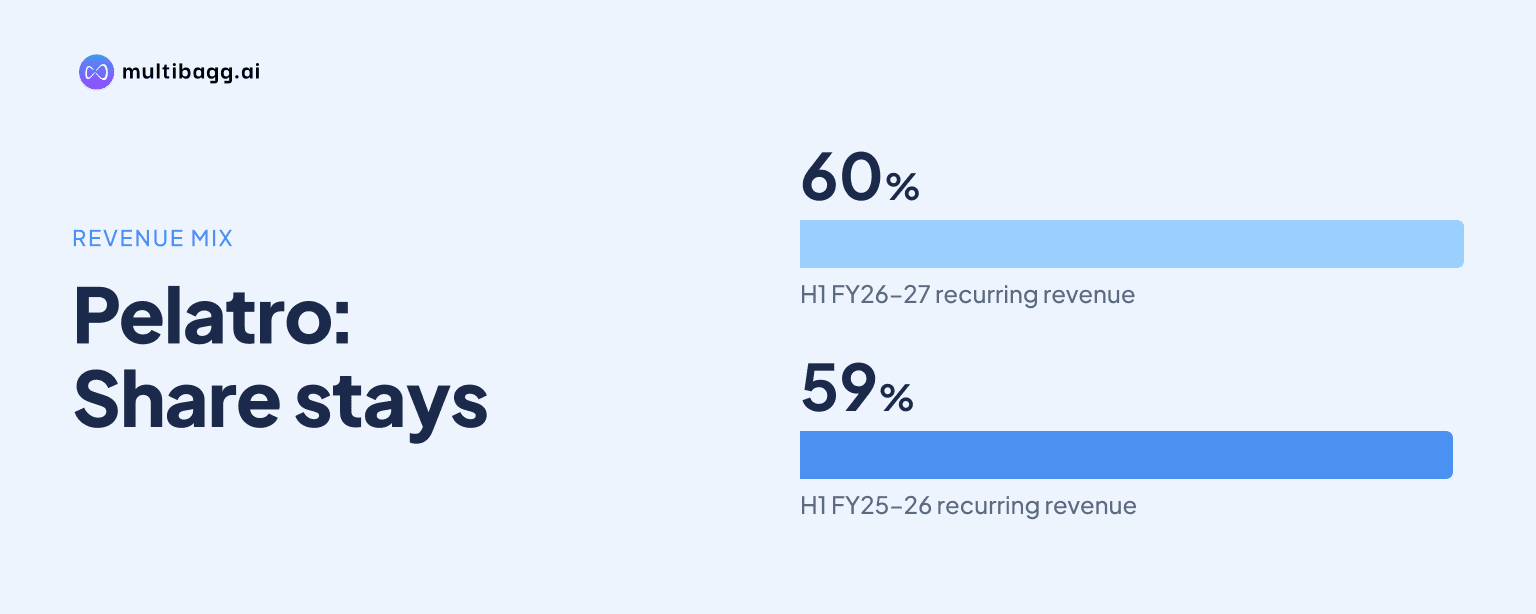
In FY26-27 H1, Pelatro kept recurring revenue at 59% of total revenue while change requests rose to 35%, from 22% in FY25-26. The increase in change-request income shifted the mix within repeat revenue, while one-time revenue declined to 6% from 18% and recurring revenue remained the largest reported category.
Know Pelatro inside out
Results, valuation, peers and who's buying, in one view.
What changed in Pelatro's revenue mix in FY26-27 H1?
Pelatro's revenue mix shifted towards change requests in FY26-27 H1, with re-occurring revenue rising 13 percentage points to 35% from 22% in FY25-26. Recurring revenue declined by one percentage point to 59%, while one-time revenue fell 12 percentage points to 6%. The three disclosed categories total 100% in each period.
Pelatro classifies both recurring and re-occurring income as repeat revenue, making their combined share 94% in FY26-27 H1, compared with 82% in FY25-26. This 12-percentage-point increase corresponds with the decline in one-time revenue to 6%. The presentation provides revenue shares rather than rupee amounts for the three categories.
The disclosed mix does not establish whether one-time revenue declined in rupee terms or whether repeat revenue grew faster than one-time revenue. Pelatro also does not provide separate revenue figures for monthly licence fees, annual maintenance contracts, managed services, change requests, perpetual licences or implementation fees. The comparison therefore measures composition, not category-level revenue growth.
What does Pelatro count as recurring revenue?
Pelatro defines recurring revenue as monthly fixed licence fees, annual maintenance contracts (AMC), and managed services. It separately defines re-occurring revenue as change requests, while perpetual licences and implementation fees are classified as one-time revenue.
The distinction means that Pelatro reported 59% as recurring revenue in FY26-27 H1 and another 35% as re-occurring change-request revenue. Change requests were 24 percentage points below recurring revenue but 29 percentage points above the 6% one-time category. The presentation does not identify the share of recurring revenue contributed by licence fees, AMC or managed services.
Managed services are included in both of Pelatro's operating divisions. The customer value management division offers business consulting, business operations and information-technology operations support, while the Estel division lists the same managed-services mechanism alongside payment, recharge and distribution offerings. Neither division is assigned a separate revenue contribution in the FY26-27 H1 mix disclosure.
Is Pelatro's managed-services customer base growing?
Yes, Pelatro reported 31 managed-services customers at December 31, 2025, up from 22 at December 31, 2024 and 15 at December 31, 2023. The count increased from one managed-services customer at December 31, 2019 to 31 in 2025.
Pelatro's total customer count reached 46 at December 31, 2025, compared with 36 a year earlier. Managed-services customers increased by nine during 2025, while total customers increased by 10. The presentation reports customer counts, but not contract values, retention rates or revenue per managed-services customer.
The 31 managed-services customers represented about two-thirds of the 46 total customers reported for December 31, 2025, based on the stated counts. Pelatro does not say that all 31 customers contributed recurring revenue in FY26-27 H1, and it does not disclose the duration or renewal terms of their managed-services arrangements.
Got a follow-up? Ask IRIS
What cross-sell opportunity does Pelatro identify?
Pelatro identifies additional product and service sales to existing customers as an opportunity because it has eight products and an average presence of 1.3 products per customer. The company reported 46 telecom networks globally as of December 31, 2025, creating the customer base against which management describes wider product adoption.
Management places the market size at Rs 12,000 crore across 450 telcos and says Pelatro has penetrated 10% of telcos. It says increased market penetration can expand the base for cross-selling products and services and raise revenue per customer. The presentation does not disclose product-level revenue, divisional revenue or a timetable for additional deployments.
The customer value management portfolio includes contextual campaign management, data monetisation, contextual loyalty management, unified communication and a customer data platform. Estel offers eRecharge and voucher management, sales and distribution management, and a mobile money platform. Pelatro presents this range of engagement, analytics, recharge, distribution and payment capabilities as the basis for selling more than the current average of 1.3 products per customer.
What revenue visibility and growth plan has Pelatro disclosed?
Management says 100% of FY27 revenue has been contracted and has outlined annual revenue growth of about 15% over the next five years. It also expects expanding earnings before interest, tax, depreciation and amortisation, or EBITDA, but these are management expectations rather than reported outcomes.
Management links this plan to further telecom penetration, more recurring revenue and higher revenue per customer from additional products and services. The presentation identifies long sales cycles, complex integrations and regulatory intensity in telecom, but it provides no annual revenue targets or interim milestones within the stated five-year period.
Pelatro also says its products and processes have been re-engineered to use artificial intelligence, including agentic artificial intelligence. Its development initiatives include large language model use in coding and model development, an artificial-intelligence deployment console and automated support correction. Management says lower cost per dollar of revenue and higher profitability from these initiatives will be visible in FY28.
Conclusion
Pelatro's FY26-27 H1 mix shows recurring revenue holding near its FY25-26 level at 59%, while change requests became a larger part of repeat revenue at 35%. Together, recurring and re-occurring revenue represented 94% of the reported mix, compared with 82% in FY25-26, alongside a managed-services customer base of 31 at December 31, 2025.
The next disclosures to watch are whether 100% contracted FY27 revenue converts into reported revenue, progress against management's about-15% annual growth plan over five years, and the stated FY28 timing for artificial-intelligence-related profitability effects. Future updates on products per customer, currently 1.3, would also show whether the cross-sell plan is advancing.