










Pernia’s Pop-Up Shop FY26 AOV reached Rs 76,000 on luxury mix
Key highlights
- Pernia’s FY26 AOV rose to Rs 76,000 from Rs 56,000 in FY25.
- Pernia’s FY26 GMV increased to Rs 722 crore from Rs 588 crore despite orders falling to 96,000.
- Womenswear above Rs 1 lakh generated Rs 312 crore, or 43% of Pernia’s FY26 GMV.
- Pernia’s top 50,000 customers contributed Rs 702 crore, or 97% of FY26 GMV.
powered by IRIS
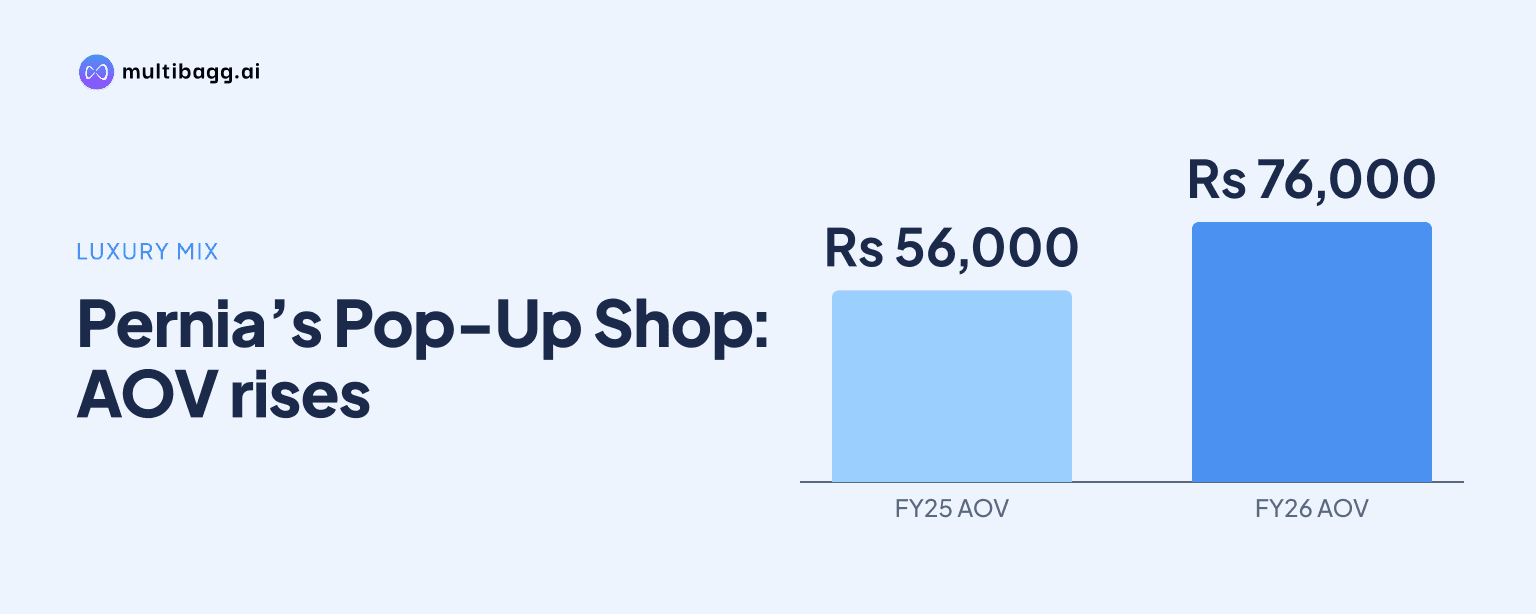
In fiscal year 2026 (FY26), Pernia’s Pop-Up Shop lifted average order value (AOV) to Rs 76,000 and gross merchandise value (GMV) to Rs 722 crore, although orders declined to 96,000 from 105,000 and unique customers to 67,000 from 71,000. The company attributes this trade-off to its FY25 strategy of eliminating the mass-premium long tail among designers and customers.
Know Purple Style Labs inside out
Results, valuation, peers and who's buying, in one view.
What changed in Pernia’s FY26 customer strategy?
Pernia’s shifted its platform strategy towards luxury in its third generation, which began in FY25, by trimming the mass-premium long tail on both the designer and customer sides. Management describes the programme as a comprehensive elimination of that long tail rather than a broad-based push for more transactions. Orders declined from 137,000 in FY24 to 105,000 in FY25 and 96,000 in FY26.
The FY26 outcome was higher value per transaction and per customer rather than a larger customer count. AOV increased from Rs 56,000 in FY25 to Rs 76,000 in FY26, while average GMV per customer rose from Rs 83,000 to Rs 1.08 lakh. Total GMV increased by Rs 134 crore, from Rs 588 crore to Rs 722 crore, even as unique customers fell by 4,000.
Pernia’s repeat-customer measure also increased during the strategy change. Repeat customers represented 28% in FY25 and 29% in FY26, compared with 22% in FY24. The 1 percentage-point FY26 increase occurred alongside the decline in unique customers to 67,000, consistent with management’s stated focus on a more loyal and higher-spending customer base.
Did higher spending offset Pernia’s lower order volumes?
Yes, higher spending per order offset lower order volumes in FY26, as Pernia’s GMV increased to Rs 722 crore from Rs 588 crore in FY25. Orders fell by 9,000 over the same period, while AOV rose by Rs 20,000. The FY26 GMV increase therefore coincided with a higher-value sales mix rather than more individual transactions.
The pattern differs from Pernia’s earlier growth phases. In the first generation, AOV fell from Rs 27,000 in FY19 to Rs 22,000 in FY21 while GMV reached Rs 66 crore. In the second generation, AOV rose to Rs 46,000 and GMV to Rs 622 crore by FY24. The third generation extended the increase in ticket size, with AOV at Rs 56,000 in FY25 and Rs 76,000 in FY26, while GMV recovered from Rs 588 crore to Rs 722 crore.
Average spending per customer showed a similar movement. Pernia’s average GMV per customer increased from Rs 67,000 in FY24 to Rs 83,000 in FY25 and Rs 1.08 lakh in FY26. Over those two years, unique customers declined from 93,000 to 71,000 and then 67,000, while GMV increased from Rs 622 crore to Rs 722 crore.
Which categories drove Pernia’s luxury sales mix?
Womenswear priced above Rs 1 lakh was Pernia’s largest FY26 GMV category, generating Rs 312 crore and accounting for 43% of total GMV. Its GMV rose by Rs 116 crore from Rs 196 crore in FY25, while units increased from 10,000 to 15,000. The category contributed the largest increase among Pernia’s FY26 product segments.
The lower-priced womenswear category moved in the opposite direction. Womenswear priced up to Rs 35,000 declined from Rs 112 crore in FY25 to Rs 86 crore in FY26, while units fell from 59,000 to 42,000. Its GMV share dropped from 19% to 12%, compared with 51% in FY19, illustrating the change from Pernia’s earlier mass-premium mix.
Womenswear from Rs 35,000 to Rs 1 lakh added Rs 26 crore to reach Rs 163 crore in FY26, while menswear added Rs 23 crore to Rs 132 crore. By contrast, the Others category, comprising jewellery, accessories, kidswear and home decor, declined by Rs 5 crore to Rs 29 crore. The resulting FY26 mix comprised 43% womenswear above Rs 1 lakh, 23% mid-priced womenswear and 18% menswear.
Got a follow-up? Ask IRIS
How dependent is Pernia’s on its highest-spending customers?
Pernia’s reported Rs 406 crore of FY26 GMV from its top 10,000 customers, equal to 56% of total GMV of Rs 722 crore. Average GMV for this group was Rs 4.06 lakh, up from Rs 3.42 lakh in FY25. The group’s GMV share declined by 2 percentage points from 58%, even as its absolute GMV increased by Rs 64 crore.
Pernia’s top 50,000 customers generated Rs 702 crore in FY26, or 97% of total GMV, compared with Rs 564 crore and 96% in FY25. Average GMV for the top 50,000 customers reached Rs 1.40 lakh, up from Rs 1.13 lakh. With total unique customers at 67,000 in FY26, the disclosed figures show that sales were concentrated among Pernia’s larger customer cohorts.
The top 50,000 cohort’s contribution increased from 91% of GMV in FY24 to 96% in FY25 and 97% in FY26. For the top 10,000 customers, average GMV increased from Rs 1.54 lakh in FY22 to Rs 4.06 lakh in FY26. These figures align with management’s stated aim of increasing wallet share among high-value customers.
How does Pernia’s luxury strategy connect to its 2030 plan?
Pernia’s 2030 roadmap targets total GMV of Rs 2,100 crore, compared with Rs 722 crore in FY26, through store expansion, upgrades and international online reach. The India plan assigns Rs 700 crore of target GMV to Delhi, Rs 500 crore to Mumbai and Rs 450 crore to the rest of India. Management identifies a new approximately 100,000-square-foot fourth-generation flagship in Delhi as part of that plan.
Internationally, the roadmap assigns Rs 270 crore of target GMV to the United States and Rs 180 crore to the rest of the world. Management plans to use the New York flagship to enable wider and deeper customer spending, and to upgrade the London store to the third generation while expanding online reach in other countries. In FY26, US GMV was Rs 77 crore, down from Rs 97 crore in FY25, while UK GMV increased from Rs 37 crore to Rs 40 crore.
Management said Pernia’s opened four large-format stores in FY26. Kalaghoda Fort in Mumbai and South-Ex in Delhi had been fully operational since Q2FY26, while Madison Avenue in New York and Linking Road in Bandra, Mumbai became operational from Q1FY27. Management said Pernia’s invested heavily in FY26 and expects returns to compound from FY27, which is a management expectation rather than a reported outcome.
Conclusion
Pernia’s FY26 figures show a deliberate shift from transaction and customer-volume growth towards higher-value luxury purchases. GMV increased by Rs 134 crore to Rs 722 crore despite a decline of 9,000 orders and 4,000 unique customers, led by Rs 312 crore of GMV from womenswear above Rs 1 lakh and an AOV of Rs 76,000.
The next measures to watch are the performance of the four recently opened large-format stores from FY27 and progress towards management’s Rs 2,100 crore 2030 GMV target. The unresolved near-term matter is whether higher spending from the top 10,000 and top 50,000 customers can continue to outweigh lower volumes as Pernia’s further narrows its customer and designer base.