










Phoenix Mills lifts new mall benchmark to 1.3-1.4m sq ft
Key highlights
- Phoenix Mills has raised its new-mall benchmark from 1 million sq ft to 1.3-1.4 million sq ft.
- Palladium and Phoenix MarketCity Bangalore are planned to expand from 1 million sq ft to about 2 million sq ft each.
- Phoenix Mills places prospective new-city projects in its 2035-36 plan, subject to suitable land being secured.
- Phoenix Mills plans to increase retail area from 11 million sq ft in 2024 to about 19 million sq ft by 2030.
powered by IRIS
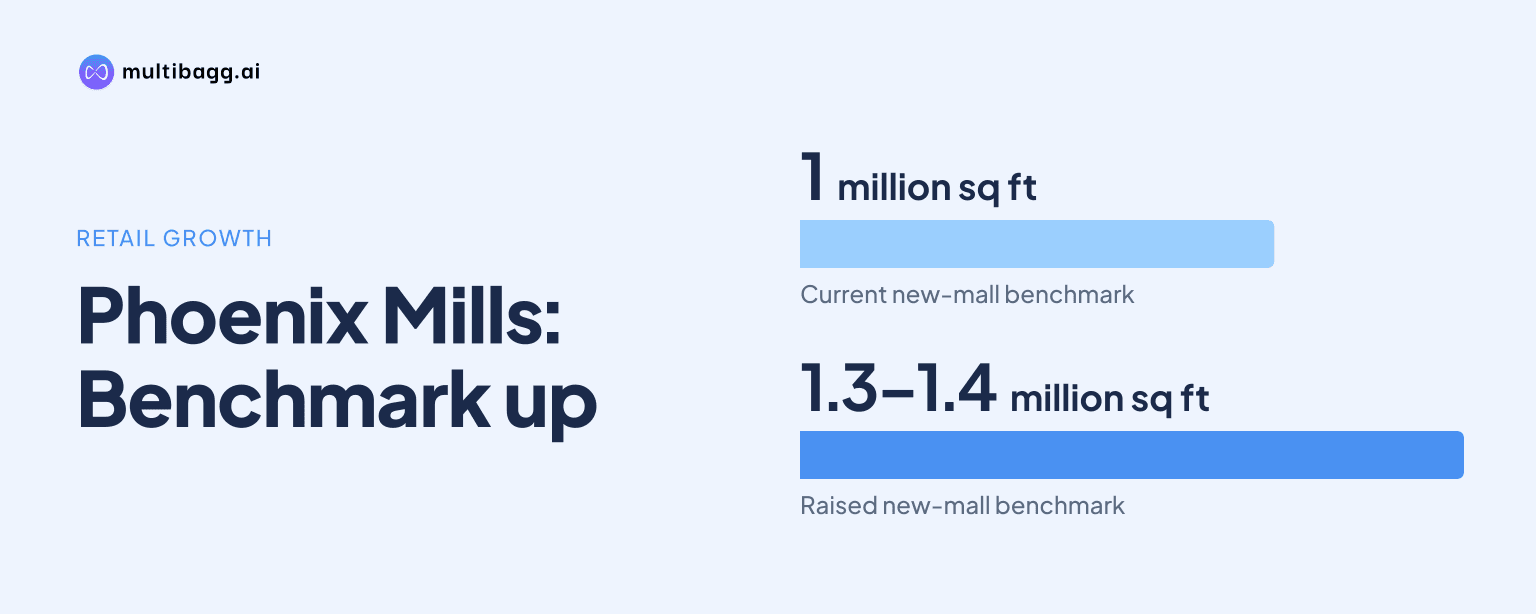
The Phoenix Mills Limited, referred to as Phoenix Mills, has raised its new-mall benchmark to 1.3-1.4 million sq ft from 1 million sq ft. Management said potential entries into identified new cities belong to its 2035-36 plan, but gave no project timelines because suitable land parcels must first be secured.
Know Phoenix Mills inside out
Results, valuation, peers and who's buying, in one view.
Why is Phoenix Mills raising its mall-size benchmark?
Phoenix Mills is raising the benchmark because management sees retailer interest supporting larger retail formats. It said the earlier reference point was 1 million sq ft of retail space for a new location, while the new benchmark is moving to 1.3-1.4 million sq ft. Management did not present this as a revised annual area-addition target.
Current expansion proposals illustrate the change in scale. Phoenix Mills intends to double Palladium and Phoenix MarketCity Bangalore from 1 million sq ft each to about 2 million sq ft each. It is also pushing the retail malls in Thane and Chandigarh to 1.6-1.8 million sq ft, which management linked to retailer interest.
Lucknow shows how an operating asset can move beyond its initial format. The mall started at 900,000 sq ft and is expected to reach 1.1 million sq ft after the current expansion. Phoenix Mills is also evaluating a luxury hotel above the Lucknow mall, a mixed-use option that management said could increase a centre’s earning capacity and productivity.
How do current projects compare with Phoenix Mills' old benchmark?
Phoenix Mills’ planned formats in Thane, Chandigarh, Palladium and Phoenix MarketCity Bangalore all exceed the former 1 million sq ft benchmark. The two proposed 2 million sq ft formats would be about twice that earlier reference point, while the 1.6-1.8 million sq ft plans are also above the new 1.3-1.4 million sq ft range.
Leasing progress across projects provides context for management’s emphasis on larger centres. Kolkata was about 90% leased, Surat was 50% leased, the Bangalore expansion was about 70% leased and Palladium was about 60% leased. Management said it had a long pipeline of brands for these centres but was making tenant-mix decisions selectively before completing leases.
Phoenix Mills is also pursuing upgrades and tenant churn at existing properties. At Phoenix MarketCity Mumbai, it is undertaking facade and landscaping work, alongside retailer optimisation intended to introduce new brands and categories. At Indore, management said a large chunk of lease expiries will occur over the next nine months, creating an opening to add brands that were not present when the centre was leased about five years earlier.
When will Phoenix Mills enter prospective new cities?
Phoenix Mills has not set timelines for prospective new-city projects because it must first finalise suitable land. Management said it cannot simply select a site at random and is identifying land and discussing opportunities in a couple of locations. It said guidance on area additions can follow only after a land parcel is finalised.
An analyst referred to 10 potential locations in the company presentation, including Hyderabad, the National Capital Region, Navi Mumbai, Goa, Jaipur, Visakhapatnam and Nagpur. Phoenix Mills said these are potential cities where it expects to be present at some point, but it did not disclose project sizes, acquisition dates, construction schedules or opening dates for any of them.
The company distinguished these possible entries from its nearer-term target. Phoenix Mills plans to increase retail area from 11 million sq ft in 2024 to about 19 million sq ft by 2030, while office area is planned to rise from about 2 million sq ft to 9 million sq ft. Management said the new cities discussed would form part of the 2035-36 plan instead.
Got a follow-up? Ask IRIS
How will Phoenix Mills pursue growth through 2035-36?
Phoenix Mills said the broad growth delivered between 2024 and 2030 would be a baseline to replicate through 2035-36. Management identified three levers: the existing operational portfolio, new city centres and densification of established centres. This was a long-range framework rather than a commitment to a specified annual addition after 2030.
The Lucknow hotel evaluation separates densification from a new-city development. A hotel above a mall would add another use at an existing centre, while new-city projects depend on land selection. Operating-asset work is a third route, illustrated by tenant churn at Indore and upgrades at Phoenix MarketCity Mumbai.
Phoenix Mills has also left future ownership structures open. When asked whether economic interest in new acquisitions would be higher than the 50%-51% levels referred to by the analyst, management said it could not commit to 51%, 100% or another arrangement. It said the structure would be decided property by property and location by location.
What supports Phoenix Mills' larger-format strategy?
Phoenix Mills cited retailer interest, operating-asset improvement and rental growth plans as support for its development approach. Management reiterated an expectation of 14%-15% rental growth in fiscal year 2027 (FY27) and FY28, adding that the first half of FY27 had been stronger than its expectations. It expects trading-occupancy ramp-up, lease repricing and new assets to contribute over time.
Lease expiries are one mechanism management identified for rental growth. It said 50% of the portfolio is due for expiry over the next two years plus, and repricing has typically produced a 20% increase over previous minimum-guarantee rentals. Management expects that pattern to continue, but did not guarantee the outcome for each expiring lease.
Management said mall consumption and rent do not move in a straight quarter-on-quarter relationship. It said rent had been 15 percentage points ahead of consumption three years earlier before the relationship reversed last year. In the reported quarter, the rent-to-consumption ratio improved to 13% from a 12% low in the fourth quarter, moving toward management’s cited long-term range of 13.5%-14%.
Conclusion
Phoenix Mills is planning materially larger malls than its previous 1 million sq ft reference, with a new 1.3-1.4 million sq ft benchmark and several existing expansion concepts ranging from 1.6 million to about 2 million sq ft. Its strategy combines larger retail formats, improvements at operating centres and selective mixed-use densification.
The next development to watch is land finalisation in the prospective cities, since management cannot provide timing or area guidance until sites are secured. Investors can also track progress toward the 2030 plan of about 19 million sq ft of retail area and 9 million sq ft of office area, as well as management’s 14%-15% rental-growth expectation for FY27 and FY28.