










Phoenix Mills reports Q2 mall spending rose 25% across portfolio
Key highlights
- Phoenix Mills reported Q2 FY27 retail consumption of Rs 4,685 crore, up 25% year on year.
- Every Phoenix Mills mall delivered double-digit consumption growth in Q2 FY27.
- Phoenix Mills' Q2 FY27 rental income rose 15% to Rs 605 crore and retail EBITDA increased 18% to Rs 639 crore.
- Phoenix Mall of Asia reported 68% consumption growth and 96% trading occupancy in Q2 FY27.
powered by IRIS
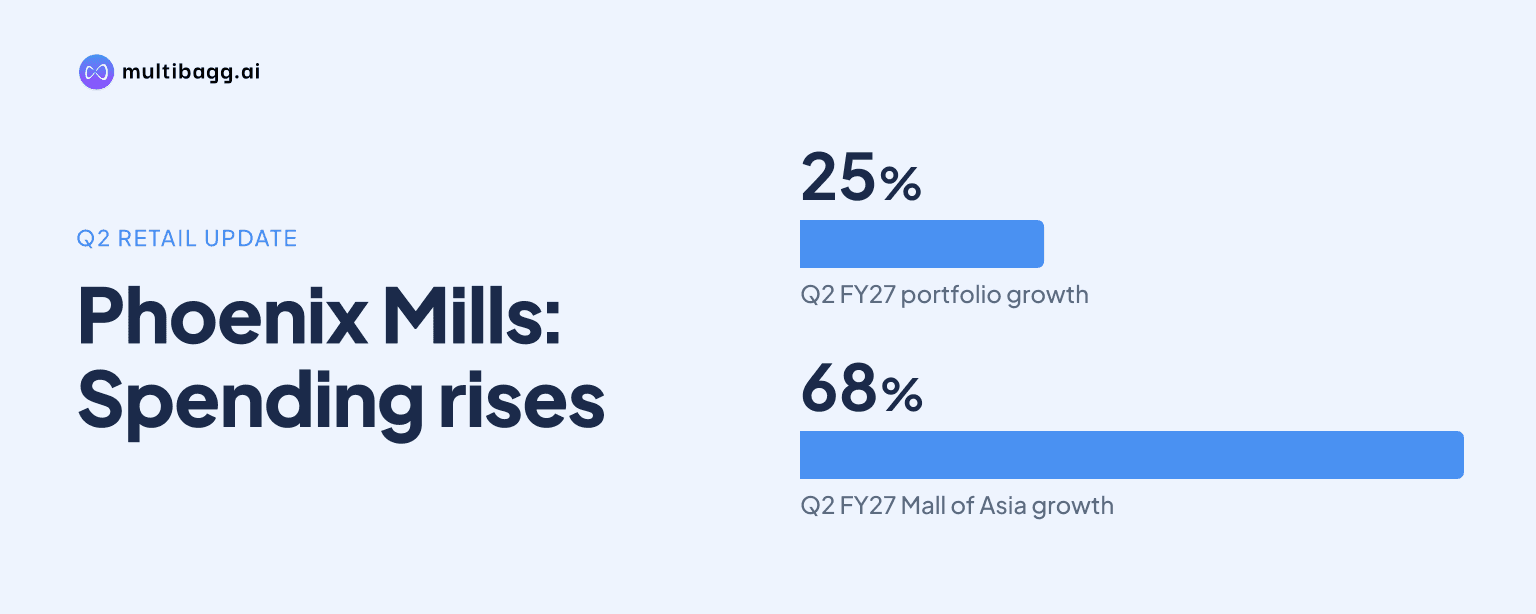
The Phoenix Mills Limited reported Rs 4,685 crore of retail consumption in Q2 FY27, up 25% year on year, with every mall in its operational portfolio recording double-digit growth. Phoenix Mills said the result came without any addition to operational retail area, while fashion, food and beverages, and entertainment all contributed to the increase.
Know Phoenix Mills inside out
Results, valuation, peers and who's buying, in one view.
Did Phoenix Mills deliver broad-based consumption growth?
Yes. Phoenix Mills said every mall in its portfolio delivered double-digit consumption growth in Q2 FY27, taking quarterly retail consumption to Rs 4,685 crore. First-half consumption rose 28% year on year to Rs 9,415 crore, compared with the 25% growth recorded in the second quarter.
The company said its operational retail area had not increased for the past two years. That means the Q2 FY27 consumption gain was generated within the existing mall portfolio rather than through newly operational retail space, alongside changes to brands, store formats and asset operations.
Fashion and accessories, which account for about 60% of Phoenix Mills' trading area, increased 22% in Q2 FY27. Food and beverages grew 21% and entertainment grew 16%, providing category evidence for management's statement that spending growth was not dependent on one or two retail segments.
Phoenix Mills also said consumption excluding jewelry and electronics rose 22% during the quarter. New brands introduced over the previous year made a notable contribution to incremental consumption after planned store closures, according to management, which said the additions supported productivity across the wider retailer mix.
How did consumption growth affect Phoenix Mills' retail earnings?
Phoenix Mills' Q2 FY27 rental income increased 15% year on year to Rs 605 crore, while retail earnings before interest, tax, depreciation and amortisation (EBITDA) rose 18% to Rs 639 crore. Management attributed the EBITDA increase to rental growth, operating leverage and cost discipline.
Consumption grew faster than rental income in Q2 FY27, at 25% versus 15%. The two measures capture different activities: consumption is spending at retailers, while rental income includes minimum-guarantee rentals and revenue-share income. Management said minimum-guarantee rentals continued to grow and revenue-share income increased significantly.
Retail EBITDA rose 17% to Rs 1,264 crore in H1 FY27, compared with the 18% growth recorded in Q2 FY27. The supplied call transcript did not provide a separate first-half retail rental-income figure, but it linked the half-year EBITDA increase to rental growth, operating leverage and cost discipline.
The company said food-and-beverage revenue shares typically range from 15% to 20% or more, depending on the format. Phoenix Mills is rolling out experiential fine-dining formats after launching Gourmet Village at Phoenix Palladium in the previous year, and management said such restaurants take time to reach optimisation.
Which Phoenix Mills malls recorded the largest changes?
Phoenix Mall of Asia recorded the largest disclosed consumption increase, at 68% in Q2 FY27, while rental income rose 44%. Trading occupancy reached 96%, up from 84% a year earlier, and trading density exceeded Rs 3,300 per square foot per month.
Phoenix MarketCity Bangalore posted 19% consumption growth and 25% rental-income growth in Q2 FY27. Its trading occupancy improved to 93% from 82% a year earlier, which Phoenix Mills cited as evidence that its repositioning programme was translating into stronger operating performance.
Phoenix Avenue of Stars, Pune reported 21% growth in consumption and 16% growth in rental income during Q2 FY27. Trading occupancy increased to 90% from 82% a year earlier, while Phoenix Mills said both the Pune and Bangalore centres were more than 97% leased.
The disclosed assets show differing rates of improvement across the portfolio. Mall of Asia's 68% consumption growth exceeded the 19% at Phoenix MarketCity Bangalore and 21% at Phoenix Avenue of Stars, Pune, while the latter two assets reported occupancy increases of 11 and eight percentage points, respectively.
Got a follow-up? Ask IRIS
What changes is Phoenix Mills making to existing malls?
Phoenix Mills is planning about 100 additional stores at Phoenix Palassio in Lucknow and 150 stores in the immediate next expansion phase at Phoenix Palladium. The projects involve reconfiguration and tenant-mix changes within existing assets rather than a new operational mall addition.
At Phoenix Palassio, Phoenix Mills is converting part of its non-food-and-beverage area into an expanded food-and-beverage offering and adding a floor. Management said anchor and hypermarket optimisation, together with new area, should add at least 100,000 square feet to the Lucknow mall, which opened in July 2020.
At Phoenix Palladium, the company is refreshing the tenant mix and reconfiguring selected spaces before adding new retail area. Management said the expansion would enable the introduction of several brands new to Phoenix Mills' portfolio and, in some cases, new to India.
Store renovations and fit-outs at Phoenix Palladium and Phoenix Palassio affected trading occupancy and consumption during September 2026. Management estimated this disruption reduced overall Q2 FY27 consumption by about 2% to 3%, and said it expects occupancy to improve as new stores and upgraded formats begin operations.
What leasing opportunity does Phoenix Mills have?
Phoenix Mills completed more than 675 leasing deals covering about 1.8 million square feet in H1 FY27 across operational and under-construction assets. Management said leasing at new retail destinations and expansion projects was progressing, supported by interest from marquee brands.
Leases covering around 50% of Phoenix Mills' retail area are due to expire between FY27 and FY29. Management said the renewal cycle gives it an opportunity to refresh the brand mix strategically and reprice space, although the call did not quantify the resulting rental impact.
Management said July and August 2026 consumption was strong and in line with expectations, aided by end-of-season sales and Independence Day. It described September as normally the weakest calendar month after holiday breaks, with Dussehra and Diwali occurring later in 2026.
Phoenix Mills expects the Diwali period to support healthy consumption across the portfolio. Its malls ran festive activations including a Ramayana-themed Diwali display, drone show and fireworks at Phoenix Palassio, while Mall of Asia introduced its Festival of Lights programme.
Conclusion
Phoenix Mills' Q2 FY27 performance indicates that consumption growth was distributed across its existing mall network, categories and selected assets. Spending rose 25% to Rs 4,685 crore, every mall achieved double-digit growth, and retail EBITDA increased 18% to Rs 639 crore as rental income rose 15% to Rs 605 crore.
The next developments to watch are festive-season consumption, the reopening of renovated stores, and progress on the planned 100 stores at Phoenix Palassio and 150 stores at Phoenix Palladium. Management also identified lease expiries covering about 50% of retail area between FY27 and FY29 as a scheduled opportunity for tenant-mix changes and space repricing.