










Piccadily Agro Q2 revenue rises 19.4% as distillery expands
Key highlights
- Piccadily Agro reported Q2 FY27 revenue from operations of ₹277.9 crore, up 19.4% year-on-year.
- Distillery revenue rose 30.5% year-on-year to ₹271.3 crore and represented 97.6% of quarterly revenue from operations.
- Standalone EBITDA increased 9.6% year-on-year to ₹53.0 crore, with margin at 21.7%.
- Standalone profit after tax declined 9% year-on-year to ₹24.2 crore as finance and depreciation costs increased.
powered by IRIS
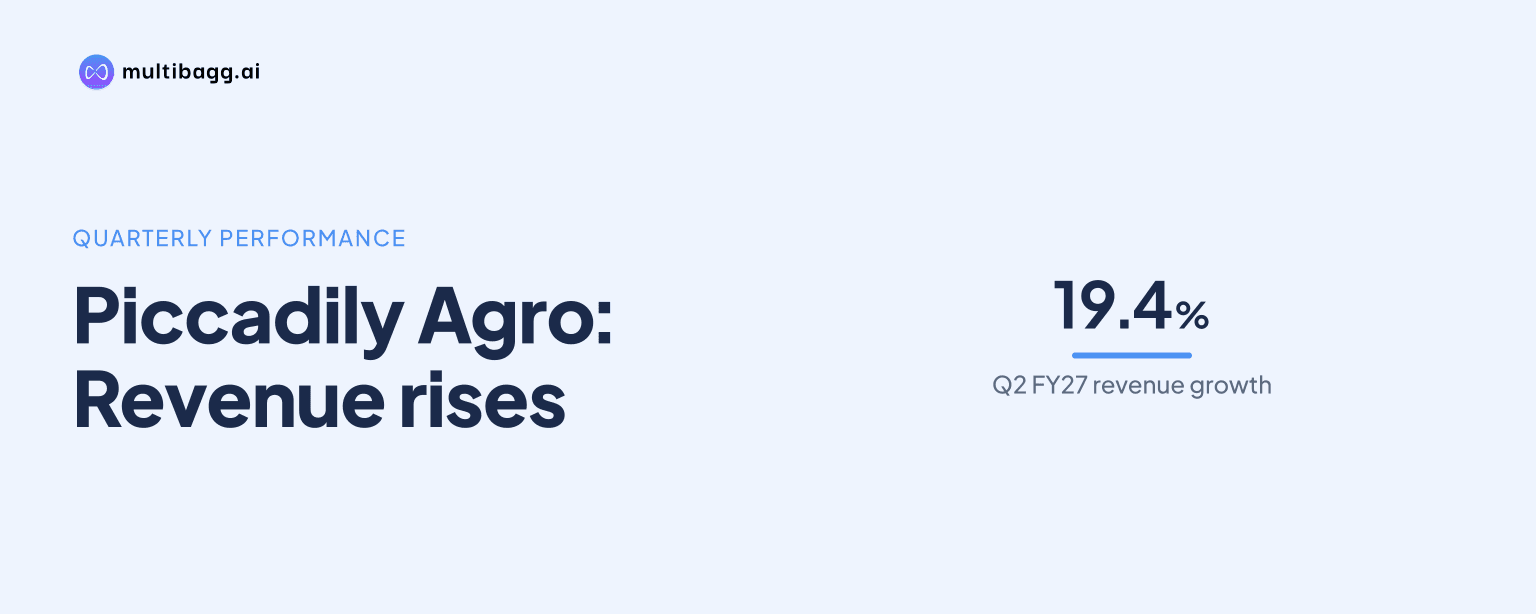
Piccadily Agro Industries Limited reported revenue from operations of ₹277.9 crore in Q2 FY27, up 19.4% year-on-year, led by a 30.5% increase in distillery revenue to ₹271.3 crore. The September-quarter result underlines the growing weight of the distillery business, although higher finance and depreciation costs affected profit growth.
Know Piccadily Agro Industries inside out
Results, valuation, peers and who's buying, in one view.
What did Piccadily Agro report for Q2 FY27?
Piccadily Agro reported its highest-ever second-quarter revenue from operations at ₹277.9 crore for the quarter ended September 30, 2026, compared with ₹232.7 crore a year earlier. The company disclosed the Q2 FY27 results in November 2026, with the results filed with stock exchanges on November 12.
The revenue increase was led by the distillery division. Distillery revenue rose to ₹271.3 crore from ₹207.9 crore in Q2 FY26, a year-on-year increase of 30.5%. This segment accounted for 97.6% of revenue from operations, compared with 89.3% in the corresponding quarter last year.
Total income was reported at ₹278.9 crore, up about 19% year-on-year. For the first half of FY27, total income reached ₹552.5 crore, an increase of 19.1% from the year-earlier period. Revenue from operations for the first half was ₹548.7 crore, up 18.8%.
How did the distillery and sugar businesses affect the quarter?
The distillery business was the principal driver of Piccadily Agro's quarterly growth, while the sugar business declined sharply. Sugar revenue fell 73.4% year-on-year to ₹6.6 crore in Q2 FY27, making the company substantially more dependent on distillery operations than it was a year earlier.
The shift in business mix is visible in the contribution data. Distillery revenue represented more than 97% of quarterly revenue from operations, leaving the sugar segment with a limited share. The increase in distillery sales more than offset the decline in sugar revenue at the overall revenue level.
Management also referred to continuing margin pressure from weather patterns, drought conditions in southern regions, and issues affecting corn and rice crops. Rakesh Vasishta, President - Sales, said these conditions had persisted, although the cost of production had declined.
What happened to Piccadily Agro's profit and margins?
Piccadily Agro's operating profit increased, but profit after tax declined as finance and depreciation costs rose. Standalone EBITDA was ₹53.0 crore in Q2 FY27, up 9.6% year-on-year, while the standalone EBITDA margin was 21.7%, compared with 20.8% a year earlier.
The company's reported standalone profit after tax was ₹24.2 crore, down 9% from ₹26.6 crore in Q2 FY26. The decline came despite revenue growth, reflecting the effect of costs below the operating-profit line.
Consolidated figures presented separately showed EBITDA of about ₹51 crore, up 10.3% year-on-year, and an EBITDA margin of 18.4%, down 153 basis points. Consolidated net profit was ₹23.28 crore, down 10.8% year-on-year, while earnings per share were ₹2.40 against ₹2.72 a year earlier. The difference between the standalone and consolidated figures reflects the reporting basis used in the respective disclosures.
Got a follow-up? Ask IRIS
Why do the Q2 numbers matter for investors?
The Q2 performance matters because it confirms that Piccadily Agro's revenue profile is now overwhelmingly linked to its distillery business. The segment's 30.5% growth lifted overall revenue even as sugar revenue fell, but the concentration also means quarterly operating performance is more closely tied to distillery demand, input costs, and production conditions.
The difference between revenue growth and profit movement is also important. Revenue from operations rose 19.4%, whereas standalone EBITDA increased 9.6% and standalone profit after tax declined 9%. This indicates that higher finance and depreciation costs reduced the conversion of operating growth into net earnings during the quarter.
For the first half, EBITDA was ₹100.3 crore, up 14.5% year-on-year, while profit after tax was ₹46.0 crore, up 1.2%. The slower growth in first-half profit than in revenue and EBITDA provides investors with a measure of the pressure from costs and expenses during the period.
What are the disclosed developments for the second half?
Piccadily Agro has indicated that revenue from Chhattisgarh is expected to begin from Q3 FY27, while the proposed sugar demerger remains pending. These are disclosed operational and corporate developments that investors can track alongside the distillery business's revenue trajectory.
Management expects the second-half business mix and operating performance to strengthen, according to the investor-presentation summary. The disclosed results, however, do not quantify the expected revenue or profit contribution from Chhattisgarh, nor do they provide a completion date for the sugar demerger.
The company held its analyst and investor meeting on November 16, 2026, to discuss the quarterly results. Investors will likely focus on future disclosures for clarity on the Chhattisgarh contribution, the status of the demerger, and the movement in finance costs, depreciation and margins.
Conclusion
Piccadily Agro delivered strong Q2 FY27 revenue growth through its distillery division, with revenue from operations reaching ₹277.9 crore and distillery revenue rising to ₹271.3 crore. But the quarter also showed that higher finance and depreciation costs can restrain net profit even when operating revenue and EBITDA increase.
The next items to watch are the expected start of Chhattisgarh revenue from Q3 FY27, management's assessment of second-half operating performance, and progress on the pending sugar demerger. Updates on input-cost conditions and margin trends will also be relevant as the distillery business accounts for nearly all of revenue from operations.