










Piccadily Agro Industries Limited targets 70%-75% H2 utilisation
Key highlights
- Piccadily targets about 70% capacity utilisation at Chhattisgarh and 70%-75% at Indri in H2 FY27.
- Piccadily's H1 FY27 distillery revenue rose 28.7% year on year to Rs 477 crore.
- Q2 FY27 distillery revenue increased 30.5% to Rs 271.3 crore and exceeded 97% of revenue from operations.
- Piccadily had more than 96,000 barrels in maturation inventory and aims to exceed 100,000 by FY27-end.
powered by IRIS
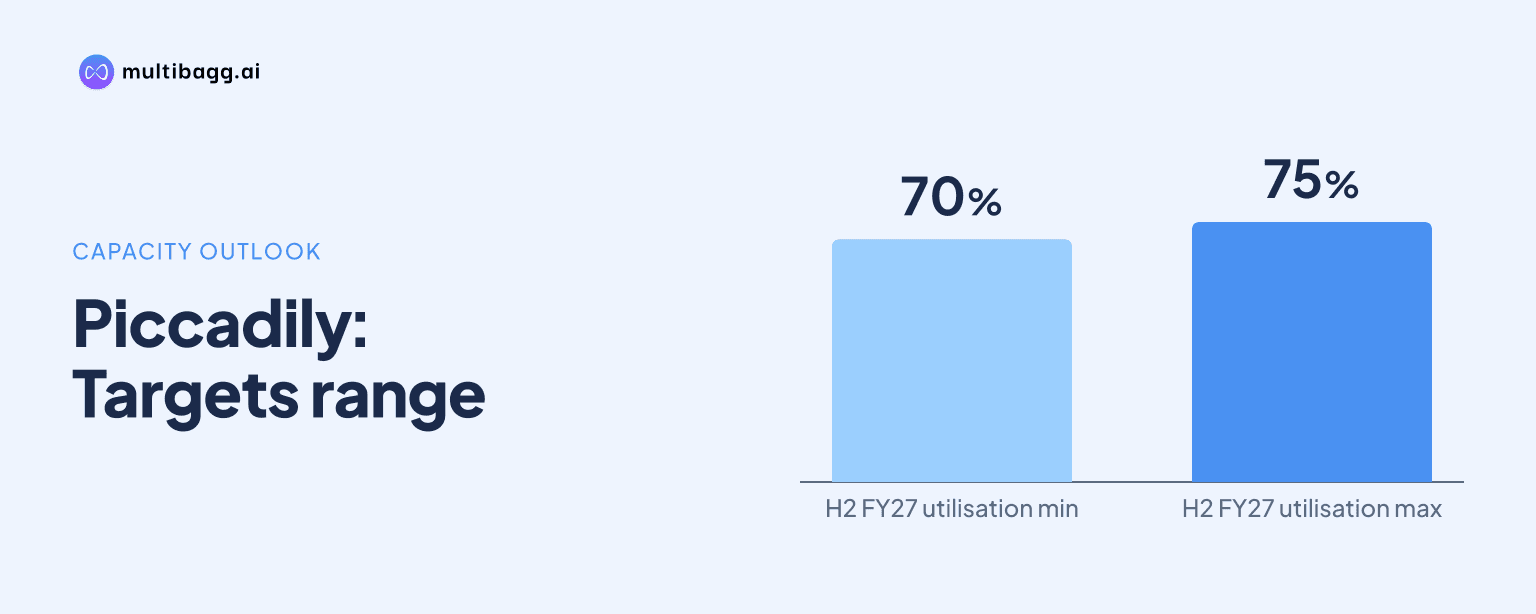
Piccadily Agro Industries Limited expects about 70% ethanol capacity utilisation at Chhattisgarh and 70%-75% at Indri in H2 FY27 after government ethanol orders, delayed by a Chennai High Court stay, were released nationwide. Management said the released volumes should support the ramp-up of recently expanded capacity alongside branded alcohol growth.
Know Piccadily Agro Industries inside out
Results, valuation, peers and who's buying, in one view.
What ethanol utilisation does Piccadily expect in H2 FY27?
Piccadily expects about 70% capacity utilisation at Chhattisgarh and 70%-75% at Indri in H2 FY27. Management provided those ranges in response to a question on whether the two ethanol plants could approach peak utilisation by Q4, without saying either facility would operate at full capacity.
The company has combined extra neutral alcohol, or ENA, and ethanol capacity of 420 kilolitres per day, or KLPD, across its two facilities. Chhattisgarh has begun sales of ethanol and Indian-made Indian liquor, or IMIL, while the Indri expansion is intended to support future demand, according to management.
Management said ethanol and IMIL will provide revenue and support asset utilisation while branded demand scales. It also said premium branded spirits remain Piccadily's long-term focus, meaning quarterly earnings before interest, tax, depreciation and amortisation, or EBITDA, margins can change with the mix of branded products, ethanol and IMIL.
Why were Piccadily's ethanol volumes delayed?
Piccadily said increased bulk capacity was affected after government ethanol orders were stayed by a Chennai High Court order. Management said the orders were released nationwide in the week before the November 16, 2026 earnings call, and that ethanol volumes had subsequently moved closer to the company's earlier expectations.
The released orders do not establish that all available capacity has been allocated. Management said that, on average, 33% had been allocated to aggregators under ethanol tenders, but did not disclose Piccadily's own allocation, the volume awarded, tender prices or the plant-level split between ethanol and ENA output.
In prepared remarks for Q2 FY27, management said new ethanol orders for FY27-28 had already been allocated to Chhattisgarh. It described its near-term priority as converting installed capacity into sustained production, sales and profitability, rather than setting a separate ethanol revenue target.
How does the capacity ramp compare with H1 performance?
Piccadily reported H1 FY27 revenue from operations of Rs 548.4 crore, up 18.8% year on year from Rs 461.7 crore, while distillery revenue rose 28.7% to Rs 477 crore. Distillery revenue grew faster than total revenue before the expected second-half increase in ethanol utilisation.
In Q2 FY27, revenue from operations rose 19.4% to Rs 277.9 crore and distillery revenue increased 30.5% to Rs 271.3 crore. The distillery accounted for more than 97% of quarterly revenue from operations, compared with 89% in Q2 FY26, as the Chhattisgarh facility began ethanol and IMIL sales and branded products expanded.
Branded alcoholic beverages, including Indri, Camikara, Cashmir and Whistler, grew 29% to Rs 175 crore in H1 FY27, while branded volumes rose 45%. Management said bulk business declined in H1 but branded alcohol grew faster, and it expects branded alcohol to remain the stronger performer as ethanol orders support bulk volumes.
Got a follow-up? Ask IRIS
What could higher utilisation mean for Piccadily's margins?
Higher ethanol and IMIL output can raise Piccadily's asset utilisation, but management said margins depend on product mix and operating efficiency. Q2 FY27 standalone EBITDA rose 9.5% to Rs 53 crore from Rs 48.4 crore, while the EBITDA margin was 21.7%, below the pace of revenue growth.
Management attributed pressure to raw-material, transportation and high-seas logistics costs. It cited droughts in southern India, a failed corn crop and marginal effects on rice, and said December crop arrivals should ease those pressures for the following six to eight months.
Management did not issue revised margin guidance during the call. An analyst referred to an earlier 23%-24% annual margin range, but management did not confirm that range in its response, instead saying it wanted further scale to improve the cost of production.
What should readers watch in the rest of FY27?
The central execution measure is whether Piccadily reaches about 70% utilisation at Chhattisgarh and 70%-75% at Indri during H2 FY27. Management said demand had increased as Q3 began and expected winter demand to continue into the new year, particularly because most of its sales are in North India, where brown spirits are more seasonal.
Branded distribution is another variable. At Q2 FY27, Piccadily reached 29 Indian states and union territories, including the Canteen Stores Department, or CSD, and more than 25,700 domestic retail and on-trade outlets. Its international footprint had reached 33 countries and 43 duty-free locations, comprising 23 in India and 20 overseas.
Management also said there would probably be one product offering in the current quarter and a few in the first quarter of 2027. Piccadily had more than 96,000 barrels in maturation inventory at Q2 FY27 and said it was on track to exceed 100,000 barrels by the end of FY27.
Conclusion
Piccadily's H2 FY27 plan combines the resumption of government ethanol orders with a 70% Chhattisgarh utilisation target and a 70%-75% Indri target. The ramp follows H1 distillery revenue growth of 28.7% to Rs 477 crore, while branded alcoholic beverage revenue increased 29% to Rs 175 crore and remained management's preferred long-term growth engine.
The next disclosure to watch is whether the two plants reach management's H2 utilisation ranges after the nationwide order release. Management also said it was working on revised targets and would provide a new three-year plan by the end of the year, which could clarify its future allocation of capital between barrels, brands and production capacity.