










Piccadily Has 96,000 Barrels, Targets 100,000 by FY27-End
Key highlights
- Piccadily reported maturation inventory of more than 96,000 barrels on November 16, 2026.
- Piccadily aims to surpass 100,000 barrels of maturation inventory by FY27-end.
- Piccadily reported Q2 FY27 distillery revenue of Rs 271.3 crore, up 30.5% year on year.
- Piccadily reported branded alcobev revenue of Rs 175 crore in H1 FY27, up 29% year on year.
powered by IRIS
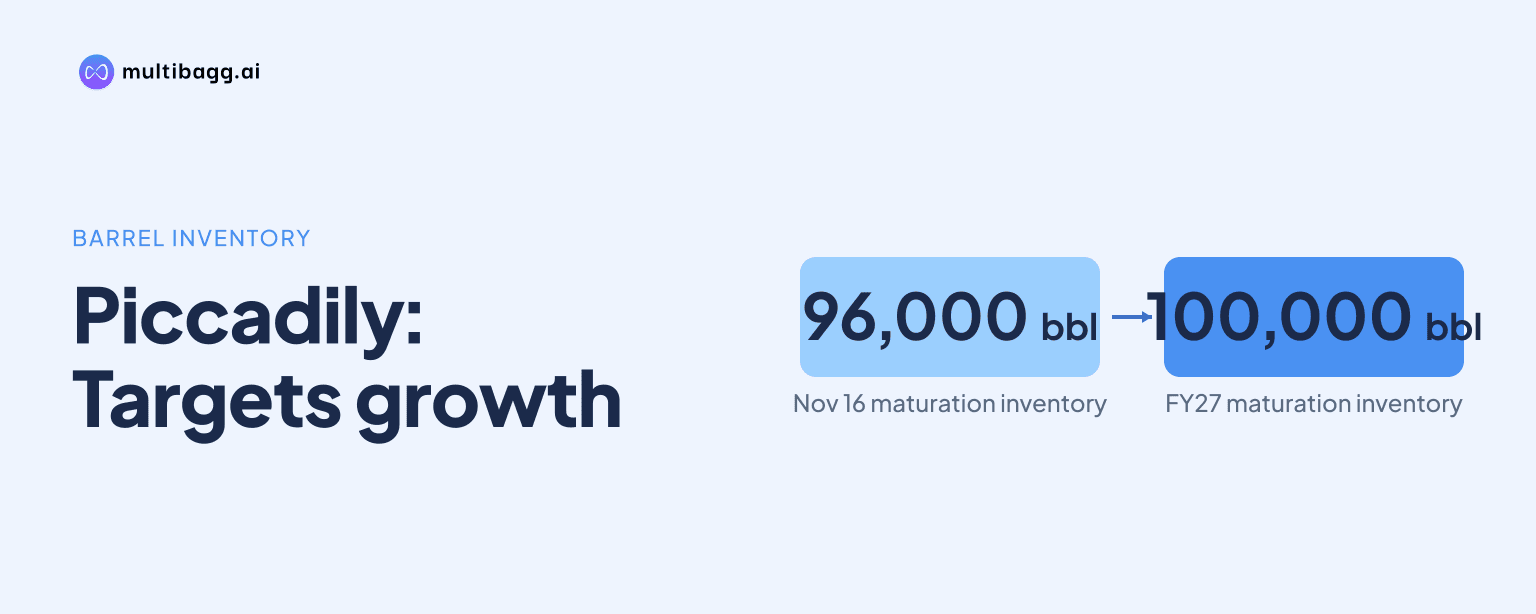
Piccadily Agro Industries Limited reported on November 16, 2026, that maturation inventory had exceeded 96,000 barrels and said it was on course to surpass 100,000 barrels by financial year 2027-end (FY27-end), a self-set benchmark management believes would make Piccadily the largest maturation inventory at an Indian distillery.
Know Piccadily Agro Industries inside out
Results, valuation, peers and who's buying, in one view.
What is Piccadily’s maturation inventory target for FY27?
Piccadily’s target is to surpass 100,000 barrels of maturation inventory by FY27-end, from more than 96,000 barrels held at the time of its second-quarter (Q2) FY27 earnings call. Management said it believed that reaching this benchmark would make Piccadily’s stock the largest maturation inventory at any distillery in India.
Management described the stock as a long-term investment for future demand, linked to premiumisation in India and overseas and increased acceptance of Indian single malt and other Indian spirits. Piccadily did not disclose the financial carrying value of the barrels, their age profile, or the allocation between products and distilleries during the November 16 call.
The 100,000-barrel objective is a management benchmark rather than a reported result. With inventory already above 96,000 barrels by November 16, Piccadily had fewer than 4,000 barrels left to reach the threshold, but did not provide a quarterly filling schedule or a specific date within FY27 for doing so.
Why is Piccadily holding more than 96,000 barrels in maturation?
Piccadily says its 96,000-plus-barrel stock is needed to build a durable and differentiated aged-spirits franchise. Its stated long-term strategy centres on premium and above branded products, including Indri, Camikara, Cashmir and Whistler, rather than treating the maturing inventory as an immediate sales driver.
Management said its investments were made to serve demand beyond the current year, with future monetisation expected through higher capacity utilisation, premiumisation, product introductions, operating leverage and cash generation. These were management expectations, and Piccadily did not quantify the future revenue, profit or cash-flow contribution expected from the maturing barrels.
The company linked the inventory plan to growth in branded alcohol. Branded alcobev volumes rose 38% year on year in Q2 FY27 and 45% year on year in the first half (H1) FY27. Management also said branded alcobev revenue rose from Rs 10 crore when Indri launched in 2022 to more than Rs 500 crore in FY26, without identifying the share derived from aged spirits.
How does Piccadily’s capacity support its maturation plan?
Piccadily reported malt capacity of 30 kilolitres (KL) per day and combined extra neutral alcohol (ENA) and ethanol capacity of 420 KL per day across its two facilities. Management said the Indri distillery expansion would support future demand, while the newly commissioned Chhattisgarh facility was moving through its operating ramp-up.
The facilities have separate roles in the stated plan. Piccadily said it would use expanded capacity to produce and sell ethanol and Indian-made Indian liquor (IMIL) while branded demand scales. Management said these categories generate revenue and support asset utilisation, but that their long-term role is to supplement the premium branded spirits portfolio.
At the Chhattisgarh plant, sales of ethanol and IMIL had commenced by Q2 FY27, and management said utilisation was continuing to increase. It also said new ethanol orders for FY27-28 had already been allocated, while its near-term priority was to convert installed capacity into sustained production, sales and profitability.
Product mix can affect quarterly profitability as capacity and maturation inventory rise. Management said earnings before interest, tax, depreciation and amortisation (EBITDA) margin would depend on mix and operating efficiency. In Q2 FY27, standalone EBITDA was Rs 53 crore, up 9.5% year on year from Rs 48.4 crore, and the standalone EBITDA margin was 21.7%.
Got a follow-up? Ask IRIS
What changed in Piccadily’s second-quarter and first-half FY27 performance?
Piccadily’s Q2 FY27 revenue from operations rose 19.4% year on year to Rs 277.9 crore from Rs 232.7 crore, while distillery revenue increased faster, by 30.5%, to Rs 271.3 crore from Rs 207.9 crore. As a result, distillery operations contributed more than 97% of quarterly revenue from operations, compared with 89% in the prior-year quarter.
For H1 FY27, revenue from operations increased 18.8% to Rs 548.4 crore from Rs 461.7 crore. Distillery revenue grew 28.7% to Rs 477 crore, while branded alcobev revenue increased 29% year on year to Rs 175 crore. Distillery revenue therefore grew faster than total revenue in both Q2 and H1 as the production platform expanded.
Management said the second half has historically contributed more branded-spirits revenue over the past three to four years. It expects Q3 to benefit from festive, gifting and wedding-season demand, while Q4 should reflect distribution expansion, additional launches and further ramp-up at Indri and Chhattisgarh. Those are management expectations rather than reported H2 results.
How is Piccadily building demand for aged spirits?
Piccadily reported operations in 33 countries after adding Qatar and Oman during Q2 FY27, alongside 43 duty-free locations. The duty-free network comprised 23 locations in India and 20 internationally, extending potential outlets for the branded portfolio as management seeks to build overseas demand for Indian spirits.
In India, Piccadily said its brands reached 29 states and union territories, including the Canteen Stores Department (CSD), and more than 25,700 retail and on-trade outlets. Management cited wider distribution, consumer experiences, brand advocacy and on-trade engagement as factors supporting the 38% Q2 increase in branded alcobev volumes.
The company also identified product development at both Indri and Chhattisgarh as part of its strategy. Its Q2 festive activity included the Indri Diwali Collector’s Edition 2026, while management said additional offerings were under development. The stated objective is to build higher-value revenue streams, but no launch dates, product specifications or sales targets were provided.
Piccadily reported H1 net sales revenue (NSR) of Rs 9,274 per case. Management said NSR could vary as product mix changes and products are scaled for a wider audience, although it intended to maintain NSR in respective categories. This makes the balance between ethanol, IMIL and branded aged spirits relevant to revenue composition and margins.
Conclusion
Piccadily’s maturation build is part of a broader plan that combines 30 KL per day of malt capacity, 420 KL per day of ENA and ethanol capacity, growing branded volumes and wider domestic and overseas distribution. The company is using ethanol and IMIL to support utilisation while it positions aged inventory for future premium branded-spirit sales.
The next disclosures to watch are confirmation that Piccadily crossed its 100,000-barrel benchmark by FY27-end, the rate of utilisation at Chhattisgarh and any additional product launches. Management also expects a stronger branded-spirits contribution in H2 FY27, while stating that EBITDA margin will depend on product mix and operating efficiency.