










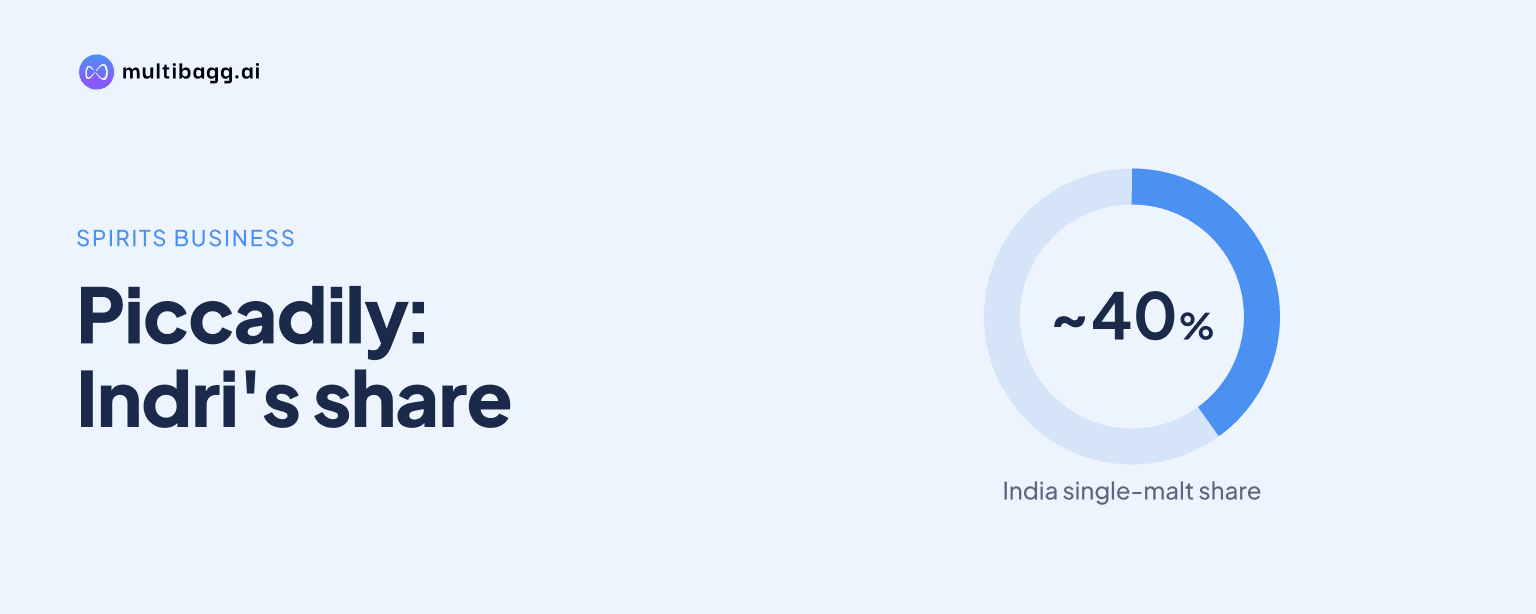
Piccadily puts Indri near 40% of India's single-malt market
Key highlights
- Piccadily estimates that Indri holds about 40% of India’s single-malt market.
- Piccadily said UAE sales had fallen to 10% of normal levels amid geopolitical disruption.
- Management expects Indri to reach 5 lakh cases in three to four years through 20% to 22% annual growth.
- Piccadily expects second-half capacity utilisation of about 70% in Chhattisgarh and 70% to 75% at Indri.
powered by IRIS
Piccadily Agro Industries Limited said on its November 16, 2026 earnings call that Indri holds about 40% of India’s single-malt market on its internal estimate, while UAE sales had fallen to 10% of normal levels amid geopolitical disruption. Management said US tariffs also affected international sales, although US sales had not declined.
Know Piccadily Agro Industries inside out
Results, valuation, peers and who's buying, in one view.
What share does Piccadily estimate Indri has in India’s single-malt market?
Piccadily estimates that Indri holds about 40% of India’s single-malt market. Management said the calculation is based on internal numbers and declined to provide a more precise industry figure because not all competitors disclose their sales data, making this an internal estimate rather than a syndicated market-share reading.
Piccadily also cited IWSR, which named Indri the largest Indian single malt for the second consecutive year in the prior year. Management did not provide a value or volume split for the 40% estimate, nor did it disclose India-wide category sales, but it described Indri as the central brand in an alcobev business that grew from Rs 10 crore to Rs 500 crore over four years.
Piccadily did not have data separating single-malt consumption by male and female consumers. Management said the distribution appeared broadly even from its observation of traction at tasting sessions and events, but this was not presented as a measured consumer-penetration statistic. The 40% estimate concerns Indri’s market position in India, not demographic participation in the category.
How have UAE disruption and US tariffs affected Piccadily exports?
Piccadily said geopolitical conditions had reduced UAE sales to 10% of normal levels, while US tariffs had also affected international sales. Management said international business had grown during the year, but the UAE outcome indicates uneven growth across overseas markets rather than a uniform expansion.
Piccadily said its US sales had not declined despite the tariff effect. Management contrasted that outcome with its view that other global single-malt manufacturers were losing US market share, but did not disclose US revenue, case volumes or Piccadily’s US market share. The statement therefore establishes that sales did not fall, rather than quantifying growth.
Which export markets is Piccadily prioritising?
Piccadily is prioritising the US, UAE, France and Brazil among its overseas opportunities. Management described the US as the number-one global market for whisky and specialty-flavour malt and China as number two, while identifying the UAE, France and emerging markets such as Brazil as areas where it is allocating resources and time.
Piccadily did not confirm a target for exports to contribute 50% of total sales. That proposition came from an analyst, while management said it was opening as many new markets, duty-free channels and global travel retail opportunities as possible. The call did not disclose an export-sales percentage, country-level revenue or profitability by geography.
In the US, management said the three-tier distribution system involves importer margins of about 25%, distributor margins of about 25%, and retailer margins of 25% to 35%. Piccadily said that, after these margins and varying duties and taxes, the net value it realises broadly evens out globally. It also said it is not a large net importer, reducing its exposure to concerns around overseas imports and free-trade agreements.
Got a follow-up? Ask IRIS
What is Piccadily’s plan for Indri volumes and new brands?
Piccadily’s stated plan is for Indri to grow 20% to 22% year on year and reach 5 lakh cases within three to four years. Management said the outlook looked decent from the existing base, but the case objective is a forward-looking target rather than a reported current-period volume.
Piccadily said it had built enough maturing inventory for what it expects Indri will require over the next five years. Management said the company was on course to reach 1 lakh barrels by year-end, after which stocks under maturation could support new products. By the end of the year, management expects to present a revised plan for the company’s next three years.
The barrel programme requires extended holding periods. Management put the cost of a bare barrel at about Rs 30,000 to Rs 35,000, including Indian duties and taxes, and said a maturation cycle lasts four to seven years. Sweet-wine and wine barrels are typically used twice, while bourbon barrels are typically used three times.
Piccadily said there would probably be one new offering in the current quarter and a few offerings in the first quarter of 2027. Management said the pipeline includes blended whiskies, white spirits and other categories, but gave no revenue guidance for Camikara, Cashmir or planned launches because new brands can develop unpredictably.
What operating factors could shape Piccadily’s branded growth?
Piccadily expects branded alcohol to remain a larger growth contributor than bulk alcohol. Management said branded business grew more than bulk business in the first half, while bulk business declined after increased capacity coincided with a stay on government ethanol orders. Those orders had been released nationally by the date of the call.
Management said demand had increased on entering Q3 and expected the pickup to continue through the new year and winter. Most sales are concentrated in North India, where management said brown spirits receive greater winter demand. Piccadily did not provide a North, South, East and West sales split, saying it did not have the figures available during the call.
For the second half, Piccadily expects capacity utilisation of about 70% in Chhattisgarh and 70% to 75% at Indri. Management attributed the gap from full utilisation to ethanol tender allocations, saying aggregators had received only about 33% on average. Marketing spend earmarked across brands and categories is about 10% of sales.
Management said drought in southern India, a failed corn crop and some rice impact had created raw-material pressure. It said cost of production had declined despite those factors and expects the new crop arriving in December to ease the pressure for six to eight months. That easing is management’s expectation, not a reported cost outcome.
Conclusion
Piccadily’s internal estimate places Indri at about 40% of India’s single-malt market and frames branded alcohol as the company’s intended growth engine. The overseas picture is more mixed: management reported no decline in US sales despite tariff effects, but said UAE sales had dropped to 10% of normal levels because of geopolitical disruption.
The next disclosures to watch are Piccadily’s revised three-year plan, expected by year-end, and progress toward 1 lakh barrels. Management has also indicated one product offering in the current quarter and several in the first quarter of 2027, while the expected December crop could affect raw-material pressure over the subsequent six to eight months.