










POCL says Future Tech merger will secure recycled inputs
Key highlights
- POCL's boards approved the proposed amalgamation with POCL Future Tech on 28 January 2026.
- The NCLT, Chennai Bench, allowed the joint scheme application on 3 November 2026.
- POCL Future Tech had Rs 99.9925 lakh of paid-up equity capital at 31 March 2025.
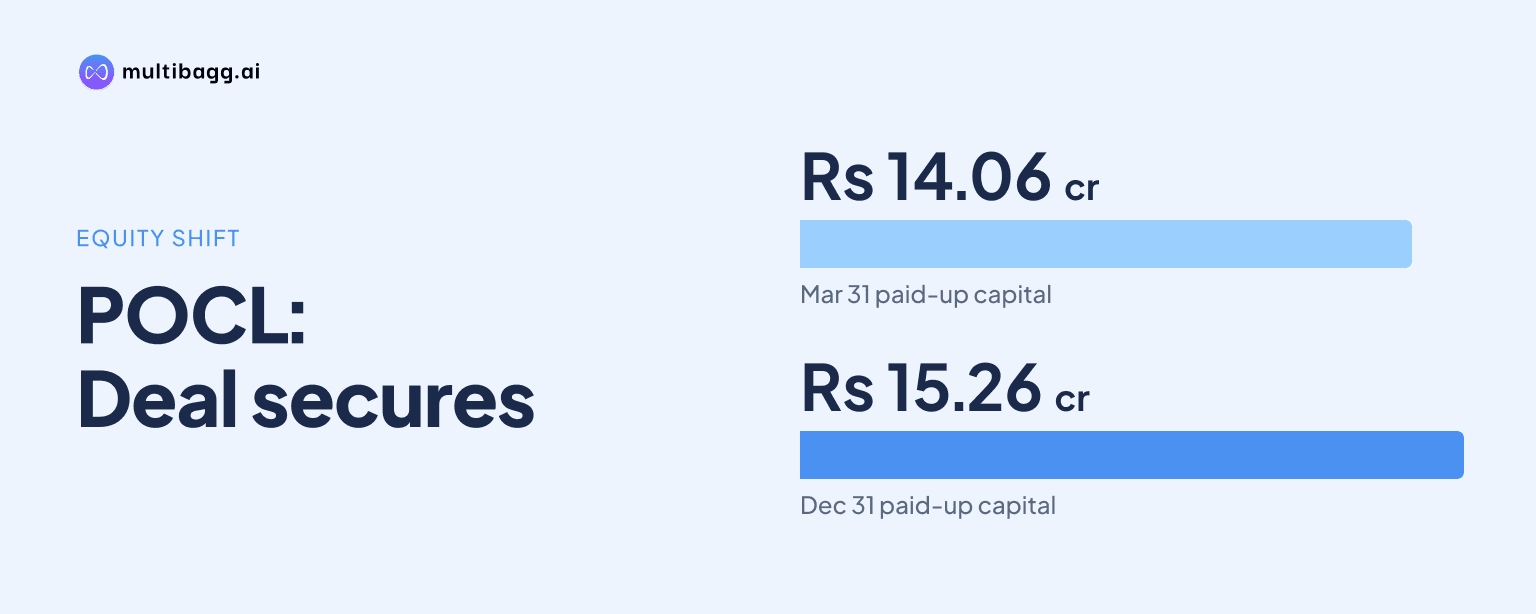
- POCL's paid-up equity capital rose to Rs 15.2556395 crore at 31 December 2025 from Rs 14.0623445 crore at 31 March 2025.
powered by IRIS
Pondy Oxides and Chemicals Limited says its proposed merger with POCL Future Tech Private Limited will integrate recycling and refining with manufacturing to secure recycled-metal inputs and reduce reliance on external suppliers. The boards approved the scheme on 28 January 2026, and the National Company Law Tribunal allowed the joint application on 3 November 2026.
Know Pondy Oxides & Chemicals inside out
Results, valuation, peers and who's buying, in one view.
What businesses would POCL Future Tech merger combine?
POCL would combine its manufacturing of lead metals and alloys, copper, other non-ferrous metals and plastics with POCL Future Tech's plastics-recycling operation. POCL Future Tech was incorporated on 27 May 2022, while POCL was incorporated on 21 March 1995, placing the recycling business within the older manufacturing company under the proposed amalgamation.
POCL Future Tech's objects include recycling e-waste, electric vehicles and components, metals, rubber, oil, glass, paper and plastics, alongside ferrous and non-ferrous metals, chemicals and solvents. Its authorised capital was Rs 1 crore at 31 March 2025, while issued, subscribed and paid-up capital was Rs 99.9925 lakh, represented by 9,99,925 equity shares of Rs 10 each.
POCL's own objects already cover processing plastics into recycled granules and pellets, including polypropylene, polyvinyl chloride, high-density polyethylene, low-density polyethylene, high-impact polystyrene and acrylonitrile butadiene styrene. They also cover recovery, reprocessing, refining and salvage of industrial, domestic and commercial waste, including lithium and e-waste, which the filing presents as complementary to POCL Future Tech's operations.
The proposed transaction is an amalgamation under Sections 230 to 232 of the Companies Act, 2013. The National Company Law Tribunal (NCLT), Chennai Bench, recorded that the two applicants filed the joint scheme application, C.A.(CAA)/44(CHE)2026, and allowed it on 3 November 2026.
How would the merger change POCL's materials supply?
POCL says the merger would create a vertically integrated structure by joining POCL Future Tech's recycling and refining operations with POCL's manufacturing processes. The stated mechanism is secure, reliable and cost-stable access to recycled-metal inputs, although the filing gives no volume, procurement-cost or capacity target for this outcome.
The company says internal integration should reduce dependence on external suppliers, minimise supply disruptions and support operational continuity. It also says the combined structure should improve long-term planning and capacity utilisation across business units, but these are expected effects rather than reported results as of the NCLT order dated 3 November 2026.
The disclosed distinction is that POCL manufactures lead metals and alloys, copper, other non-ferrous metals and plastics, whereas POCL Future Tech operates in plastics recycling. Following amalgamation, POCL Future Tech's activities would sit within POCL rather than in a separate wholly owned subsidiary with Rs 99.9925 lakh of paid-up capital at 31 March 2025.
The filing does not disclose POCL's pre-merger purchases of recycled metal from external suppliers or a forecast reduction in such purchases. It therefore identifies the intended supply-security mechanism, but does not allow calculation of any possible impact on input cost, margins, production volumes or utilisation.
What management efficiencies does POCL expect from amalgamation?
POCL says amalgamation is expected to improve management and control by eliminating duplicated functions, streamlining decision-making and creating unified management oversight. The boards of both companies approved that approach on 28 January 2026, linking it to focused strategic execution for POCL's future growth and development.
Management also expects economies of scale, operational efficiencies and better coordination of financial resources. The specific mechanisms listed are more efficient capital use, optimised cash-flow and debt management, and access to cash flows generated by the combined businesses; the application states no rupee savings, debt-reduction or cash-flow target.
The legal structure is relevant because POCL Future Tech is already a wholly owned subsidiary of POCL. The NCLT record states that no compromise is offered to creditors of either company and says the combined entities' net worth would remain positive after the scheme, without providing a net-worth amount.
The filing describes enhanced stakeholder value and long-term value maximisation as expected outcomes, not measured financial results. Statutory auditors of both applicants certified that the accounting treatment complied with Section 133 of the Companies Act, 2013, but the document contains no pro forma revenue, profit, asset, liability or cash-flow statement for the combined entity.
Got a follow-up? Ask IRIS
How would the merger affect POCL's capital and shareholders?
POCL's paid-up equity capital rose to Rs 15.2556395 crore at 31 December 2025 from Rs 14.0623445 crore at 31 March 2025. The change followed the full conversion of 11,93,295 outstanding warrants, each convertible into two equity shares of Rs 5, adding 23,86,590 shares.
POCL is not required to issue new shares as merger consideration because POCL Future Tech is wholly owned by POCL. The NCLT record consequently says the scheme involves no reorganisation of POCL's share capital and does not affect POCL equity shareholders' rights through an allotment to POCL Future Tech shareholders.
POCL had 62,267 equity shareholders, four secured creditors and 236 unsecured loan creditors as at 31 December 2025. POCL Future Tech had seven equity shareholders, one secured creditor and 41 unsecured creditors; all seven shareholders and its one secured creditor gave affidavits representing 100% by value, supporting the request to dispense with those meetings.
What did the NCLT decide on the POCL Future Tech scheme?
The NCLT allowed C.A.(CAA)/44(CHE)2026 on 3 November 2026 after considering the submissions and documents filed by POCL Future Tech and POCL. The application concerned their scheme of amalgamation under Sections 230 to 232 of the Companies Act, 2013.
For POCL Future Tech, the NCLT dispensed with meetings of seven equity shareholders and one secured creditor after recording 100% consent by value through affidavits. It also dispensed with the unsecured-creditor meeting, citing the subsidiary relationship, no proposed creditor compromise and the applicants' submission that assets were sufficient to meet liabilities.
For POCL, the NCLT recorded that no shares would be issued because the transferor is wholly owned. On that basis, it dispensed with an equity-shareholder meeting, noting 62,267 equity shareholders and no arrangement affecting their rights through a share-capital reorganisation.
The order identifies no effective date for the amalgamation and does not quantify post-merger financial benefits. Its disclosed finding is procedural: the tribunal allowed the joint application on 3 November 2026 after considering the scheme, shareholder and creditor submissions, and the companies' supporting records.
Conclusion
The proposed absorption of POCL Future Tech would bring its recycling and refining activities into POCL's lead, copper, non-ferrous metals and plastics manufacturing structure. POCL's stated case is that the combination can improve recycled-material supply security, reduce external dependence, remove duplicated functions and coordinate capital, cash flow and debt management, without a quantified financial forecast.
The next matter to watch is whether POCL discloses an effective date or further implementation steps, since the 3 November 2026 NCLT order allowed the application but does not state an effective date. Investors can also watch for later company disclosures that quantify procurement, capacity-utilisation, cash-flow or debt-management outcomes that the scheme describes only as expected benefits.