










Pondy Oxides and Chemicals Limited gets NCLT merger meeting waiver
Key highlights
- The NCLT dispensed with a POCL shareholder meeting involving 62,267 equity shareholders.
- POCL had 3,05,11,279 paid-up equity shares worth Rs 15.2556395 crore as of December 31, 2025.
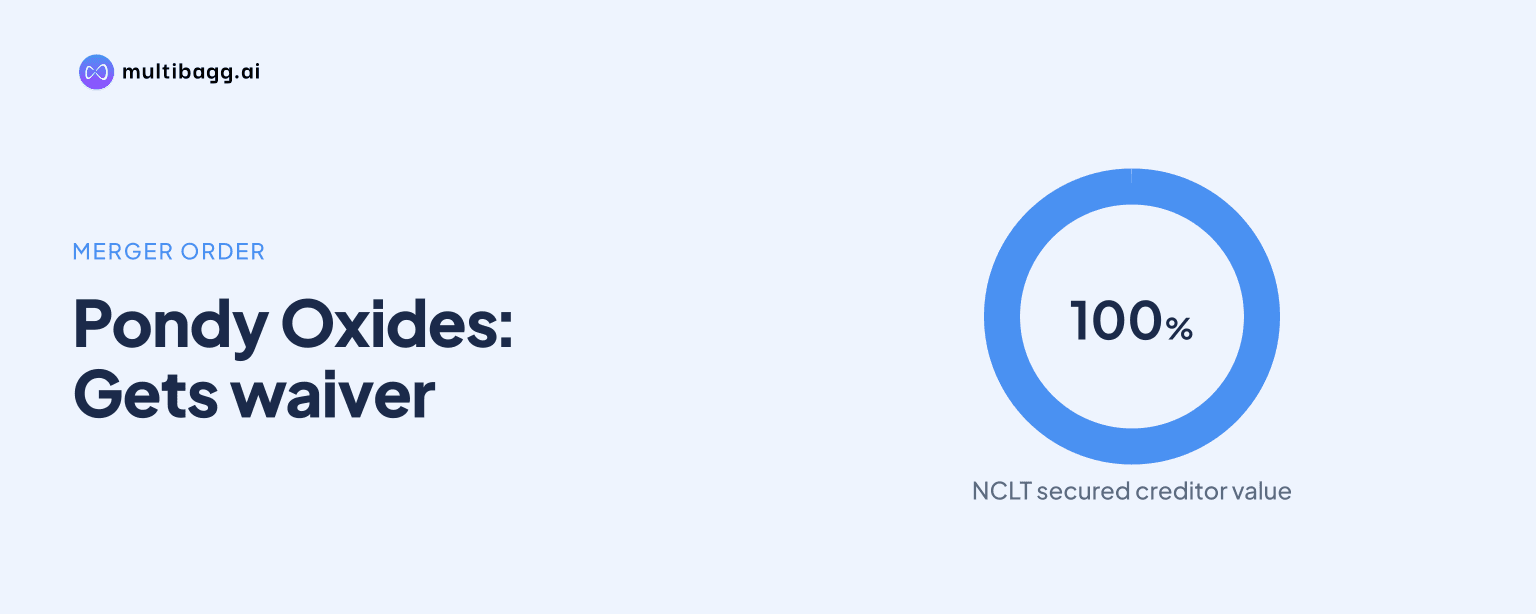
- POCL’s four secured creditors submitted affidavits representing 100% in value.
- POCL Future Tech had seven equity shareholders, one secured creditor and 41 unsecured creditors.
powered by IRIS
Pondy Oxides and Chemicals Limited (POCL) secured a National Company Law Tribunal, or NCLT, order allowing CA (CAA)/44 (CHE)/2026 and dispensing with merger meetings, including a meeting of its 62,267 equity shareholders, because its wholly owned subsidiary amalgamation requires no new POCL shares or share-capital reorganisation.
Know Pondy Oxides & Chemicals inside out
Results, valuation, peers and who's buying, in one view.
Why did POCL not need shareholder and creditor meetings?
POCL did not need an equity-shareholder meeting because POCL Future Tech Private Limited, the transferor company, is its wholly owned subsidiary and the scheme requires no issue or allotment of shares as merger consideration. The NCLT recorded that POCL’s 62,267 equity shareholders would have no arrangement with either POCL or the subsidiary’s shareholders, and that their rights would not be affected because no capital reorganisation is proposed.
POCL also did not need secured-creditor or unsecured-creditor meetings. Its four secured creditors had filed affidavits representing 100% in value, while the order records 236 unsecured creditors and no proposed compromise with creditors. The companies represented that the combined entities’ assets were sufficient for their liabilities, their combined net worth would remain positive after the scheme, and creditor rights would not be adversely affected.
The tribunal applied similar reasoning to POCL Future Tech. All seven of its equity shareholders submitted affidavits representing 100% in value, as did its one secured creditor. The meeting of its 41 unsecured creditors was waived because the subsidiary is wholly owned by POCL, no creditor compromise is offered and no new POCL shares are to be issued.
What did the NCLT order allow in POCL’s merger application?
The NCLT allowed application CA (CAA)/44 (CHE)/2026 after considering the companies’ submissions and documents, and issued directions dispensing with meetings for each relevant shareholder and creditor class. The order does not record a stakeholder vote, because the meetings for POCL’s 62,267 shareholders, four secured creditors and 236 unsecured creditors, as well as the corresponding POCL Future Tech groups, were dispensed with.
POCL and POCL Future Tech boards approved the proposed scheme on January 28, 2026. The order also states that the statutory auditors of both applicant companies certified that the proposed accounting treatment complied with Section 133 of the Companies Act, 2013, which concerns accounting standards.
In dispensing with the meetings, the NCLT referred to the National Company Law Appellate Tribunal decision in Mohit Agro Commodities Processing Pvt Ltd and another, Company Appeal (AT) No. 59 of 2021. The ownership mechanism was central: POCL holds 100% of POCL Future Tech, so the scheme contains neither a new-share issue nor a reorganisation of POCL’s share capital.
How does the merger affect POCL’s share capital?
The merger does not alter POCL’s share capital through consideration shares, according to the NCLT order. As of December 31, 2025, POCL had 3,05,11,279 issued, subscribed and paid-up equity shares of Rs 5 each, representing Rs 15.2556395 crore, against authorised share capital of Rs 20.15 crore.
The December 31, 2025 position changed from March 31, 2025, when POCL had 11,93,295 outstanding convertible warrants. Each warrant was convertible into two Rs 5 equity shares, and all of those warrants were subsequently converted upon exercise by their holders; the later capital structure therefore reported nil outstanding convertible warrants.
The absence of merger consideration shares differs from a transaction in which shareholders receive shares in exchange for holdings in a transferor company. Here, the NCLT recorded that POCL’s 62,267 shareholders were not party to an arrangement, while POCL Future Tech’s seven shareholders are within the 100% subsidiary ownership structure.
Got a follow-up? Ask IRIS
What businesses would POCL combine through the scheme?
POCL would combine its manufacturing operations in lead metals and alloys, copper, other non-ferrous metals and plastics with POCL Future Tech’s plastics-recycling operations. The scheme describes the intended structure as vertically integrated, connecting the subsidiary’s recycling and refining activities with POCL’s manufacturing processes.
Management stated that the integration is intended to provide secure, reliable and cost-stable access to recycled metal inputs, reduce dependence on external suppliers and minimise supply disruptions. The filing identifies operational continuity, long-term planning and capacity utilisation as expected outcomes, but it provides no quantified saving, revenue target or completion-date estimate.
POCL Future Tech’s stated objects include recycling, treating, recovering, reprocessing, refining and salvaging industrial, domestic and commercial waste, including lithium waste and electronic waste. Its plastics scope includes recycled granules and pellets of polypropylene, polyvinyl chloride, high-density polyethylene, low-density polyethylene, high-impact polystyrene and acrylonitrile butadiene styrene.
What benefits does management expect from the POCL Future Tech merger?
Management expects the amalgamation to eliminate duplicated functions, streamline decision-making and establish unified management oversight across POCL’s metals, alloys and plastics activities and POCL Future Tech’s recycling operations. The stated rationale also refers to economies of scale and more efficient management and control, without putting a rupee value or timetable on those expected effects.
The scheme further identifies more efficient capital use, optimised cash-flow and debt management, and access to cash flows of the combined businesses as intended financial mechanisms. These are management’s stated expectations rather than reported post-merger outcomes, since the order records board approval on January 28, 2026 and an allowed application but no effective date for the amalgamation.
The creditor waivers are consistent with that proposed structure because the order says neither company offers a compromise to creditors. For POCL’s 236 unsecured creditors and POCL Future Tech’s 41 unsecured creditors, the tribunal relied on the representations regarding liabilities, positive combined net worth and unchanged creditor rights.
Conclusion
The NCLT order clears a procedural hurdle for POCL’s amalgamation of POCL Future Tech by removing the need for meetings across six stakeholder classes. The outcome rests on the 100% subsidiary relationship, the absence of new POCL shares or capital reorganisation, 100% consent by value from secured creditors where recorded, and the companies’ representation that creditor rights are not compromised.
What to watch next is the execution of the integration plan identified in the scheme, particularly the proposed connection of recycling and refining with POCL’s manufacturing operations in lead metals, alloys, copper, other non-ferrous metals and plastics. The filing discloses expected benefits in supply access, capacity utilisation, cash-flow management and elimination of duplicate functions, but gives no financial targets or amalgamation completion date.