










PPAP Automotive targets Q3 battery EBITDA break-even
Key highlights
- PPAP Automotive's battery EBITDA loss narrowed to Rs 30 lakh in Q2 FY27 from Rs 1.2 crore in Q2 FY26.
- PPAP Automotive battery revenue rose to Rs 6.6 crore in Q2 FY27 from Rs 1 crore a year earlier.
- PPAP Automotive management targets a zero-EBITDA battery position in Q3 FY27.
- PPAP Automotive expects the Avinya Batteries merger by end-Q4 FY27, subject to approvals.
powered by IRIS
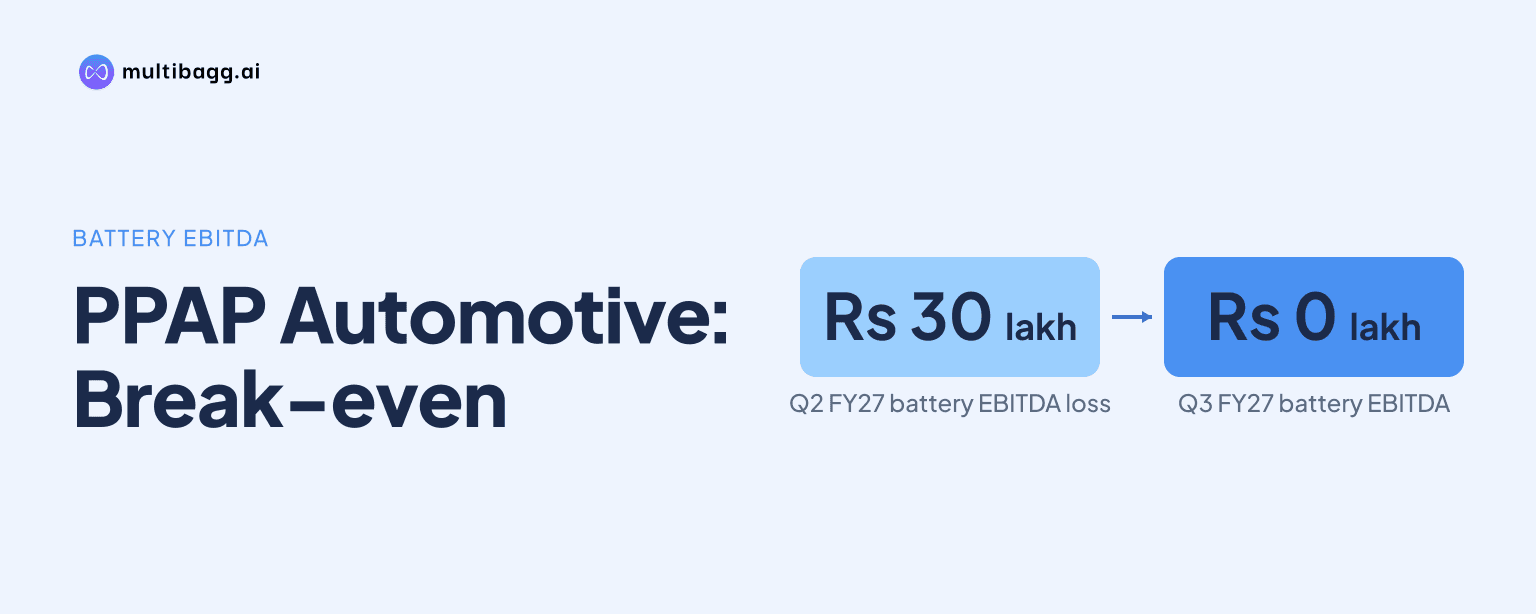
PPAP Automotive Limited expects its lithium-ion battery business to reach zero earnings before interest, tax, depreciation and amortisation (EBITDA) in Q3 FY27 after narrowing its Q2 FY27 EBITDA loss to Rs 30 lakh from Rs 1.2 crore a year earlier. Battery revenue rose to Rs 6.6 crore from Rs 1 crore, while plant utilisation reached about 15%.
Know PPAP Automotive inside out
Results, valuation, peers and who's buying, in one view.
Can PPAP Automotive's battery business reach break-even in Q3 FY27?
PPAP Automotive management said it is hopeful of achieving a “zero EBITDA kind of a situation” in Q3 FY27, which would eliminate operating-level losses in the battery business. The target follows a Q2 FY27 EBITDA loss of Rs 30 lakh, compared with a Rs 1.2 crore loss in Q2 FY26, reducing the quarterly loss by Rs 90 lakh.
The Q3 FY27 objective is an operating milestone rather than a net-profit forecast for the battery unit. Management linked the progress to execution and higher scale in energy storage system (ESS) applications, where Q2 FY27 revenue reached Rs 6.6 crore versus Rs 1 crore in the corresponding quarter a year earlier.
What drove PPAP Automotive's lower battery EBITDA loss?
Higher battery revenue and improved operating performance drove PPAP Automotive's lower Q2 FY27 EBITDA loss. Revenue rose by Rs 5.6 crore year on year, while the loss narrowed by Rs 90 lakh, meaning the increase in activity was accompanied by lower operating losses.
Plant capacity utilisation reached about 15% in Q2 FY27, although PPAP Automotive did not provide a comparable prior-year utilisation figure. Management said it is working with customers and supply-chain partners to improve sourcing efficiency, optimise inventory and increase cost competitiveness.
The battery business nevertheless operates in an environment management described as competitive, with cell-price volatility, inconsistent cell quality from suppliers, market pricing pressure and shorter delivery timelines. These factors remain relevant to delivery of the Q3 FY27 break-even target after the Rs 30 lakh EBITDA loss reported in Q2.
How will the Avinya Batteries merger affect PPAP Automotive?
PPAP Automotive expects the proposed merger of Avinya Batteries Limited with the company to be completed by the end of FY27, probably by the end of Q4, subject to regulatory and statutory approvals. Management said the transaction would simplify the corporate structure and allow the battery business to be integrated more closely with the rest of PPAP Automotive.
The merger timetable is separate from the Q3 FY27 zero-EBITDA objective. Management therefore expects the battery operation to remove operating losses before the proposed end-Q4 FY27 merger deadline, while the transaction itself remains conditional on approvals.
The rise in battery sales has also affected the group revenue mix. Management said a higher contribution from tooling and battery businesses was one reason consolidated gross margin declined to 39.8% in Q2 FY27 from 45.6% in Q2 FY26, alongside elevated raw-material costs.
Got a follow-up? Ask IRIS
What do PPAP Automotive's group results show about operating momentum?
PPAP Automotive reported consolidated revenue of Rs 177.8 crore in Q2 FY27, up 29.8% year on year, while EBITDA increased 23% to Rs 15.7 crore. EBITDA margin was 8.8%, compared with the 39.8% gross margin, as management cited operating efficiencies and improved operating leverage despite gross-margin pressure.
For H1 FY27, consolidated revenue increased 31.8% year on year to Rs 334.2 crore and EBITDA rose 27.4% to Rs 28.1 crore. Consolidated profit after tax was Rs 3.3 crore, compared with a loss of Rs 2.3 crore in H1 FY26, even though the battery business still recorded an EBITDA loss in Q2 FY27.
Overall capacity utilisation was about 78% in Q2 FY27, up from 73% in Q1 FY27 and 68% in Q2 FY26. Consolidated net finance costs fell about 28% to Rs 6.12 crore in H1 FY27 from Rs 8.5 crore a year earlier, aided by treasury income on short-term investment of joint-venture divestment proceeds.
What other FY27 milestones could affect PPAP Automotive's execution?
PPAP Automotive expects investments at its Chennai plant to become fully operational by Q3 FY27 and plans to assess further capacity expansion in that quarter. Management said the decision will depend on the order book, business-growth prospects and capacity utilisation, which stood at about 78% for the group in Q2 FY27.
In tooling, PPAP Automotive secured 50 new mould orders in Q2 FY27, taking its mould order book to 196 moulds worth about Rs 40 crore. Meraki tooling revenue rose about 60% year on year to Rs 8.3 crore, with capacity utilisation of 86%, and the proposed slump sale to wholly owned Meraki Precision Tool Engineering Limited is expected by the end of Q3 FY27, subject to approvals.
PPAP Automotive reported lifetime order wins of Rs 429 crore in H1 FY27, including Rs 300 crore secured in Q2 FY27. Management said such orders are generally executed over two to four years, while new programmes contributed about 10% of sales in H1 and are expected to account for about 15% in H2 FY27.
The aftermarket business contributed about 5% of group sales and management aims to lift that share to about 10% over the coming years. PPAP Automotive added 79 products in Q2 FY27, taking the active portfolio to 1,337 stock-keeping units (SKUs), and had 154 distributors while planning two additional regional warehouses by Q4 FY27.
Conclusion
PPAP Automotive's battery turnaround is defined by a measurable Q2 FY27 change: revenue reached Rs 6.6 crore, plant utilisation reached about 15%, and EBITDA loss narrowed to Rs 30 lakh from Rs 1.2 crore a year earlier. At the group level, consolidated revenue rose 29.8% to Rs 177.8 crore and EBITDA increased 23% to Rs 15.7 crore, although gross margin declined by 5.8 percentage points.
The next event to watch is whether PPAP Automotive delivers its stated Q3 FY27 zero-EBITDA target for batteries while managing cell-price, quality and customer-pricing pressures. Other disclosed milestones include the expected Q3 FY27 commissioning of Chennai plant investments and the proposed Avinya Batteries merger by the end of Q4 FY27, subject to approvals.