










PPAP Automotive returns to H1 profit as gross margin falls
Key highlights
- PPAP Automotive reported H1 FY27 consolidated PAT of Rs 3.3 crore, reversing a Rs 2.3 crore loss a year earlier.
- PPAP Automotive's H1 FY27 consolidated revenue increased 31.8% to Rs 334.2 crore and EBITDA rose 27.4% to Rs 28.1 crore.
- PPAP Automotive's H1 FY27 gross margin fell to 40.7% from 45.4% amid raw-material costs and business-mix changes.
- PPAP Automotive secured about Rs 429 crore of lifetime order wins in H1 FY27, including about Rs 300 crore in Q2 FY27.
powered by IRIS
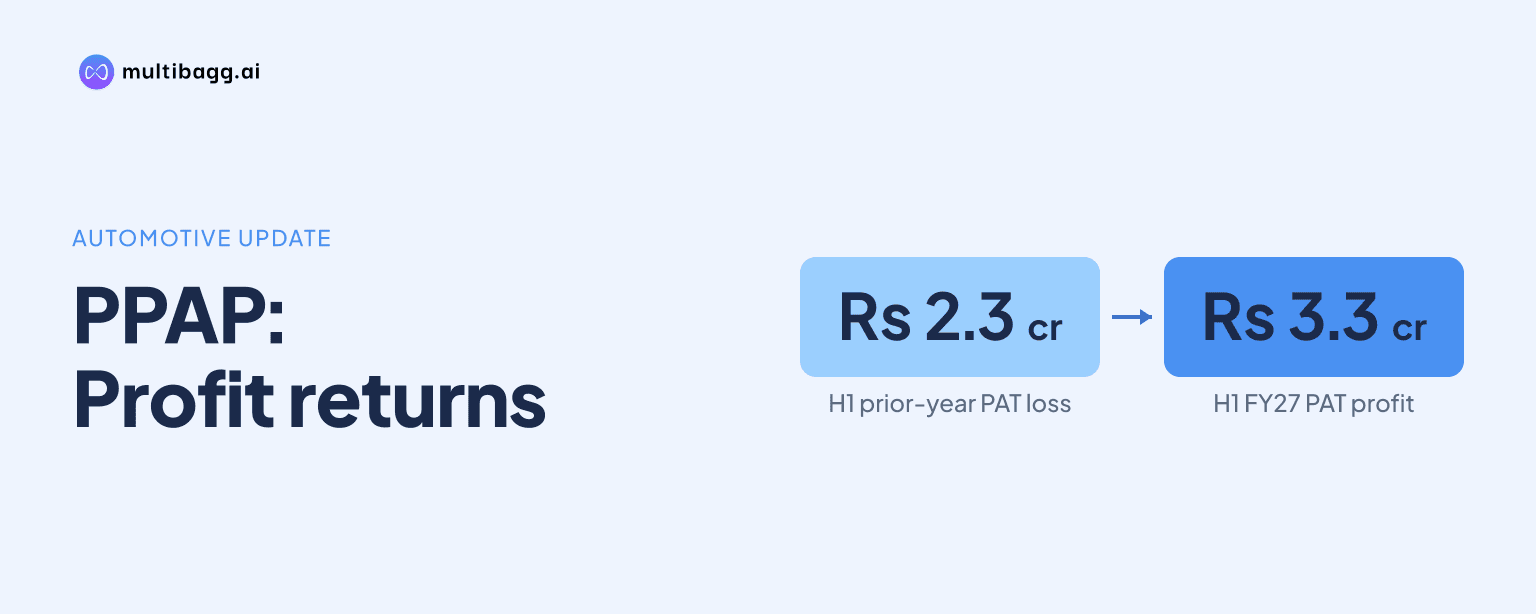
PPAP Automotive Limited returned to consolidated profit of Rs 3.3 crore in H1 FY27, reversing a Rs 2.3 crore loss a year earlier, as revenue rose 31.8% to Rs 334.2 crore and net finance costs declined about 28%. The turnaround came despite consolidated gross margin falling to 40.7% from 45.4% amid higher raw-material costs and a changed business mix.
Know PPAP Automotive inside out
Results, valuation, peers and who's buying, in one view.
How did PPAP Automotive return to profit in H1 FY27?
PPAP Automotive returned to profit through higher sales volumes, operating leverage, operational efficiencies and lower finance costs. Consolidated revenue increased 31.8% year on year to Rs 334.2 crore in H1 FY27, while earnings before interest, tax, depreciation and amortisation, or EBITDA, rose 27.4% to Rs 28.1 crore. Management attributed the revenue increase to order-book execution and automobile-industry growth.
Consolidated profit after tax, or PAT, was Rs 3.3 crore in H1 FY27, compared with a Rs 2.3 crore loss in the prior-year first half. Q2 FY27 PAT was Rs 2.5 crore, against a Rs 5 lakh loss in Q2 FY26. Management said higher business volumes, improved operating leverage and operational efficiencies supported the bottom-line change.
The stand-alone business also recorded higher earnings. Stand-alone revenue rose 26.7% to Rs 309.3 crore in H1 FY27 and EBITDA increased 16.8% to Rs 27 crore, producing an EBITDA margin of 8.7%. Stand-alone PAT rose to Rs 5.8 crore from Rs 1.6 crore in the previous first half, while Q2 stand-alone PAT increased 78.9% to Rs 3.5 crore.
Why did PPAP Automotive's gross margin decline?
PPAP Automotive's consolidated gross margin declined to 40.7% in H1 FY27 from 45.4% a year earlier because of elevated raw-material costs and a higher revenue contribution from tooling and battery businesses. Gross profit still increased 18.1% year on year to Rs 136 crore, but that growth was below the 31.8% increase in consolidated revenue.
The Q2 comparison showed a similar pattern: gross profit rose 13.4% to Rs 70.8 crore, while gross margin fell to 39.8% from 45.6%. Management said customer pass-throughs for input costs can lift reported revenue without a proportionate rise in gross profit, mechanically reducing the reported margin percentage even if costs are ultimately recovered.
Original equipment manufacturer, or OEM, price revisions also have a recovery lag, according to management, leaving customer claims and cost recoveries pending. At the EBITDA level, H1 FY27 margin was 8.4% and Q2 margin was 8.8%. Capacity utilisation reached about 78% in Q2 FY27, compared with 73% in Q1 FY27 and 68% in Q2 FY26.
What reduced PPAP Automotive's finance costs?
PPAP Automotive's consolidated net finance costs declined about 28% to Rs 6.12 crore in H1 FY27 from Rs 8.5 crore in the prior-year first half. Management said treasury income on short-term funds, created from the divestment of its stake in a joint venture, contributed to the reduction. Those proceeds remain invested pending strategic deployment.
The lower finance cost coincided with a Rs 6.04 crore year-on-year increase in EBITDA to Rs 28.1 crore, based on the reported 27.4% growth. PPAP Automotive did not disclose the amount of treasury income or a deployment timetable for the divestment proceeds. The board declared an interim dividend of Rs 1.5 per equity share during the period.
Management said raw-material price movements and geopolitical uncertainty remain factors to monitor in the second half of FY27. Its stated response is continued engagement with customers for timely cost pass-throughs, alongside cost optimisation and operating-efficiency measures.
Got a follow-up? Ask IRIS
What orders and capacity plans support PPAP Automotive?
PPAP Automotive secured lifetime order wins of about Rs 429 crore in H1 FY27, including about Rs 300 crore in Q2 FY27. Management said these orders are generally executed over two to four years, although certain programmes can be executed within one year. The automotive-parts business remained the company's largest revenue contributor.
Management stated that electric-vehicle-related order wins increased to Rs 156.5 crore in H1 FY25 from about Rs 27 crore in H1 FY26. PPAP Automotive is also developing about 400 new stock-keeping units, or SKUs, expected to enter production over the next 12 months. Its Chennai plant investments are expected to become fully operational in Q3 FY27.
Further capacity-expansion investments will be evaluated in Q3 FY27 based on the order book, business-growth prospects and capacity utilisation. PPAP Automotive also said it is pursuing a technology partnership with Hutchinson for automotive body-sealing systems and hopes for a customer breakthrough in Q4 FY27.
How are PPAP Automotive's other businesses performing?
PPAP Automotive's Meraki tooling business recorded Q2 FY27 revenue growth of about 60% year on year to Rs 8.3 crore, with capacity utilisation of 86%. The tooling operation secured orders for 50 new moulds in the quarter, taking its order book to 196 moulds valued at about Rs 40 crore.
The lithium-ion battery business generated Q2 FY27 revenue of Rs 6.6 crore, compared with Rs 1 crore in Q2 FY26. Its EBITDA loss narrowed to Rs 30 lakh from Rs 1.2 crore, while capacity utilisation improved to about 15%. Management cited cell-price volatility, supplier quality consistency, pricing pressure and delivery timelines as continuing challenges.
The aftermarket business grew Q2 FY27 revenue by 24% year on year and represented about 5% of group sales. It added 79 products during the quarter, had 1,337 active SKUs and operated through 154 distributors. Industrial-products revenue rose about 64% to Rs 2.8 crore in Q2 FY27, representing around 2% of group revenue.
What structural changes does PPAP Automotive plan?
PPAP Automotive expects the slump sale of its tooling business into wholly owned Meraki Precision Tool Engineering Limited to be completed by the end of Q3 FY27, subject to approvals. Management said the structure is intended to provide a dedicated platform for the tooling operation, whose Q2 FY27 order book stood at 196 moulds.
The proposed merger of Avinya Batteries Limited with PPAP Automotive is expected by the end of FY27, probably by the end of Q4, subject to regulatory and statutory approvals. In the aftermarket business, management plans to add two regional warehouses and strengthen the team by Q4 FY27, while targeting an increase in the business's group-sales contribution from about 5% to about 10% over coming years.
Conclusion
PPAP Automotive's H1 FY27 result combined 31.8% revenue growth, a 27.4% rise in EBITDA and a 28% decline in net finance costs to reverse a Rs 2.3 crore consolidated loss into Rs 3.3 crore PAT. The key offset was a 4.7-percentage-point fall in gross margin to 40.7%, reflecting raw-material costs, pass-through timing and a larger tooling and battery revenue mix.
Next, investors can watch whether pending OEM price revisions and customer cost recoveries reduce margin pressure. Management has identified Q3 FY27 as the expected operational date for Chennai plant investments and the timing for a capacity review, while the Meraki slump sale is targeted by end-Q3 FY27 and the Avinya Batteries merger by end-FY27, subject to approvals.