










Prasol Chemicals Limited Q2 PAT Rises 122% to ₹38 Crore
Key highlights
- Prasol Chemicals reported Q2 FY27 revenue of ₹412.6 crore, up 38.6% year-on-year.
- Q2 FY27 PAT rose 122.2% year-on-year to ₹37.9 crore, while EBITDA increased 86.1% to ₹57.7 crore.
- H1 FY27 revenue reached ₹846.2 crore and PAT stood at ₹99 crore, up 37.1% and 138.9% year-on-year respectively.
- Prasol Chemicals closed at ₹754.5, down 7.87%, on the next trading day after its November 2 results event.
powered by IRIS
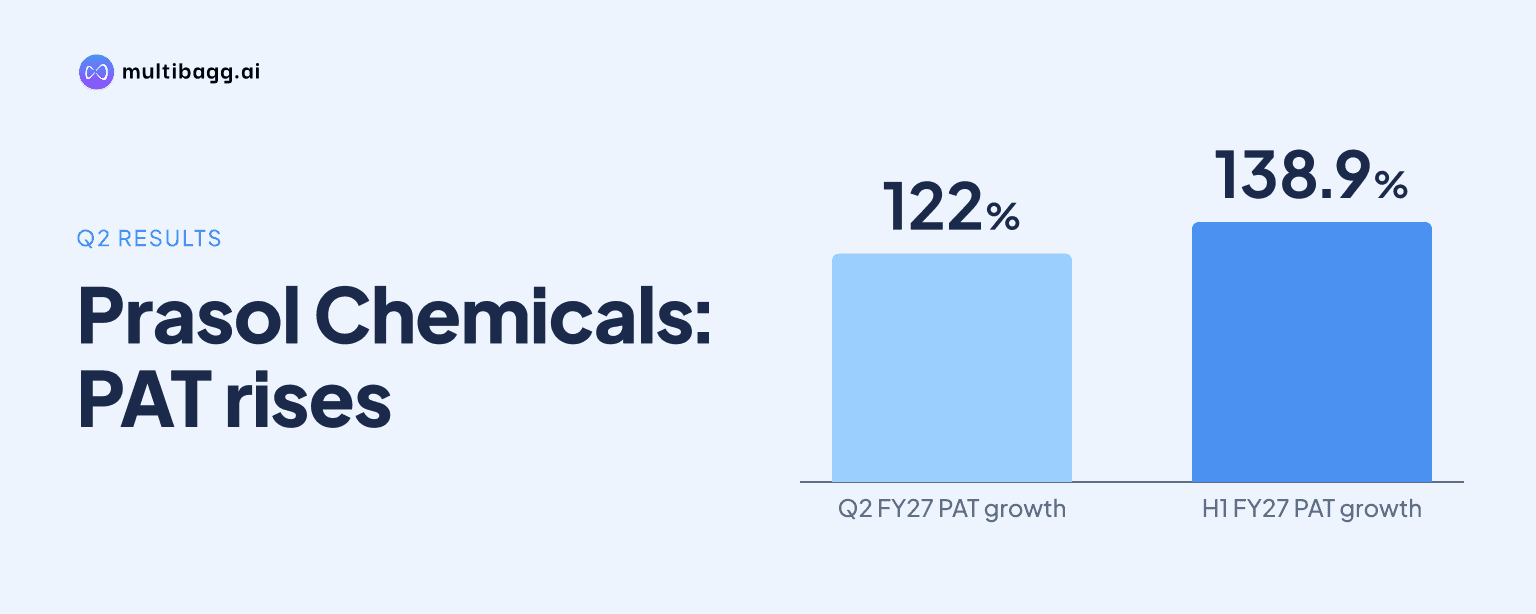
Prasol Chemicals Limited reported Q2 FY27 profit after tax of ₹37.9 crore, up 122.2% year-on-year, as revenue from operations increased 38.6% to ₹412.6 crore for the quarter ended September 2026. The results showed a sharp improvement in profitability from a year earlier, though profit and operating margin declined sequentially.
Know Prasol Chemicals inside out
Results, valuation, peers and who's buying, in one view.
What were Prasol Chemicals' Q2 FY27 results?
Prasol Chemicals reported revenue from operations of ₹412.6 crore in Q2 FY27, compared with ₹297.6 crore in Q2 FY26. EBITDA rose 86.1% year-on-year to ₹57.7 crore, while PAT increased to ₹37.9 crore from ₹17.1 crore. Earnings per share rose to ₹6.53 from ₹2.95 in the corresponding quarter of the previous year.
The quarterly performance was formally approved by the board on November 2 along with the limited review report. The company subsequently hosted an earnings conference call on November 3, with Chairman Nishith Shah and CFO Rahul Shroff listed as participants. The call recording was made available on the company's investor relations website.
How did Prasol Chemicals' Q2 performance compare with the previous quarter?
Prasol Chemicals' Q2 revenue was 4.9% lower sequentially, while PAT declined 37.8% from ₹61.0 crore in the June 2026 quarter. Operating margin also fell to 14.0% in September 2026 from 20.8% in June 2026, a decrease of 682 basis points.
The year-on-year comparison nevertheless showed a substantial expansion in operating profitability. Gross margin improved to 30.1% from 27.9% in Q2 FY26, and EBITDA margin rose to 14.0% from 10.4%. The company reported combined plant utilisation in the range of 65% to 75% during the quarter.
The sequential movement is relevant because the company recorded a stronger first quarter, reflected in the higher June-quarter profit and margin. The Q2 filing therefore presents two distinct comparisons: significant growth over the year-earlier period and lower revenue, profit and operating margin compared with the immediately preceding quarter.
What did Prasol Chemicals report for the first half of FY27?
Prasol Chemicals reported H1 FY27 revenue from operations of ₹846.2 crore, a 37.1% increase from ₹617.2 crore in H1 FY26. EBITDA for the first half was ₹148 crore, up 106% year-on-year, with an EBITDA margin of 17.5%.
H1 FY27 PAT stood at ₹99 crore, representing growth of 138.9% from the year-earlier half. Gross profit rose 61.5% to ₹288.8 crore, and gross margin improved to 34.1% from 29.0%. These figures show that the company delivered stronger profitability over the six-month period despite the moderation in Q2 margin compared with Q1.
Management had previously guided for FY27 revenue of ₹1,550 crore to ₹1,650 crore and EBITDA of ₹240 crore to ₹250 crore. The guidance, cited in an October 5 transcript, excludes the effect of price fluctuations linked to geopolitical supply-chain issues and foreign-exchange gains or losses.
Got a follow-up? Ask IRIS
What growth plans has Prasol Chemicals disclosed?
Prasol Chemicals has disclosed a capacity expansion programme of about 60,000 tonnes, with a stated aim of scaling total revenue to around ₹3,000 crore over the next five years. The company has also indicated a target for exports to exceed 30% of revenue.
The earnings material linked Q2 growth to export demand and capacity expansion. However, the disclosed utilisation range of 65% to 75% indicates that production assets were not operating at full capacity during the September quarter. The company has not provided, in the supplied information, a project-wise commissioning schedule or capital expenditure figure for the planned additions.
For investors, the expansion plan provides context for the company's revenue ambition, while the FY27 guidance gives a nearer-term benchmark. Actual performance will remain subject to operating execution, product pricing, export demand, supply-chain conditions and currency movements, all of which were referenced in the guidance qualification.
How did the market react to Prasol Chemicals' results?
Prasol Chemicals' shares closed at ₹754.5 on the next trading day after the November 2 results event, down 7.87%, according to the supplied filings summary. The move followed the board's approval of unaudited Q2 FY27 financial results and the submission of the quarterly presentation to stock exchanges.
The stock reaction came despite the strong year-on-year increase in revenue and PAT. The reported sequential decline in revenue and profit, together with the reduction in operating margin from the June quarter, formed part of the financial context available to shareholders after the results release.
The broader equity market was higher at the November 5 close, with the Nifty 50 up 2.40% at 24,536.60 and the Sensex up 2.60% at 79,310.01. Bank Nifty gained 3.33%, while India VIX rose 2.83% to 15.62. These market-wide moves do not establish a direct explanation for Prasol Chemicals' share-price change, which followed its own earnings disclosures.
Conclusion
Prasol Chemicals delivered a strong year-on-year Q2 FY27 performance, with revenue rising 38.6%, EBITDA increasing 86.1% and PAT more than doubling to ₹37.9 crore. H1 results also reflected improved margins and substantial growth in profit, while the Q2 sequential comparison showed lower revenue, PAT and operating margin than in the June quarter.
The next points to watch are progress toward the FY27 revenue guidance of ₹1,550 crore to ₹1,650 crore and EBITDA guidance of ₹240 crore to ₹250 crore, as well as updates on the proposed 60,000-tonne capacity programme. Investors will also monitor whether exports move toward the company's stated target of more than 30% of revenue.