










Prasol uses order-backed buying to curb inventory losses
Key highlights
- Prasol's net working-capital cycle rose to 76 days in Q2 FY27 from 63 days in Q1 FY27.
- Prasol said phosphorus-based products have order visibility for almost 2 to 2.5 months and are fully sold out over that period.
- Q2 FY27 revenue was Rs 413 crore, up 38.6% year on year, while EBITDA was Rs 58 crore, up 86.1%.
- Phase 1 is expected to add about 60,000 tonnes of capacity over the next 12 to 24 months.
powered by IRIS
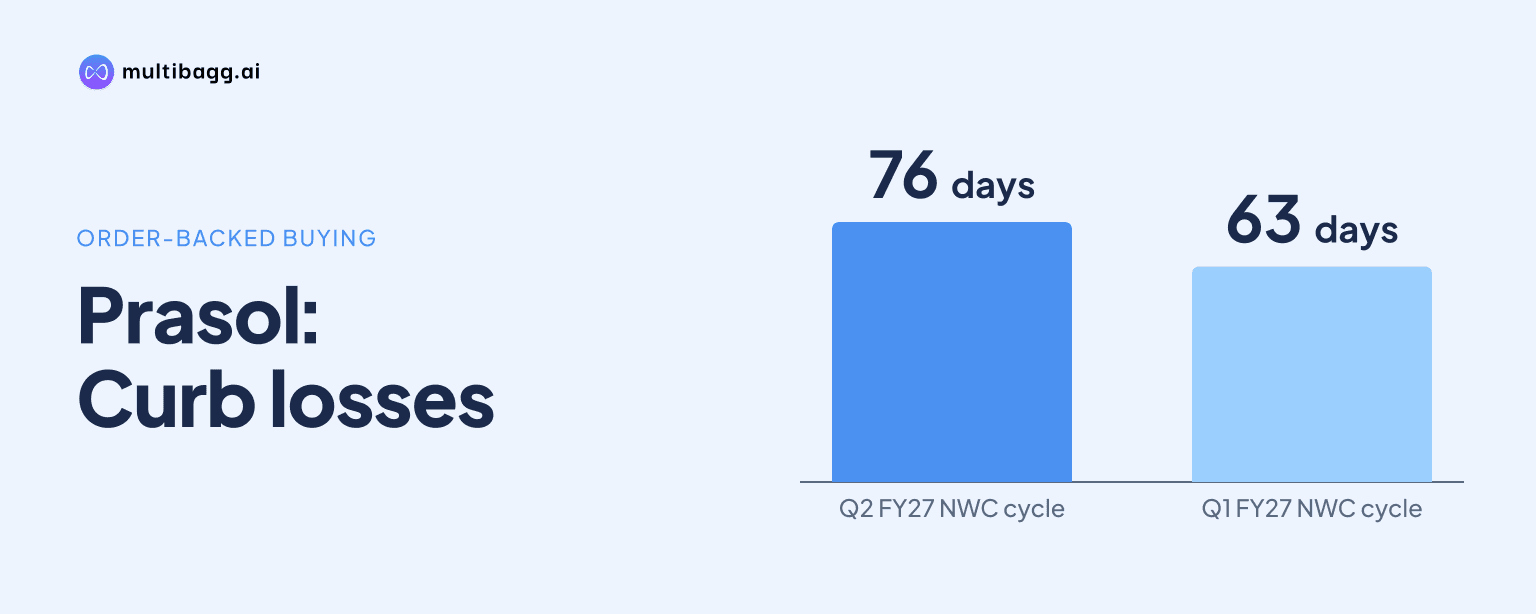
Prasol said in Q2 FY27 that it is reducing exposure to inventory losses by buying imported raw materials against visible customer demand and linking prices to stock and new orders. The approach was disclosed as its net working-capital cycle increased by 13 days to 76 days from 63 days in Q1 FY27.
Know Prasol Chemicals inside out
Results, valuation, peers and who's buying, in one view.
How is Prasol limiting inventory-loss risk?
Prasol is limiting inventory-loss risk by linking raw-material procurement to customer requirements instead of buying additional stock for possible future orders. Management said it had discussed a pricing formula with its top 10 users: material already held would be supplied at the price attached to that stock, while fresh imports would be booked against each customer’s requirement.
The arrangement is intended to work in both directions when input prices move. Management used an example of a product priced at Rs 100 that could rise to Rs 110, saying Prasol would first supply available stock and then import new material against the customer’s order. It added that customers would honour material booked for their requirements if prices fall.
Prasol said it does not buy inventory on the assumption that orders may arrive later. For phosphorus-based products, management said it has visibility for almost 2 to 2.5 months and is fully sold out over that period. This means procurement is based on identified demand and order confidence, although management did not say the practice removes all valuation risk.
Why did Prasol's working-capital cycle rise in Q2 FY27?
Prasol’s net working-capital cycle rose to 76 days at the end of Q2 FY27 from 63 days at the end of Q1 FY27 because the company added suppliers that offer shorter credit periods. Finance Director Rahul Shroff said the wider sourcing network was important for continuity of operations and supply-chain resilience despite the temporary working-capital effect.
The 13-day increase also reflected higher inventory costs as raw-material prices rose. Management said one imported material that had typically taken one to one-and-a-half months to arrive took four months in one case. It said forward orders, expected second-half volumes and plant-utilisation demand made it necessary to secure supply rather than risk running out of material.
Management said inventory was in the normal course of business and expected the position to come into line by the end of Q3. Prasol’s stated objective is to bring the working-capital cycle back within its usual 60-to-70-day range, though management said further purchases could occur in Q4 if demand remains high.
How do shipping delays affect Prasol's raw-material strategy?
Prasol is managing longer transit times and volatile imported-input availability by widening its supplier base across geographies. Management said the company had increased both its customer and supplier base with raw-material volatility in mind. The addition of suppliers with shorter payment terms was a stated reason for the rise to 76 working-capital days in Q2 FY27.
Shipping disruption has increased the amount of material needed to maintain supply. Management said some shipments that had taken 30 days were taking 45 to 60 days, depending on origin, while one input shipment took four months. It said it may purchase material at price dips within a 75-day range, but only where forward demand and customer requirements support the buying decision.
The logistics problem also affects exports. Prasol said sea-freight costs had risen by 2.5 to three times for the United States and by seven to eight times for certain destinations, while exports accounted for about 25% of revenue. Management expects export performance to improve when shipping availability and freight conditions normalise, and it is targeting exports of more than 30% of revenue in coming years.
Got a follow-up? Ask IRIS
How quickly can Prasol pass raw-material price changes to customers?
Prasol said it generally takes 10 to 15 days to pass higher raw-material prices through to customers, creating an interim margin exposure when imported inputs become more expensive. Management said this delay is relevant because most inputs are imported and fresh purchases are tied to shipping lead times rather than immediate local availability.
When raw-material prices decline, management said customer prices are not reduced on the first day. It described a 15-, 20- or 30-day period before reductions are made, reflecting the time taken for imported material to reach the company. Prasol presented this timing, together with its stock-and-order pricing formula, as a way to manage rather than eliminate inventory-price exposure.
The pricing mechanism is supported by demand visibility in certain products. Management said Prasol is fully sold on current lubricant-additive output and has orders beyond available facility capacity. It also said some expansion volumes are for existing products already approved by end customers, including customers seeking supply into markets such as France and Mexico.
What do Prasol's Q2 FY27 results show about demand?
Prasol reported Q2 FY27 revenue from operations of Rs 413 crore, up 38.6% year on year, driven primarily by higher realisations and single-digit domestic volume growth. Earnings before interest, tax, depreciation and amortisation, or EBITDA, was Rs 58 crore, up 86.1%, while profit after tax rose 122.2% to Rs 38 crore.
For H1 FY27, revenue from operations was Rs 846 crore, up 37.1% year on year, and EBITDA was Rs 148 crore, up 106%, giving an EBITDA margin of 17.5%. The first-half EBITDA included an exceptional gain of Rs 25 crore and a foreign-exchange gain of Rs 92 lakh in Q1 FY27, which management identified when discussing performance.
Management said price increases across the product portfolio should support profitability and said H1 FY27 profit before tax had surpassed the prior full-year level. It reiterated FY27 revenue guidance of Rs 1,550 crore to Rs 1,650 crore and EBITDA guidance of Rs 240 crore to Rs 250 crore, excluding gains from price fluctuations related to geopolitical events.
What will Prasol change next in its supply chain?
Prasol plans to develop a storage facility at Khopoli, which management said would allow bulk procurement and help optimise logistics and raw-material costs. Management also said additional domestic acetone capacity is expected to begin coming on stream from January 2027, but did not quantify the potential effect on Prasol’s costs or sourcing mix.
The company is also expanding capacity while managing supply continuity. Phase 1 is expected to add about 60,000 tonnes, taking total installed capacity to 150,000 to 160,000 tonnes over the next 12 to 24 months. Prasol incurred about Rs 75 crore on Phase 1 projects in H1 FY27 and said about 25% to 30% of envisaged expansion products should reach mechanical completion by March.
Conclusion
Prasol’s response to imported-input volatility combines supplier diversification, order-backed procurement and customer-linked pricing. The trade-off was visible in Q2 FY27: the working-capital cycle rose from 63 to 76 days as creditor periods shortened and higher-cost inventory was carried through longer shipping times, while revenue rose 38.6% to Rs 413 crore.
The next measures to watch are management’s expectation that working capital will come into line by the end of Q3, the pace of freight and shipping normalisation, and the Phase 1 capacity additions expected to begin going live around June or July next year after approvals. Prasol’s FY27 revenue guidance of Rs 1,550 crore to Rs 1,650 crore and EBITDA guidance of Rs 240 crore to Rs 250 crore remain the disclosed benchmarks.