










Prasol targets exports above 30% as capacity ramps in phases
Key highlights
- Prasol targets exports above 30% of revenue, compared with about 25% currently.
- Freight costs to the United States have risen 2.5 to 3 times, while some routes have increased 7 to 8 times.
- About 25% of planned expansion products are expected to go live by June or July next year.
- Prasol said mining approvals commonly take 3 to 4 years, and it is in year 2 to 2.5 of its programme.
powered by IRIS
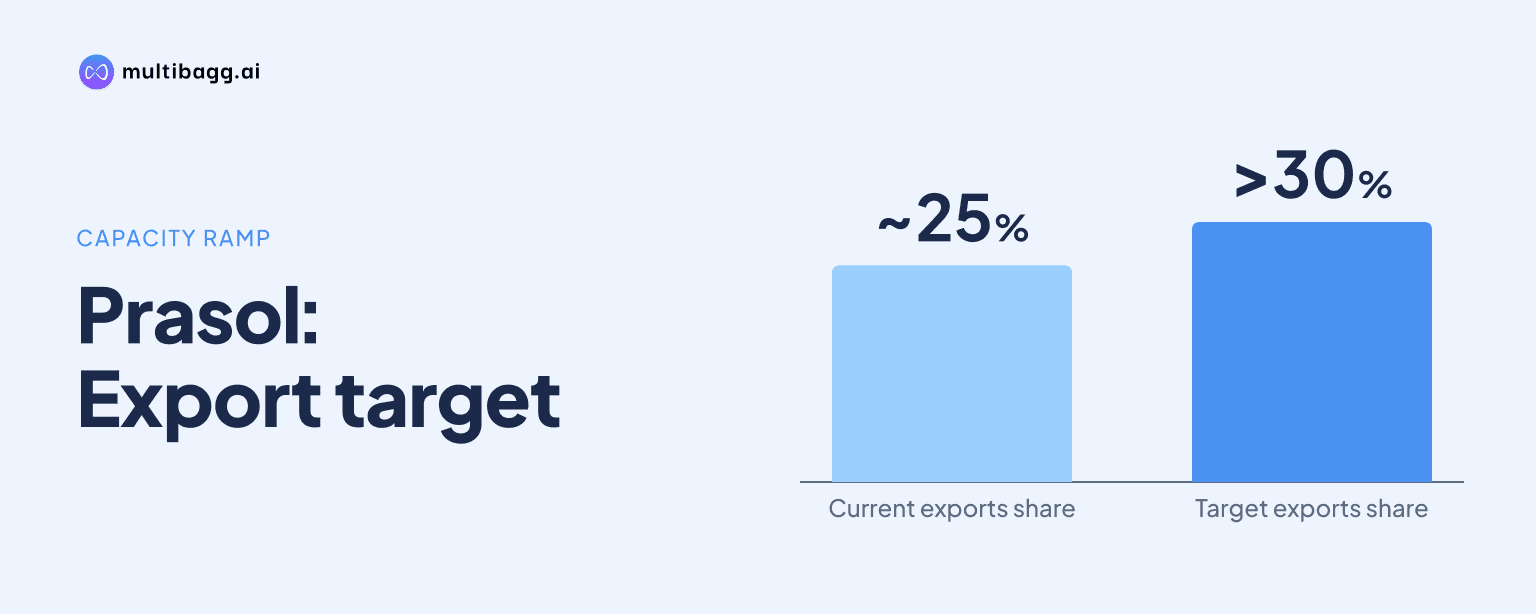
On its earnings call, Prasol said it is targeting exports above 30% of total revenue in the coming years, from around 25% currently, despite sharply higher freight costs and shipping delays. Management plans to bring roughly 25% of its expansion products online by June or July next year after mechanical completion targeted by March.
Know Prasol Chemicals inside out
Results, valuation, peers and who's buying, in one view.
Why is Prasol targeting exports above 30% of revenue?
Prasol is targeting exports of more than 30% of revenue in the coming years, compared with about 25% currently. Management said it continues to export to the United States and Europe despite vessel availability constraints, geopolitical disruption and elevated sea-freight costs.
The logistics pressure is substantial. Management said freight costs to the United States had risen by 2.5 to 3 times depending on location, while rates on some routes had increased by 7 to 8 times. It also said a shipment that formerly took about 30 days could now require 45 to 60 days, depending on the origin country.
Management described gross contribution from manufacturing exports at about 35%, compared with about 30% for distribution exports. The disclosed mix indicates that the export ambition is linked both to manufacturing capacity and distribution activity, although Prasol did not give a date by which exports must exceed 30%.
When will Prasol's capacity expansion begin commercial production?
Prasol expects roughly 25% of the products in its expansion plan to go live by June or July next year, following mechanical completion targeted by March. Management said a further 25% is planned for the second half of next year because projects are spread across different locations and engineering stages.
Commercial production is expected to follow mechanical completion rather than begin immediately. Management said sample approvals generally take about three months before a plant starts generating revenue, and investors should expect updates every 3 to 6 months on mechanical completion, new products and commercial commissioning.
The expansion covers existing product lines except agrochemicals. Management said capacity increases range from 30% to 40% in some products and from 70% to 80% in others, with certain lines approaching a 100% increase. It also cited demand for a lubricant grade that is about 50% higher than current supply capability.
Prasol said it is fully sold on current lubricant-additive production and has orders that cannot be fully met without additional capacity. Management characterized the expansion as a volume ramp-up for products with established quality, rather than an approval-led launch of an entirely new lubricant product.
Which new markets is Prasol pursuing through research and development?
Prasol is developing products for mining chemicals, lubricants and pharmaceuticals through research and development. Management said detailed engineering has been completed for some projects, but it did not disclose individual project capacity, investment or revenue expectations for these three areas.
One propylene-based chemistry project is expected to take about 2.5 years because it requires regulatory and land-development approvals before plant construction can start. Management said another project may take about 1.5 to 2 years, creating a staggered product-development timetable rather than a single commissioning event.
For antibacterial drugs, Prasol said a new plant and changed manufacturing process require requalification even though the product made by the earlier method is already approved. Management expects this approval work to take about 3 to 6 months and said its experiments had been satisfactory, without providing a commercial launch date.
The research pipeline sits alongside management's stated five-year revenue target of Rs 3,000 crore. Management said Prasol has historically reinvested more than 80% to 90% of earnings into growth, while acknowledging that some new products may not deliver their expected returns.
Got a follow-up? Ask IRIS
What progress has Prasol made in mining chemicals?
Prasol has secured approval from a United States laboratory and has moved into mine-specific trials, which management said are the next step before bidding. It said samples have been supplied to various mines and company personnel are working with clients in South Africa and other locations.
Mine-specific testing is required because the same mineral in two countries can have different impurity profiles and therefore require different chemical dosage or purification methods. Management said a laboratory approval is the first stage, followed by mine-level approval and then a bidding process that could create an opportunity to win business.
Management said mining approvals generally take 3 to 4 years and that Prasol is in the second 2 to 2.5 years of its own cycle. It believes a significant mining breakthrough could occur in the next 2.5 years, or earlier, but that is management's expectation rather than a disclosed customer order.
Some reactors being installed for lubricants can also produce mining chemicals with minor modifications, according to management. This dual-use equipment means a mining order would not necessarily require a dedicated new plant, while the company continues to build lubricant capacity to meet existing demand.
How is Prasol managing inventory during supply disruption?
Prasol expects working capital to come in line by the end of the third quarter, although management said stronger fourth-quarter demand could lead to further inventory buying. It attributed the higher inventory value to rising raw-material prices and one shipping period that extended from 1 to 1.5 months to four months.
Management said it is purchasing material within a roughly 75-day range to support second-half volume growth, plant utilization and forward orders. It also said a newly added supplier base with shorter cycles increased the working-capital cycle, while first-half negative operating cash flow represented a point-in-time snapshot.
Prasol said it has nearly 2 to 2.5 months of visibility for certain phosphorus-based products and was fully sold out for that period. Purchases are based on customer order visibility rather than speculative stock building, management said, while pricing formulas with major customers are intended to limit exposure to inventory-price movements.
Management estimated that rising raw-material costs can take 10 to 15 days to pass through to customers. When prices decline, it said reductions may take 15, 20 or 30 days because many raw materials are imported, a timing difference that can affect inventory gains or losses.
Conclusion
Prasol's export plan combines a target of more than 30% of revenue from overseas markets with phased additions to existing product capacity and research-led entry into mining chemicals, lubricants and pharmaceuticals. The move begins from an export share of about 25%, while freight costs of up to 7 to 8 times on some routes remain a constraint.
The next disclosed milestones are mechanical completion by March, the first roughly 25% of expansion products going live by June or July next year, and another 25% in the second half of next year. Investors can also watch for the usual three-month sample-approval period before commercial production, mine-specific trial progress and management's expected working-capital normalization by the end of the third quarter.