










Prasol plans Rs 500-600 crore expansion toward Rs 3,000 crore
Key highlights
- Prasol proposes Rs 500-600 crore of capital expenditure across two expansion phases.
- Phase I would add 60,000 MTPA, taking capacity to 1,58,844 MTPA by FY29.
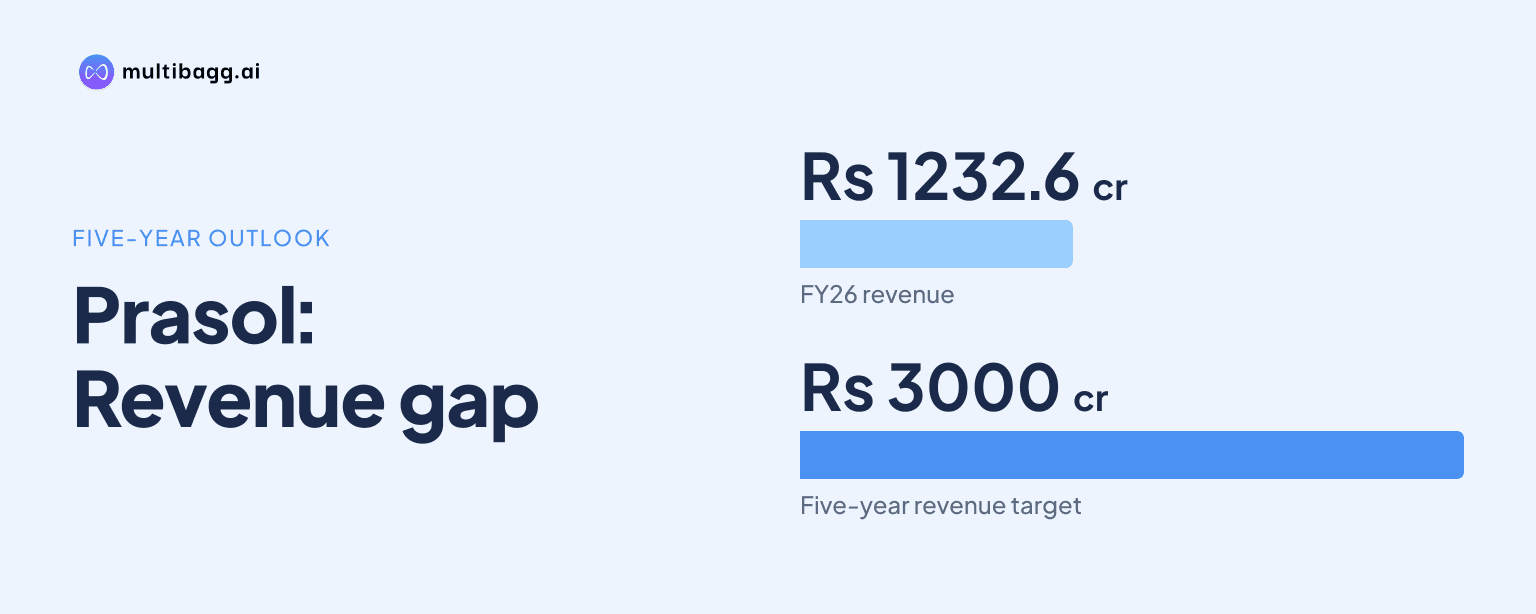
- Management aspires to Rs 2,800-3,000 crore of revenue within five years, subject to necessary approvals.
- Prasol reported FY26 revenue of Rs 1,232.6 crore and an EBITDA margin of 11.3%.
powered by IRIS
Prasol Chemicals Limited plans a Rs 500-600 crore two-phase expansion programme that management says could support Rs 2,800-3,000 crore of revenue within five years, subject to necessary approvals. The defined Phase I project would add 60,000 metric tonnes per annum (MTPA), lifting capacity 61% to 1,58,844 MTPA by FY29.
Know Prasol Chemicals inside out
Results, valuation, peers and who's buying, in one view.
What is Prasol's two-phase expansion plan?
Prasol has proposed Phase I capital expenditure of about Rs 250-300 crore for existing products and Phase II expenditure of about Rs 250-300 crore for new research and development (R&D) products. The two phases together form the Rs 500-600 crore programme, which management says will be funded through internal accruals and debt.
Phase I covers debottlenecking and process augmentation at Prasol's Khopoli and Mahad plants. It includes Rs 50-60 crore for land and infrastructure development and is scheduled for completion in multiple sub-phases over the next two years. Management expects Phase I to generate Rs 500-550 crore of revenue at peak utilisation.
Phase II targets new product lines that management says have higher margins. Prasol has allocated Rs 50-60 crore for infrastructure development in this phase, while product identification, site preparation and regulatory approvals were in progress when the presentation was issued. Management expects Phase II capital spending to begin in H2FY28.
How much capacity will Prasol add by FY29?
Prasol plans to add 60,000 MTPA in Phase I, taking installed capacity from 98,844 MTPA to 1,58,844 MTPA by FY29. This represents a 61% increase from the existing capacity base. FY26 utilisation was reported at 70-72%.
Prasol's Khopoli plant, established in 1995, has capacity of 78,784 MTPA, 29.8 acres of existing land and 11.98 acres of spare land. Its Mahad plant, established in 2020, has capacity of 19,860 MTPA, 29.5 acres of existing land and 18.4 acres of spare land. Both sites are included in the Phase I debottlenecking and process-augmentation plan.
The manufacturing platform covers processes including aldol condensation, hydrogenation, thio acid synthesis, chelation, chlorination, esterification and oxidation. The distinction between the phases is material: Phase I seeks additional output from existing products and facilities, while Phase II is intended to commercialise new R&D-led product lines.
What R&D pipeline supports Prasol's Phase II plan?
Prasol reported 40 products in its R&D pipeline as of FY26, including 13 products commercialised during the preceding three years. The company had a 37-member R&D team, comprising four PhDs and 25 chemists, supporting process development, product development and pilot-plant testing.
The product-development funnel listed 40 products at the innovation-sourcing stage, 31 in planning, nine in hypothesis testing and 13 in commercialisation or Stream 1 optimisation. Prasol said its R&D focus includes complex chemistries, import substitution and forward and backward integration of existing products.
The proposed new-product phase comes after a FY26 portfolio in which acetone-based products accounted for 43% of revenue, phosphorus-based products for 38% and other specialty chemicals for 19%. Prasol's stated Phase II work includes identified products, but the presentation does not provide product-level capacity, revenue or commissioning dates for that phase.
Got a follow-up? Ask IRIS
How does Prasol plan to finance the expansion?
Prasol says it will fund the Rs 500-600 crore programme through internal accruals and debt. The presentation does not disclose the intended debt-equity mix, financing timetable, lender arrangements or annual capital-expenditure schedule for either Phase I or Phase II.
At March 2026, Prasol reported total equity of Rs 448.5 crore, non-current borrowings of Rs 47 crore and current borrowings of Rs 63.1 crore. Its net debt-to-equity ratio was 0.19 in FY26, compared with 0.23 in FY25 and 0.22 in FY24. These reported figures precede the completion of the proposed expansion programme.
Net cash from operating activities was Rs 49.5 crore in March 2026, compared with Rs 22.3 crore in March 2025 and Rs 115.6 crore in March 2024. Cash generated from operations increased to Rs 79.5 crore from Rs 37.6 crore in the prior year, while changes in working capital used Rs 68.8 crore in March 2026.
What operating performance underpins Prasol's revenue aspiration?
Prasol reported revenue from operations of Rs 1,232.6 crore in FY26, up from Rs 1,012.5 crore in FY25 and Rs 876.6 crore in FY24. Management's five-year aspiration of Rs 2,800-3,000 crore is therefore more than double FY26 revenue, although the presentation gives no annual revenue milestones or starting date for the five-year period.
Gross margin rose to 30.7% in FY26 from 28.5% in FY25 and 26.1% in FY24. Earnings before interest, tax, depreciation and amortisation (EBITDA) increased to Rs 139.3 crore from Rs 87.7 crore, while the EBITDA margin rose to 11.3% from 8.7%. Profit after tax increased to Rs 83.1 crore in FY26 from Rs 43.6 crore a year earlier.
Mahad-related losses reduced to Rs 3.9 crore in FY26 from Rs 14.9 crore in FY24. Prasol's stated way forward includes ramping up the Mahad unit, improving operational efficiencies, expanding capacity in two phases and enhancing exports. In FY26, domestic sales represented 73% of revenue and exports accounted for 27%.
The presentation also cites CARE market estimates of 8% compound annual growth for Indian acetone derivatives and 10% for Indian phosphorus derivatives from FY26 to FY29. These are industry estimates rather than Prasol forecasts, and the company's revenue aspiration remains subject to project completion, product commercialisation and necessary approvals.
Conclusion
Prasol's plan combines a defined Phase I expansion of existing products with a later Phase II move into R&D-derived product lines. The measurable Phase I outcome is 60,000 MTPA of additional capacity by FY29, while management's broader aspiration is Rs 2,800-3,000 crore of revenue within five years, against FY26 revenue of Rs 1,232.6 crore.
The next disclosed milestones are Phase I execution in multiple sub-phases over the next two years and the expected start of Phase II spending in H2FY28. Progress on regulatory approvals, site preparation, Mahad production ramp-up, utilisation above the FY26 range of 70-72%, and the balance between internal accruals and debt will determine implementation of the stated plan.