










Prasol’s H1 cash flow negative after Rs 141.3 crore outflow
Key highlights
- Prasol reported Rs 99.0 crore H1FY27 profit after tax, up 138.9% year on year.
- Working-capital changes absorbed Rs 141.3 crore in September 2026, versus Rs 54.0 crore a year earlier.
- Inventory rose to Rs 301.1 crore and trade receivables reached Rs 352.0 crore at September 2026.
- Cash and cash equivalents declined to Rs 4.9 crore from Rs 24.1 crore at March 2026.
powered by IRIS
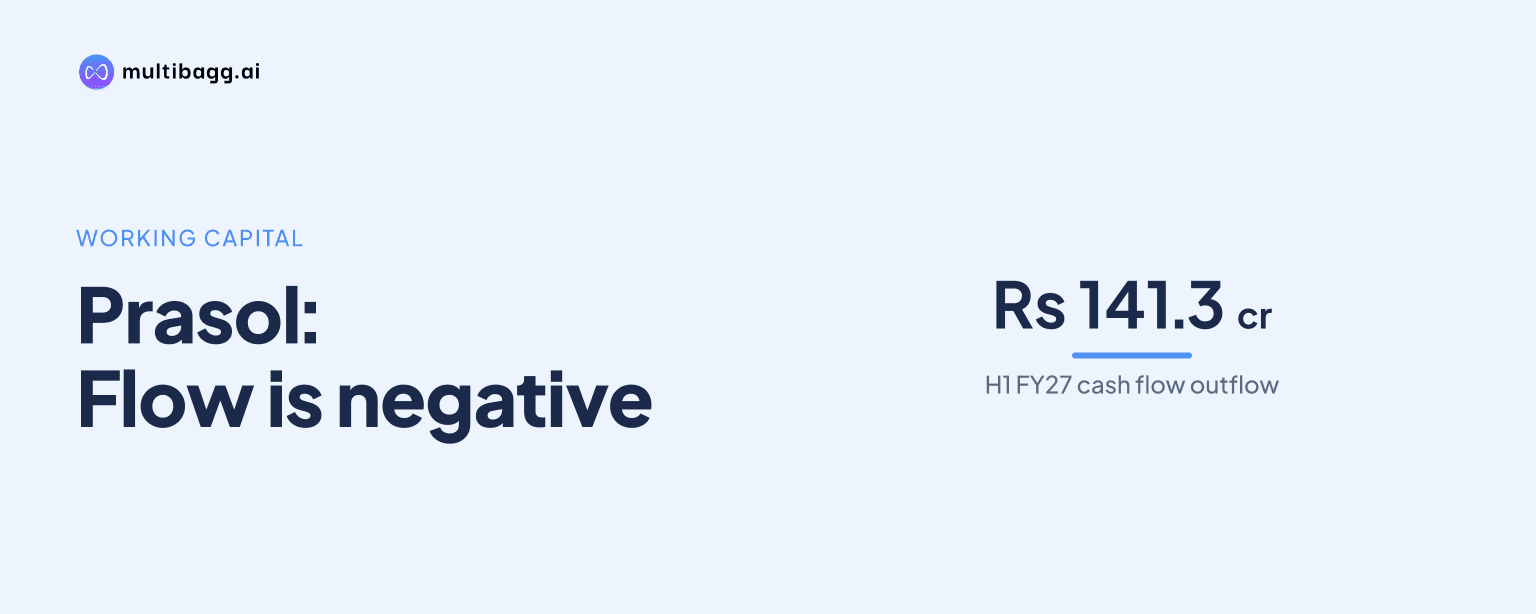
Prasol Chemicals Limited reported Rs 99.0 crore profit after tax in H1FY27, but net cash from operating activities was negative Rs 11.7 crore after working-capital changes absorbed Rs 141.3 crore. Inventory rose to Rs 301.1 crore and trade receivables reached Rs 352.0 crore by September 2026, while cash and cash equivalents fell to Rs 4.9 crore.
Know Prasol Chemicals inside out
Results, valuation, peers and who's buying, in one view.
Why did Prasol’s operating cash flow turn negative in H1FY27?
Prasol’s operating cash flow turned negative because the Rs 141.3 crore working-capital outflow and Rs 20.3 crore of direct taxes paid exceeded cash generated from operations. Operating profit before working-capital changes was Rs 149.9 crore for the September 2026 period, up from Rs 73.7 crore in September 2025, but only Rs 8.6 crore remained as cash generated from operations after the working-capital movement.
Net cash from operating activities was negative Rs 11.7 crore in September 2026, compared with positive Rs 7.2 crore in September 2025. The reversal occurred even as profit before tax rose to Rs 133.5 crore from Rs 56.0 crore, indicating that changes in operating assets and liabilities shaped the cash outcome during H1FY27.
The working-capital absorption was Rs 87.3 crore higher than the Rs 54.0 crore outflow recorded in September 2025. Cash generated from operations fell by Rs 11.0 crore to Rs 8.6 crore even as operating profit before working-capital changes increased by Rs 76.2 crore, demonstrating the gap between operating profit and cash conversion in H1FY27.
What changed in Prasol’s working capital in H1FY27?
Prasol’s inventory and trade receivables increased sharply between March 2026 and September 2026, while trade payables rose by less than the combined increase in those two current assets. Inventory grew by Rs 147.9 crore to Rs 301.1 crore, while trade receivables increased by Rs 73.3 crore to Rs 352.0 crore over the six-month period.
The Rs 221.2 crore combined increase in inventory and receivables exceeded the Rs 96.3 crore rise in trade payables. These movements provide balance-sheet context for the Rs 141.3 crore working-capital outflow, although the cash-flow statement does not allocate the outflow separately among inventory, receivables, payables and other working-capital accounts.
Current assets increased by Rs 204.8 crore to Rs 679.0 crore at September 2026, whereas current liabilities increased by Rs 108.2 crore to Rs 415.9 crore. Cash and cash equivalents, which are included in current assets, fell to Rs 4.9 crore from Rs 24.1 crore, while other current assets changed marginally to Rs 17.8 crore from Rs 17.4 crore.
Got a follow-up? Ask IRIS
Why did Prasol’s profit rise while operating cash flow fell?
Prasol’s profit rose on higher revenue and margins in H1FY27, while operating cash flow fell because working capital consumed more cash than the business generated before those changes. Revenue from operations increased 37.1% year on year to Rs 846.2 crore, profit after tax increased 138.9% to Rs 99.0 crore, and earnings before interest, tax, depreciation and amortisation, or EBITDA, increased 106.6% to Rs 148.0 crore.
Gross margin increased to 34.1% in H1FY27 from 29.0% in H1FY26, while EBITDA margin increased to 17.5% from 11.6%. Prasol said geopolitical-led supply-chain issues lifted average selling prices and added Rs 25 crore to gross profit in Q1FY27, with a Rs 0.92 crore positive foreign-currency impact, and that these effects had normalised in Q2FY27.
The contrast is also apparent against FY26. Prasol generated Rs 49.5 crore of net operating cash flow in FY26 after a Rs 68.8 crore working-capital outflow, while profit after tax was Rs 83.1 crore. In H1FY27, the Rs 141.3 crore working-capital outflow exceeded the FY26 full-year outflow by Rs 72.5 crore, while H1FY27 profit after tax exceeded FY26 profit.
Prasol’s net working-capital days had risen to 50 days in FY26 from 37 days in FY25, after 41 days in FY24. The presentation does not disclose an H1FY27 working-capital-days figure, so it does not establish whether the September 2026 balance-sheet movement changed that measure further.
How did Prasol fund cash needs during H1FY27?
Prasol partly offset negative operating cash flow and a Rs 36.1 crore investing outflow with Rs 28.6 crore of net financing inflow during the September 2026 period. The result was a Rs 19.2 crore decrease in cash and cash equivalents, reducing the closing balance to Rs 4.9 crore from Rs 24.1 crore at the beginning of the year.
Investing cash outflow increased from Rs 16.1 crore in September 2025 to Rs 36.1 crore in September 2026. Capital work-in-progress rose to Rs 70.2 crore at September 2026 from Rs 47.1 crore at March 2026, while property, plant and equipment increased to Rs 314.3 crore from Rs 311.0 crore.
Borrowings changed across maturities during the six months. Non-current borrowings declined to nil at September 2026 from Rs 47.0 crore at March 2026, while current borrowings rose to Rs 68.8 crore from Rs 63.1 crore. Total equity increased to Rs 617.4 crore from Rs 448.5 crore, and the presentation does not identify the specific components of the Rs 28.6 crore financing inflow.
What is Prasol planning after H1FY27?
Prasol plans Phase I capital expenditure of about Rs 250 crore to Rs 300 crore for existing-product expansion, with completion in multiple sub-phases over the next two years. Management says the programme includes debottlenecking and process augmentation at Khopoli and Mahad, including Rs 50 crore to Rs 60 crore for land and infrastructure development.
Management expects Phase I to add 60,000 metric tonnes per annum to existing capacity of 98,844 metric tonnes per annum, taking total capacity to 158,844 metric tonnes per annum by FY29. It states FY26 utilisation was 70% to 72% and estimates peak-utilisation revenue from Phase I at Rs 500 crore to Rs 550 crore, subject to the stated assumptions.
A second phase for new research-and-development products is estimated at about Rs 250 crore to Rs 300 crore, with capital expenditure expected to begin in H2FY28. Management says both phases are to be funded through internal accruals and debt, and aspires to revenue of Rs 2,800 crore to Rs 3,000 crore over the next five years, subject to necessary approvals.
Conclusion
Prasol’s H1FY27 results show a split between reported earnings and operating cash generation. Revenue of Rs 846.2 crore and profit after tax of Rs 99.0 crore reflected higher margins, but the Rs 141.3 crore working-capital outflow resulted in negative Rs 11.7 crore of operating cash flow and reduced cash and cash equivalents to Rs 4.9 crore by September 2026.
The next points to watch are whether inventory of Rs 301.1 crore and receivables of Rs 352.0 crore convert into cash, and how Prasol funds expansion. Management has disclosed Phase I spending of Rs 250 crore to Rs 300 crore over the next two years and expects Phase II spending to begin in H2FY28, with internal accruals and debt identified as funding sources.