










Prasol EBITDA margin reaches 17.5% while Mahad losses narrow
Key highlights
- Prasol’s EBITDA margin rose from 6.9% in FY24 to 17.5% in H1 FY27.
- H1 FY27 EBITDA increased 106.6% year on year to Rs 148.0 crore.
- Mahad losses fell from Rs 14.9 crore in FY24 to Rs 3.9 crore in FY26.
- H1 FY27 gross margin was 34.1%, including a Rs 25 crore Q1 gross-profit effect from higher selling prices.
powered by IRIS
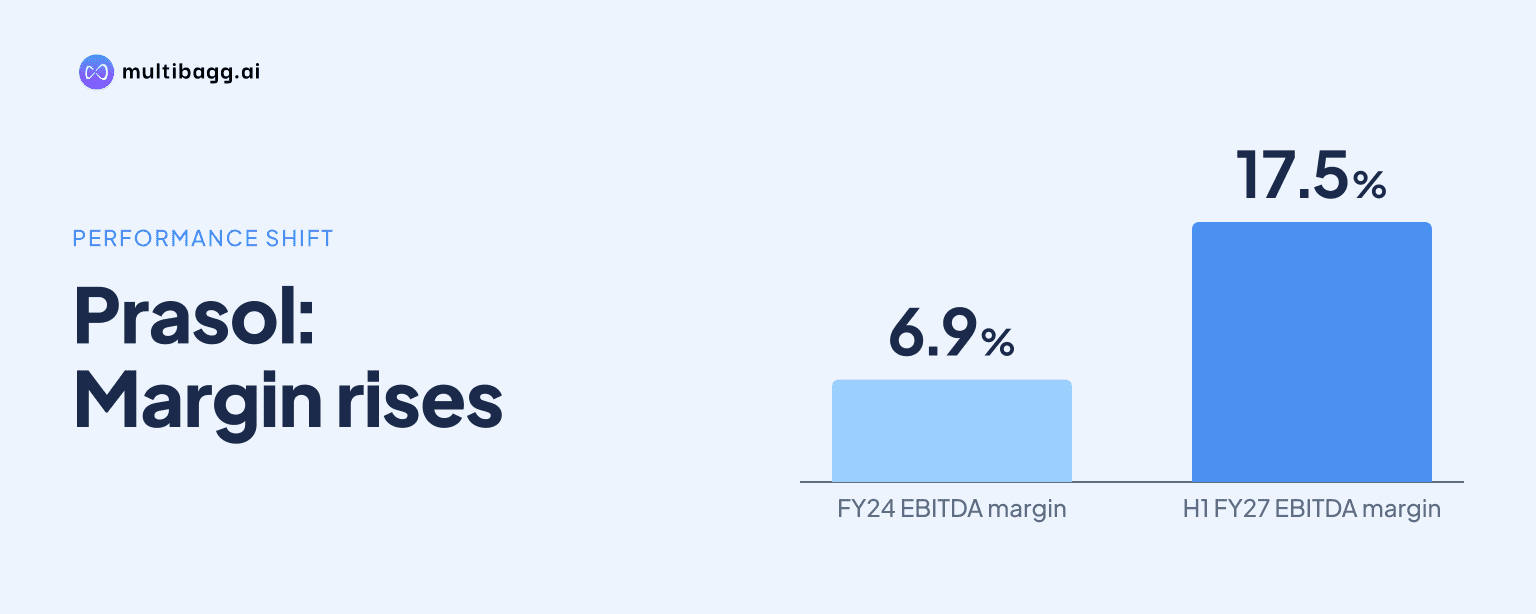
Prasol Chemicals lifted its reported earnings before interest, tax, depreciation and amortisation (EBITDA) margin to 17.5% in H1 FY27 from 6.9% in FY24, while gross margin reached 34.1% and Mahad-unit losses declined from Rs 14.9 crore in FY24 to Rs 3.9 crore in FY26.
Know Prasol Chemicals inside out
Results, valuation, peers and who's buying, in one view.
How did Prasol’s margins change from FY24 to H1 FY27?
Prasol’s reported EBITDA margin rose in each reported annual period, from 6.9% in FY24 to 8.7% in FY25 and 11.3% in FY26, before reaching 17.5% in H1 FY27. Gross margin followed the same direction, moving from 26.1% in FY24 to 28.5% in FY25, 30.7% in FY26 and 34.1% in H1 FY27.
The H1 FY27 figure is a half-year result and should not be treated as directly equivalent to a full-year margin. Against the comparable H1 FY26 period, EBITDA margin increased 590 basis points, or bps, from 11.6% to 17.5%, while EBITDA more than doubled from Rs 71.6 crore to Rs 148.0 crore on revenue growth of 37.1%.
What drove Prasol’s gross-margin expansion?
Prasol attributes its longer-term gross-margin progression to greater capacity in secondary and tertiary derivatives, additions including ZDDP, IPH and PPS, and the commissioning of cogeneration in 2019. Its average gross margin increased from 23% in FY11-FY15 to 26% in FY16-FY19 and 30% in FY20-FY26, providing the historical context for the 34.1% reported in H1 FY27.
In the latest half year, however, the presentation identifies a specific temporary influence. Geopolitical-led supply-chain issues raised average selling prices and added Rs 25 crore to gross profit during Q1 FY27, while foreign-currency fluctuations added Rs 92 lakh; Prasol says these effects normalised in Q2 FY27. Management also cited better realisations and an improving product mix, while saying it progressively raised product prices as raw-material prices increased in Q2.
How much has Mahad’s loss burden reduced?
Mahad’s disclosed losses fell by Rs 11.0 crore, from Rs 14.9 crore in FY24 to Rs 3.9 crore in FY26. That reduction matters because FY24 included a Mahad shutdown among the challenges listed by Prasol, alongside Covid-19, global inventory destocking, conflicts, tariff pressures and supply-chain disruption.
The bridge between reported EBITDA and EBITDA excluding Mahad losses shows the narrowing impact. In FY24, reported EBITDA of Rs 60.5 crore rose to Rs 75.5 crore excluding Mahad losses, whereas in FY26 reported EBITDA of Rs 139.3 crore rose to Rs 143.3 crore on that basis. The gap consequently narrowed from Rs 15.0 crore to Rs 4.0 crore, with the small difference from the separately stated loss figures reflecting rounding in the presentation.
Prasol’s operational plan is to ramp up production at Mahad while expanding its product portfolio and capacity there. The Mahad plant, established in 2020, has capacity of 19,860 metric tonnes per annum and 18.4 acres of spare land, compared with the Khopoli plant’s 78,784 metric tonnes per annum of capacity and 11.98 acres of spare land.
Got a follow-up? Ask IRIS
How did higher margins affect H1 FY27 profit?
The margin expansion translated into a larger increase in profit than in sales during H1 FY27. Revenue from operations rose Rs 229.0 crore year on year to Rs 846.2 crore, gross profit increased Rs 110.0 crore to Rs 288.8 crore, and EBITDA increased Rs 76.4 crore to Rs 148.0 crore, producing the 106.6% EBITDA growth reported by Prasol.
Profit after tax increased 138.9% to Rs 99.0 crore in H1 FY27 from Rs 41.4 crore in H1 FY26, and net profit margin rose from 6.7% to 11.7%. Finance cost declined from Rs 4.8 crore to Rs 3.5 crore despite the expansion in operating scale, while depreciation rose from Rs 12.2 crore to Rs 13.6 crore.
The reported second quarter was less profitable than the first-half aggregate implies, although it remained above the prior-year quarter. Q2 FY27 EBITDA margin was 14.0%, compared with 10.4% in Q2 FY26, while gross margin was 30.1%, compared with 27.9%; this followed the presentation’s statement that the Q1 selling-price and currency effects had normalised in Q2.
What could determine whether Prasol sustains the margin improvement?
The H1 FY27 margin includes the Rs 25 crore gross-profit effect from higher average selling prices linked to geopolitical supply-chain issues, so the reported 17.5% rate combines operating changes with a disclosed pricing event. Management said higher freight costs and limited vessel availability amid the Middle East crisis delayed some export shipments, even as demand for acetone-based and phosphorus-based products remained healthy.
Working-capital movements are another disclosed factor to monitor. Inventory rose from Rs 153.2 crore in March 2026 to Rs 301.1 crore in September 2026, while trade receivables rose from Rs 278.7 crore to Rs 352.0 crore; consequently, H1 FY27 net cash from operating activities was negative Rs 11.7 crore, versus positive Rs 7.2 crore a year earlier.
Management has retained FY27 guidance for revenue of Rs 1,550-1,650 crore and EBITDA of Rs 240-250 crore, excluding the effect of geopolitical supply-chain price fluctuations and any foreign-exchange gain or loss. That framing makes realised pricing, raw-material pass-through, the Mahad ramp-up and cash conversion relevant measures alongside the reported EBITDA margin.
Conclusion
Prasol’s figures show a multi-year expansion in gross profit and EBITDA margins, alongside a substantially smaller Mahad loss burden by FY26. Revenue rose from Rs 876.6 crore in FY24 to Rs 1,232.6 crore in FY26, while EBITDA rose from Rs 60.5 crore to Rs 139.3 crore; H1 FY27 then produced Rs 148.0 crore of EBITDA and a 17.5% margin.
Next, investors can watch whether Mahad’s production ramp and operating-efficiency measures support the stated FY27 EBITDA range of Rs 240-250 crore after the Q1 pricing effect normalised in Q2. Management’s Phase I expansion, expected to be completed in multiple sub-phases over the next two years, targets 60,000 metric tonnes per annum of added capacity and Rs 500-550 crore of revenue at peak utilisation; Phase II spending is expected to begin in H2 FY28, subject to approvals.