








Premier Energies agrees 10% RCT Space stake for space solar
MAX Plan at ₹4,999/yr

Find your next multibaggerBe a Pro Investor
Research stocks and track your picks on the go. Download the app.
Key highlights
- Premier Energies agreed on November 29, 2026, to acquire a 10% stake in RCT Space through a subsidiary.
- Premier Energies plans to use existing Hyderabad PERC and TOPCon lines for space-grade solar cells.
- RCT Space says its patented annealing method reverses 90% of radiation damage that can reduce silicon-cell efficiency by up to 50%.
- Premier Energies reported 10.6 GW of cell capacity, 11.1 GW of module capacity and a Rs 12,500 crore capex programme.
powered by IRIS
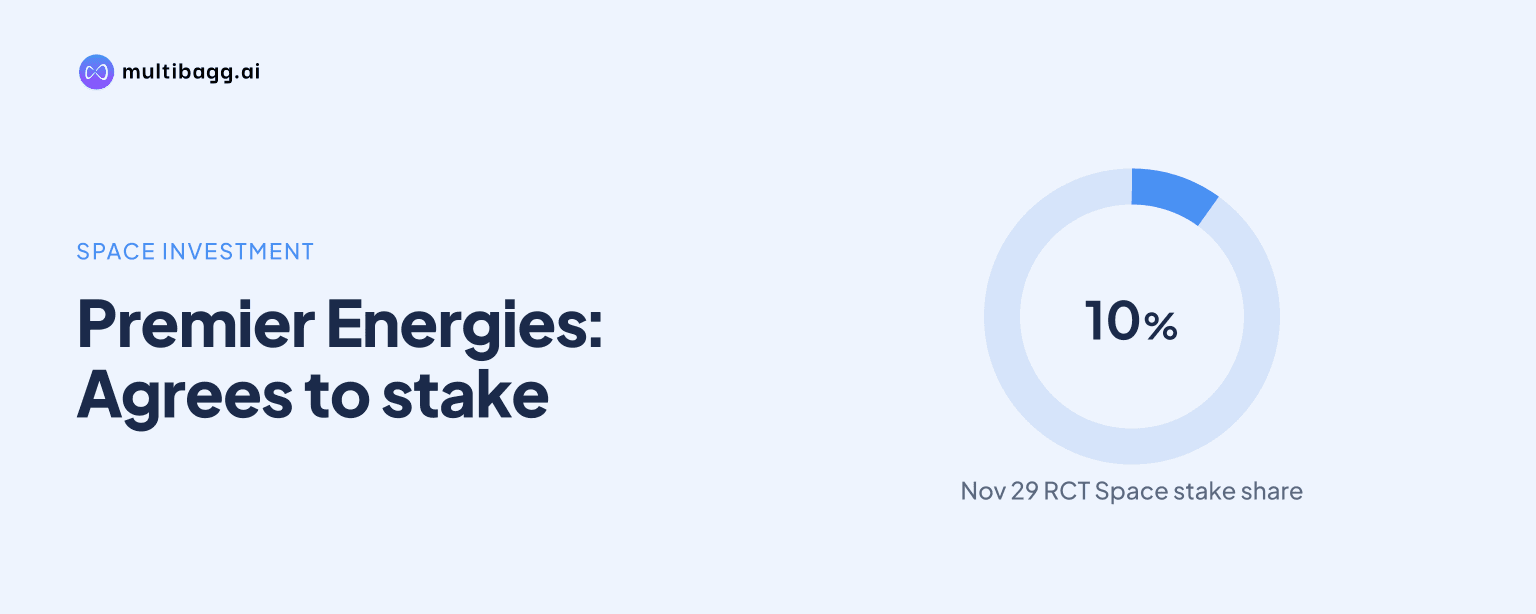
Premier Energies Limited agreed on November 29, 2026, to acquire a 10% equity stake in Germany’s RCT Space GmbH through a subsidiary, linking the minority investment to a technology partnership and planned space-grade solar-cell production on its Hyderabad lines. The company reported 10.6 gigawatts (GW) of cell capacity and 11.1 GW of module capacity.
Know Premier Energies inside out
Results, valuation, peers and who's buying, in one view.
What does Premier Energies’ 10% RCT Space stake involve?
Premier Energies has agreed to acquire a 10% equity stake in RCT Space through its subsidiary in a transaction combining primary and secondary components. The November 29, 2026 announcement does not disclose the investment amount, RCT Space’s valuation, the split between primary and secondary transactions, or a completion date.
Premier Energies said the stake includes a technology partnership rather than a full acquisition or merger. The company said the arrangement makes it one of the first Indian solar manufacturers to enter the space solar cell and module segment, while RCT Space contributes technology developed for satellite and spacecraft applications from Konstanz, Germany.
The filing does not provide a revenue target, order book, customer contract, production volume or profitability forecast for the space-solar initiative. Its disclosed mechanism is a 10% holding paired with RCT Space’s specialised space-solar technology and Premier Energies’ existing Indian manufacturing base.
How will Premier Energies make space-grade solar cells?
Premier Energies plans to manufacture space-grade solar cells on its existing passivated emitter and rear cell, or PERC, and tunnel oxide passivated contact, or TOPCon, production lines in Hyderabad. The announcement identifies these existing solar-cell technologies as the manufacturing base for the planned space-grade products.
Premier Energies reported 10.6 GW of cell manufacturing capacity and 11.1 GW of module manufacturing capacity. Module capacity was therefore 0.5 GW higher than cell capacity, but the filing does not specify how much of either capacity will be allocated to space solar or whether a stated volume will be converted from terrestrial production.
RCT Space develops silicon solar cells and modules to power satellites and other spacecraft, including lightweight products intended to withstand radiation and extreme temperature cycles. The release does not state whether module assembly will take place in Hyderabad, Germany or another location, nor does it identify satellite qualification milestones.
Why is RCT Space’s radiation technology important?
RCT Space’s patented annealing method is important because the company says it reverses 90% of radiation damage to crystalline silicon solar cells operating in space. The announcement says crystalline silicon cells can lose up to 50% of their initial efficiency in space, making radiation management a central technical issue for satellite power systems.
RCT Space says the annealing process results in higher power output by reversing most of the cited radiation damage. Its designs also include bypass diodes intended to simplify production and reduce the cost of space solar cells, although the release gives no cost figure, efficiency rating or power-output specification.
The company adapts established terrestrial silicon manufacturing processes for use in orbit, rather than describing an entirely separate cell platform. That approach aligns with Premier Energies’ plan to use existing PERC and TOPCon lines, though neither company disclosed a timetable for qualification of products for a specific spacecraft or mission.
RCT Space is part of the Germany-based RCT Group, which has engineering experience across more than 100 GW of solar manufacturing capacity in 29 countries. The release presents that figure as group engineering experience, not as RCT Space’s own manufacturing capacity or as a measure of the proposed partnership’s output.
Got a follow-up? Ask IRIS
What research and production plans have the companies disclosed?
Premier Energies and RCT Space plan to jointly set up a dedicated research and development centre in India for space solar based on RCT Space’s patented technologies. The announcement does not name a city, budget, staffing plan, ownership arrangement, launch date or research milestones for the proposed centre.
The production plan is more specific on location because Premier Energies intends to use Hyderabad production lines for space-grade solar cells. RCT Space, based in Konstanz, supplies technology designed for radiation exposure and extreme temperature cycles, while the Indian centre is intended to support research into space-solar products.
Premier Energies is separately undertaking a Rs 12,500 crore capital-expenditure programme to strengthen manufacturing capabilities, expand backward integration into ingots and wafers, and diversify into transformers and battery energy storage systems. The filing does not assign any portion of the Rs 12,500 crore programme to the RCT Space stake, the Hyderabad space-solar plan or the proposed research centre.
Management said the partnership combines German space-photovoltaic engineering with Indian manufacturing scale, with the aim of supplying globally competitive space-solar solutions and supporting self-reliance in critical technologies. These are management objectives; the release does not provide sales, capacity or margin targets for the space-solar business.
What does the RCT Space deal change for Premier Energies’ strategy?
The deal adds space solar cells and modules to Premier Energies’ disclosed manufacturing strategy, which includes 10.6 GW of cell capacity, 11.1 GW of module capacity and a Rs 12,500 crore capital-expenditure programme. The announced entry is structured as a minority stake, technology partnership, planned use of existing lines and a proposed Indian research centre.
The near-term disclosed change is therefore technological and organisational rather than a quantified expansion in capacity. Premier Energies has not announced a dedicated space-solar factory, a separate capital budget, an annual production target, customer names or a date for commercial shipments from Hyderabad.
RCT Space says it aims to make space solar power more accessible as satellite fleets grow worldwide by building on established silicon manufacturing processes. However, the companies have not disclosed a target market size, satellite fleet estimate, contract pipeline or addressable-revenue figure connected to the 10% stake.
Conclusion
Premier Energies’ planned 10% stake in RCT Space links a minority investment with a defined plan to develop space-grade solar cells on existing Hyderabad PERC and TOPCon lines. RCT Space’s stated technical contribution is an annealing method that it says reverses 90% of radiation damage, against potential initial-efficiency losses of up to 50% for crystalline silicon cells in space.
The next disclosed matters to watch are completion details for the primary and secondary transaction, the location and timetable of the Indian research centre, and production or qualification milestones for space-grade cells. The November 29, 2026 release also leaves unresolved whether any amount of Premier Energies’ Rs 12,500 crore capital-expenditure programme will support the space-solar initiative.

