








Premier Energies Plans 10% RCT Space Stake for Space Solar R&D
MAX Plan at ₹4,999/yr

Find your next multibaggerBe a Pro Investor
Research stocks and track your picks on the go. Download the app.
Key highlights
- Premier Energies plans to acquire a 10% stake in Germany's RCT Space through a subsidiary.
- Premier Energies and RCT Space plan to establish an India-based R&D centre for space solar technology.
- Premier Energies plans space-grade solar cell production using existing PERC and TOPCon lines.
- The RCT Space proposal is separate from the previously disclosed 12 GWh battery storage venture involving RCT Nexor Energy.
powered by IRIS
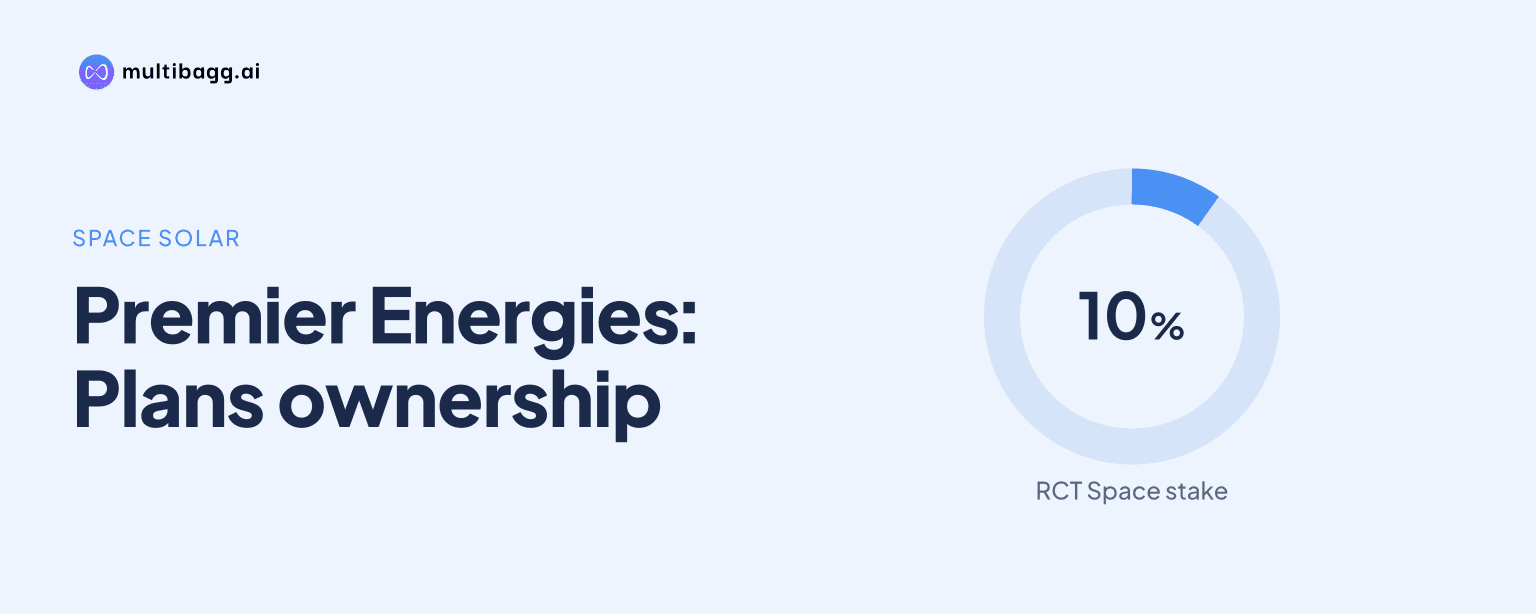
Premier Energies Limited plans to acquire a 10% stake in Germany's RCT Space through a subsidiary and jointly establish an India-based R&D centre for space solar technology. Premier Energies also plans to produce space-grade solar cells using its existing PERC and TOPCon manufacturing lines, extending the stated scope of its solar technology work.
Know Premier Energies inside out
Results, valuation, peers and who's buying, in one view.
What has Premier Energies announced with RCT Space?
Premier Energies has announced a proposed acquisition of a 10% stake in RCT Space, a Germany-based company, through one of its subsidiaries. The filing also sets out a plan for the two sides to establish a research and development centre in India focused on space solar technology.
The disclosure links the proposed equity investment with a technology-focused collaboration. It identifies space-grade solar cells as the intended production area and states that Premier Energies plans to use its existing PERC and TOPCon lines for this purpose. The filing does not provide a transaction value, the identity of the acquiring subsidiary, or a completion timetable.
The announced 10% stake is a minority holding. The filing does not state whether the proposed investment includes board representation, additional investment rights, or any change in management control at RCT Space.
How will the space solar technology collaboration work?
The collaboration is intended to combine the proposed RCT Space stake with an India-based R&D centre and a plan to make space-grade solar cells. Premier Energies has identified its current PERC and TOPCon production lines as the manufacturing base for the planned space solar cell activity.
PERC and TOPCon are solar-cell technologies used in photovoltaic manufacturing. The filing does not specify the technical modifications, certification requirements, cell capacity, investment outlay, location, or commercial production schedule for the planned space-grade products.
The stated use of existing manufacturing lines indicates that the company is considering the initiative alongside its current solar-cell operations. However, the disclosure does not quantify the production allocation, the expected output, or the financial contribution from the proposed activity.
Got a follow-up? Ask IRIS
How does this proposal fit Premier Energies' other energy initiatives?
The RCT Space proposal is separate from the previously disclosed battery energy storage system venture involving Premier Energies and RCT Nexor Energy. The supplied background describes a planned 12 GWh battery energy storage manufacturing facility at Seetharampur in Telangana under Premier Energies Storage Solutions Private Limited.
In that earlier arrangement, RCT Nexor Energy was entitled to acquire up to a 15% stake in the joint venture through four milestone-linked tranches, with an option for an additional 5% stake after Phase I. The background said the first 6 GWh phase was expected to be established in FY 2027-28.
The current filing concerns RCT Space, a proposed 10% investment, and space solar technology. It should therefore not be treated as an update to the BESS shareholding arrangement or as confirmation of any change in the 12 GWh storage project.
Together, the disclosures show Premier Energies pursuing activities beyond conventional solar module and cell manufacturing. But each project has a different disclosed counterparty, operating purpose, ownership structure, and implementation framework.
What does the filing mean for investors and operations?
For investors, the immediate significance is Premier Energies' stated plan to enter a minority strategic relationship focused on space solar technology. The 10% proposed holding provides a defined ownership figure, while the planned R&D centre and production objective indicate the operational areas covered by the collaboration.
The filing does not disclose the cost of the stake, funding source, expected revenue, profitability, order pipeline, customer base, or contribution to installed manufacturing capacity. As a result, its near-term financial impact cannot be quantified from the available information.
For operations, the proposed use of existing PERC and TOPCon lines could connect the new activity to Premier Energies' established manufacturing platform. Yet the filing does not state whether dedicated equipment, new facilities, regulatory approvals, testing, or customer qualification will be needed before commercial supply can begin.
The planned R&D centre could create an India-based platform for work on space solar technology, but its staffing, location, intellectual-property arrangements, and research milestones have not been disclosed. These details will be important for assessing how the proposal progresses beyond the announced plan.
Conclusion
Premier Energies has disclosed a planned 10% investment in Germany's RCT Space through a subsidiary, alongside a joint plan to set up an India-based R&D centre for space solar technology. Its proposal to produce space-grade solar cells on existing PERC and TOPCon lines gives the arrangement an operational dimension, although the available filing does not quantify investment, output, or expected financial returns.
The next disclosures to watch are the completion of the proposed stake acquisition, details of the R&D centre, and any stated timeline for space-grade cell production. Investors will also need further information on capital deployment, technical specifications, capacity allocation, and commercial arrangements before the financial significance of the initiative can be assessed.

