










Prospect targets 4,000 MT utilisation after factory upgrade
Key highlights
- Prospect says capacity has increased from 1,200 MT to more than 4,800 MT.
- Management targets utilisation of 3,500 to 4,000 MT this year, from approximately 2,500 MT currently.
- H1 FY27 revenue from operations rose 4.85% to Rs 31.07 crore, while derived EBITDA margin was 10.93%.
- FY26 revenue was Rs 57.54 crore, compared with Rs 30.99 crore in FY25.
powered by IRIS
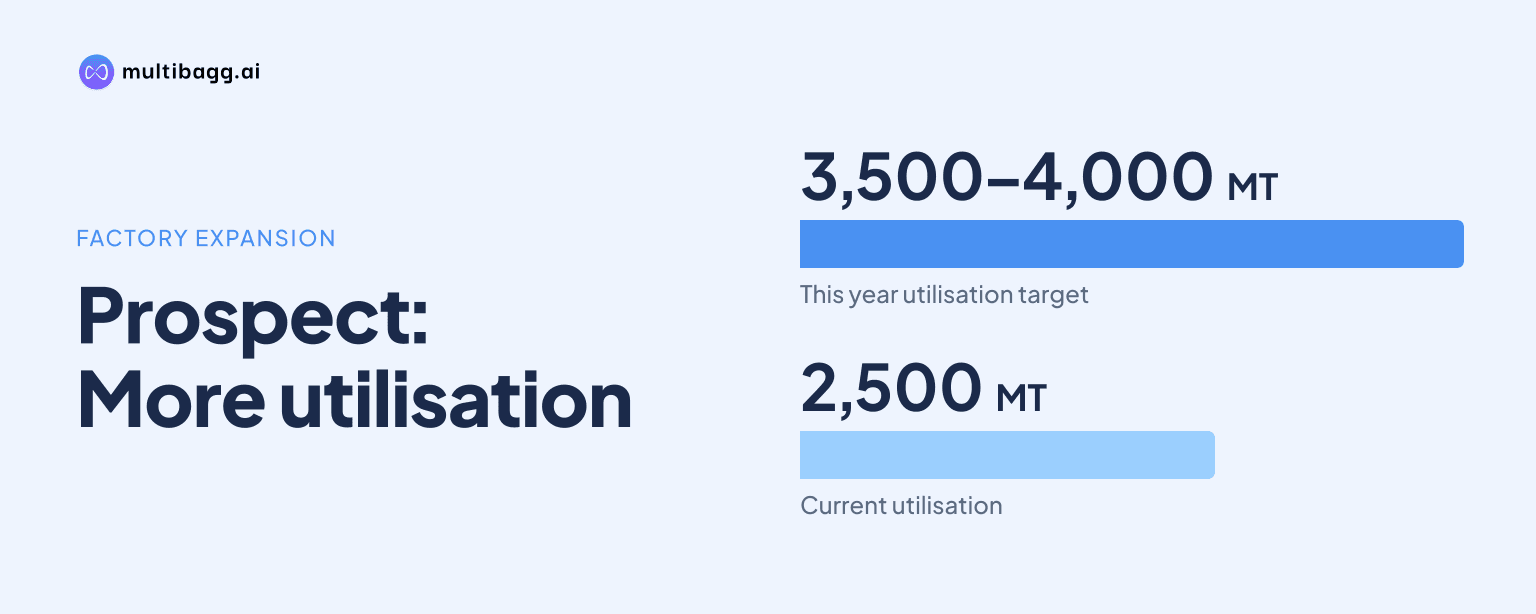
Prospect Consumer Products Limited has upgraded its cashew-processing capacity from 1,200 metric tonnes (MT) to more than 4,800 MT and management targets utilisation of 3,500 to 4,000 MT this year, from about 2,500 MT currently. Management says higher volumes should improve fixed-cost absorption and operating efficiency at the modernised facility.
Know Prospect Consumer Products inside out
Results, valuation, peers and who's buying, in one view.
What capacity has Prospect added at its cashew facility?
Prospect has raised cashew-processing capacity from 1,200 MT to more than 4,800 MT at its modernised and automated facility. The company identifies Changodar, Ahmedabad as the manufacturing location and says the unit covers 39,000 square feet, has capacity of more than 4,800 metric tonnes per annum (MTPA), and can process 15,000 kilograms a day.
The presentation contains a separate capacity disclosure that needs reconciliation. Its production-expansion page says capacity increased from 1,200 MT to more than 2,500 MT, with scope to expand beyond 4,800 MT, while management's H1 FY27 statement and the infrastructure page describe current capacity as more than 4,800 MT. Prospect does not explain whether the more than 2,500 MT figure refers to an intermediate phase, output, or another measure.
The upgraded plant handles cleaning, boiling and cooling, de-shelling, drying, moisture control and peeling, sorting and grading, packing and dispatch, and final drying. Prospect says automation has reduced manual processing requirements and improved workforce allocation, but it does not disclose headcount changes, capital expenditure or quantified cost savings.
How much of Prospect's upgraded capacity is being used?
Prospect says current utilisation is approximately 2,500 MT and management expects 3,500 to 4,000 MT this year, followed by more than 4,000 MT in the next financial year. Using 4,800 MT as the reference capacity, the current level equates to about 52%, while the management target range equates to about 73% to 83%; these are calculations rather than separately reported utilisation rates.
A second statement in the presentation says the modernised facility is achieving an “optimized utilization rate” of 75% to 80%. That range broadly aligns with 3,500 to 4,000 MT against 4,800 MT, but differs from the approximately 2,500 MT current utilisation cited by management. Prospect does not provide a period or denominator for the 75% to 80% figure.
Management says the expected increase in throughput should improve fixed-cost absorption and efficiency. This is the earnings mechanism cited for the expansion, because plant-related fixed costs can be spread across a larger volume of processed cashews; however, Prospect provides no per-unit processing-cost data or utilisation-linked margin estimate.
Got a follow-up? Ask IRIS
Why does higher utilisation matter for Prospect's profitability?
Higher utilisation matters because Prospect reported lower profitability margins in H1 FY27 despite revenue growth. Revenue from operations increased 4.85% to Rs 31.07 crore and total income rose 4.75% to Rs 31.10 crore, while derived earnings before interest, tax, depreciation and amortisation (EBITDA) were Rs 3.40 crore at a 10.93% margin, compared with 13.56% a year earlier.
Profit after tax (PAT) was Rs 1.45 crore in H1 FY27. Management acknowledged the moderation in profitability and said it is focused on improving results as volumes scale, linking the plan to better fixed-cost absorption rather than identifying a detailed cost or pricing bridge for the margin change.
FY26 revenue of Rs 57.54 crore was higher than Rs 30.99 crore in FY25, while EBITDA rose from Rs 4.18 crore to Rs 6.31 crore and PAT increased from Rs 2.14 crore to Rs 2.46 crore. These are full-year figures and are not directly comparable with H1 FY27, but the comparison shows that revenue increased faster than PAT between the two annual periods.
Management has set an aspiration for a sustained EBITDA margin of 11% to 14% over the next three years, driven by operational efficiency. Prospect says these are aspirations rather than guarantees, and it does not provide a quarterly timetable for margin recovery or a specific utilisation threshold for reaching that range.
What demand channels could support Prospect's volume target?
Prospect processes, exports and supplies natural cashew kernels to business-to-business (B2B) wholesalers, while its DriFrutz range adds business-to-consumer (B2C) products. The company sources raw cashew nuts from African countries, South Asian countries and India, and also sells cashew husk, cashew husk pellets and cashew shell as processing by-products.
The B2C range includes roasted and salted cashews, peri peri cashews, cheese cashews, almonds, pistachios, mixed dry fruits, seeds and dried berries. Product packs shown in the presentation range from 25 grams to 400 grams, while gift-hamper maximum retail prices range from Rs 776 for a two-product combo to Rs 1,800 for a six-product combo.
DriFrutz gifting products are available on Blinkit across Gujarat, Maharashtra including Nagpur, and Madhya Pradesh including Indore, according to management's H1 FY27 statement. Management also says it will widen quick-commerce and digital distribution alongside Amazon, JioMart and the Open Network for Digital Commerce (ONDC).
The presentation shows a 200-gram DriFrutz gift pack on Blinkit at Rs 489 against a maximum retail price of Rs 599, and a 300-gram pack at Rs 669 against Rs 799. Management targets revenue compound annual growth of 45% to 50% over the next three years and says B2C is intended to contribute an additional 10% over the next two years, but Prospect does not disclose the current B2C revenue base.
A separate production-expansion page cites a 40% to 45% revenue compound annual growth target over the next three years, differing from management's 45% to 50% range. The supplied presentation does not explain the difference, and neither range is a reported financial result.
Conclusion
Prospect's facility upgrade makes throughput a central operating measure: management cites more than 4,800 MT of capacity, approximately 2,500 MT of current utilisation and a target of 3,500 to 4,000 MT this year. The proposed financial benefit is better fixed-cost absorption, while H1 FY27's 10.93% EBITDA margin, down from 13.56% a year earlier, shows why execution on volume and efficiency matters.
The next disclosed milestones are management's target for utilisation above 4,000 MT in the next financial year, its 11% to 14% sustained EBITDA-margin aspiration over three years, and further DriFrutz distribution through quick commerce and digital channels. Clarification of the differing more than 2,500 MT and more than 4,800 MT capacity disclosures, as well as the 75% to 80% utilisation reference, remains unresolved in the presentation.