










Suprajit forecasts 12–13.5% FY27 EBITDA margin recovery
Key highlights
- Suprajit forecasts FY27 consolidated operational EBITDA margin of 12% to 13.5%.
- Suprajit reported a 12.2% consolidated EBITDA margin in Q2 FY27, up 60 basis points year on year.
- Suprajit’s consolidated ROCE rose to 16.4% in FY26 from 14.2% in FY25.
- Suprajit’s Q2 FY27 consolidated revenue was Rs 1,135.1 crore, up 20.6% year on year.
powered by IRIS
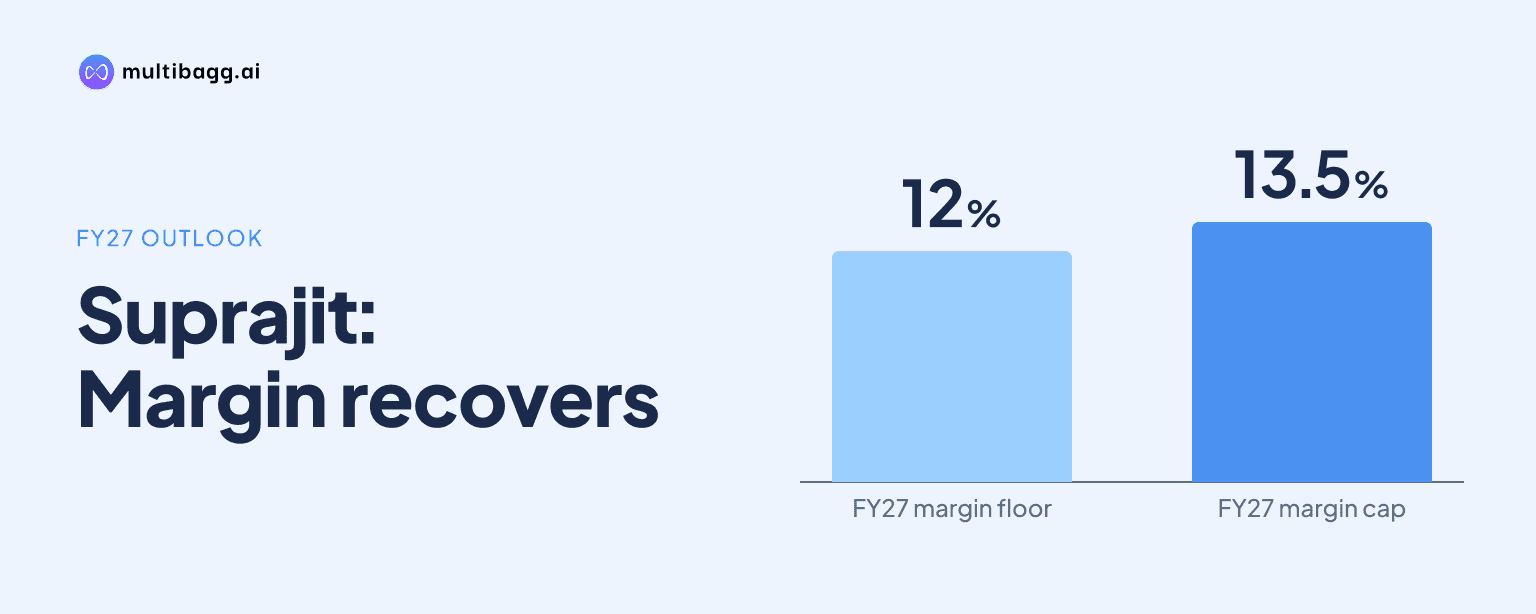
Suprajit forecasts a 12–13.5% consolidated operational EBITDA margin in FY27 after reporting 12.2% in the second quarter of FY27, up 60 basis points year on year and above FY26’s 10.4%. The presentation links the recovery to restructuring and synergies after the loss-making Kongsberg LDC and SCS acquisitions, while consolidated ROCE reached 16.4% in FY26.
Know Suprajit Engineering inside out
Results, valuation, peers and who's buying, in one view.
Why did Suprajit’s consolidated margin fall after its acquisitions?
Suprajit’s consolidated operational EBITDA margin fell from 14.1% in FY22 to 10.2% in FY25 as global acquisitions changed the group mix, before improving to 10.4% in FY26. EBITDA means earnings before interest, tax, depreciation and amortisation. The presentation identifies Kongsberg LDC, a US leader, and SCS, a Europe leader, as strategic acquisitions that were loss-making when acquired but brought technology, customers and geographic footprint.
The difference between standalone and consolidated results shows the effect of the acquired operations. Standalone operational EBITDA margin was 16.6% in FY26, compared with consolidated margin of 10.4%, a 6.2-percentage-point gap. Suprajit says standalone EBITDA also reduced because it incurred higher research and development and administrative costs to support global operations, describing this as temporary cost pressure in India.
Has Suprajit’s return on capital started recovering?
Yes, Suprajit’s consolidated return on capital employed, or ROCE, rose to 16.4% in FY26 from 14.2% in FY25. That 2.2-percentage-point increase followed three years of declining consolidated ROCE, from 19.0% in FY22 to 14.4% in FY24 and 14.2% in FY25. The presentation displays a consolidated ROCE target of 25% alongside each annual period.
Standalone ROCE moved in the opposite direction in FY26, declining to 18.4% from 19.3% in FY25, while consolidated ROCE improved. This narrowed the gap between the two measures to 2.0 percentage points in FY26, from 5.1 percentage points in FY25. The movement is consistent with Suprajit’s presentation of restructuring, integration and synergies beginning to improve returns from global operations, though its 16.4% FY26 consolidated ROCE remained below the displayed 25% target.
What did Suprajit deliver in Q2 FY27?
Suprajit reported consolidated revenue of Rs 1,135.1 crore in Q2 FY27, up 20.6% year on year, and a consolidated EBITDA margin of 12.2%, up 60 basis points year on year. The second-quarter margin was 1.8 percentage points above the 10.4% consolidated margin reported for FY26. This quarterly result sits within Suprajit’s FY27 forecast range of 12% to 13.5% for consolidated operational EBITDA margin.
Standalone revenue was Rs 564.7 crore in Q2 FY27, up 15.9% year on year. Net debt stood at Rs 371.4 crore in September 2026, down from Rs 448.5 crore, a reduction of Rs 77.1 crore. The presentation does not specify the prior-period date for the Rs 448.5 crore debt comparison, but it reports the lower September 2026 balance alongside the Q2 FY27 operating results.
Got a follow-up? Ask IRIS
Which Suprajit divisions drove the Q2 FY27 improvement?
Global Cables & Mechatronics, or GCM, delivered the largest reported Q2 FY27 revenue at Rs 577.6 crore and grew 24.3% year on year. Its EBITDA margin rose to 10.1% from 7.4%, a 2.7-percentage-point improvement. Suprajit attributed the division’s progress to US and Chinese original equipment manufacturer wins and its Chennai greenfield cable plant; first-half revenue growth was 25.9%.
India Cables & Mechatronics, or ICM, generated Rs 387.7 crore of Q2 revenue, up 13.7% year on year, with a 15.3% EBITDA margin. Its margin increased from 12.8% in Q1 FY27, while first-half revenue growth was 16.9%. Suprajit said original equipment manufacturer cable and beyond-cable business grew by more than 20%, while braking operations were scaling.
Phoenix Lighting & Electricals, or PLE, recorded a 14.4% Q2 EBITDA margin on Rs 108.0 crore of revenue, compared with 6.7% in Q1 FY27. Revenue rose 14.8% year on year and first-half growth was 10.3%. Suprajit cited a ramp-up with its largest US retailer and added volume following a competitor’s insolvency. Sensors, Electronics & Displays, or SED, was the fastest-growing division at 50.4%, but its Rs 61.8 crore revenue produced an 8.4% margin amid input-cost pressure.
What supports Suprajit’s FY27 margin forecast?
Suprajit’s FY27 forecast of 12% to 13.5% consolidated operational EBITDA margin is supported in the presentation by higher Q2 margins across GCM, ICM and PLE, as well as 20.6% consolidated revenue growth. The company characterises the Q2 FY27 outcome as a prove-out across four divisions, although SED’s 8.4% margin shows that input costs remain a disclosed constraint within the group.
The product plan aims to raise content per vehicle beyond traditional cables and halogen lighting. For passenger and commercial vehicles, Suprajit shows weighted average content rising from Rs 1,100 in its core products to Rs 3,500 across cables, actuators, shifter systems, and LED and electrical products. For two-wheelers, three-wheelers and off-highway vehicles, the comparable weighted average content rises from Rs 240 to Rs 2,240 through displays, clusters, throttles, switches, braking systems, actuators and lighting.
Suprajit’s roadmap lists control cables in 1985, halogen lamps in 2015, electronic throttles in 2016, seat actuators acquired through Kongsberg LDC in 2022, scooter actuators in 2024, and thin-film transistor displays and braking systems in 2025. These additions support its stated focus on braking, actuation and electronics. The presentation does not quantify the timing or margin contribution of each new product line, so their effect on the FY27 forecast cannot be separately measured from the disclosed material.
Conclusion
Suprajit’s disclosed figures show a group moving beyond the lower returns that followed the addition of loss-making global businesses. Consolidated ROCE improved from 14.2% in FY25 to 16.4% in FY26, consolidated EBITDA margin improved from 10.2% to 10.4%, and Q2 FY27 reached 12.2%. GCM’s 10.1% margin, ICM’s 15.3% and PLE’s 14.4% provide the operating evidence behind the 12% to 13.5% FY27 forecast.
The next measure to watch is whether Suprajit can sustain its Q2 FY27 margin through the rest of FY27 while integrating and extracting synergies from Kongsberg LDC and SCS. The presentation’s displayed longer-term reference points are 15% consolidated operational EBITDA margin and 25% consolidated ROCE, while SED’s 8.4% Q2 margin and stated input-cost pressure remain unresolved factors to monitor.