










Suprajit sees H2 margins above H1 after repricing integration
Key highlights
- Suprajit reported H1 FY27 consolidated revenue of Rs 2,205 crore, up 22% year on year.
- H1 FY27 consolidated operating EBITDA rose 40% to Rs 267 crore, with a 12.1% margin.
- GCM revenue grew about 24% and EBITDA increased 69%, lifting margin from 7.4% to more than 10%.
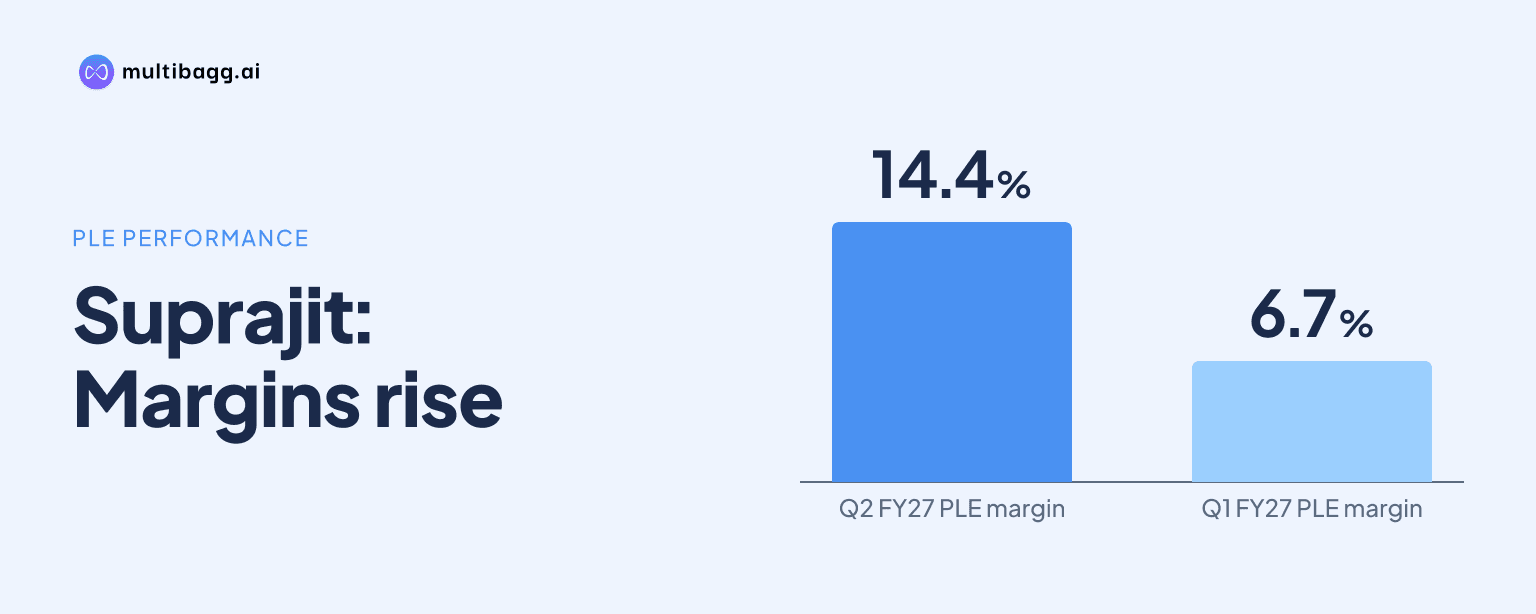
- PLE’s Q2 FY27 margin rose to 14.4% from 6.7% in Q1 FY27, though management said Q2 alone is not sustainable.
powered by IRIS
Suprajit Engineering Limited expects its FY27 second-half consolidated operating margin to exceed the 12.1% reported for the half year ended September 30, 2026, management said on November 12. It cited acquisition integration, contract mix and customer repricing, while retaining 12%-13.5% full-year guidance amid commodity and shipping uncertainty.
Know Suprajit Engineering inside out
Results, valuation, peers and who's buying, in one view.
Why does Suprajit expect higher second-half margins?
Suprajit expects H2 FY27 margins to be slightly above H1 because lower-margin legacy contracts are ending, new business is entering production and customer repricing has progressed. Management said it has gained insight after H1 into customers’ responses to commodity volatility and is receiving about 80% to 90% of the price recovery it seeks in some cases.
The outlook also reflects the consolidation of two major overseas acquisitions during 2025 and 2026. Management said these were difficult multi-geography and multi-unit integrations that contributed to a margin dip in the previous year. It said the improvement of the past two quarters indicated that the integration work was producing results.
Suprajit retained its consolidated operating earnings before interest, tax, depreciation and amortisation, or EBITDA, margin guidance of 12% to 13.5% for FY27. Global Cables and Mechatronics, or GCM, has separate margin guidance of 10% to 12%, while management described the 12.1% consolidated H1 margin as within the group’s stated annual range.
Which businesses could support Suprajit’s H2 margin improvement?
GCM, India Cable and Mechatronics, or ICM, and Phoenix Lighting and Electricals, or PLE, are expected to support H2 through different drivers. GCM revenue grew about 24% and EBITDA rose 69% in the first half, while its margin increased from 7.4% to more than 10%. Management said GCM restructuring is complete and first-half EBITDA more than doubled.
GCM’s growth is led by the United States and China, while European automotive conditions remain subdued. Management said U.S. growth reflects contract wins from competitors rather than underlying market expansion, which it put at 1% to 2%. In China, eight to nine of roughly 20 to 22 awarded projects with a major electric-vehicle original equipment manufacturer, or OEM, have entered commercial production, with another 10 to 12 due to start over the next year.
ICM revenue rose close to 14%, with OEM and beyond-cable sales growing about 20%. Its margin recovered to 15.3% in Q2 FY27 from 12.8% in Q1 FY27 after earlier pricing pressure, and management said it expected some further improvement in Q3. New launches beyond cables are also expected to contribute to ICM’s second-half performance.
PLE revenue rose close to 15% and EBITDA increased 30% in Q2 FY27, lifting its margin to 14.4% from 6.7% in Q1 FY27. Management attributed the improvement to aftermarket repricing and a ramp-up with the largest U.S. retailer, but said the 14.4% Q2 margin alone was not a sustainable reference because it included effects carried over from Q1.
Got a follow-up? Ask IRIS
How do contract mix and repricing affect Suprajit’s outlook?
Suprajit’s margin expectation is partly based on mix, as new work replaces contracts management said did not provide reasonable margins. This applies to legacy LDC-related business within GCM, where older contracts are coming off the table as new programmes begin. GCM is also pursuing material-cost and logistics-reduction projects while facing higher commodity prices and rates.
Pricing is not a formula-based pass-through, particularly at Suprajit Electronics Division, or SED, because its products use multiple imported components sourced across countries. Customer reviews typically occur every six months or annually, although significant component-price changes prompted earlier discussions in SED during Q2 FY27. Management said those discussions had not yet been finalised.
SED revenue grew 50.4% year on year in Q2 FY27, led by digital clusters and electronic throttle controls, but component and logistics costs weighed on margins. Management expects SED to return to double-digit margins once pricing is in place, without giving a timetable. SED has also begun expanding its facility after moving part of its operations to rented space, reflecting its expected project pipeline.
The division launched a thin-film transistor cluster jointly developed with Ultraviolette during Q2 FY27. Management also cited displays for earth-moving or crane-type equipment that can be priced at Rs 20,000 to Rs 25,000 each, though such applications have lower volumes. These higher-value products are part of the wider product mix management expects to build over time.
What could prevent Suprajit from lifting H2 margins?
Commodity-price volatility, shipping disruption and developments in the Middle East could prevent the expected H2 margin improvement. Management said GCM continues to face material-cost inflation, elevated rates and logistics pressures. It therefore described the H2 outlook as conditional, rather than raising its 12% to 13.5% consolidated margin guidance.
European vehicle demand is another constraint for GCM, with management describing Germany and Europe as slow and weak. It said a customer programme previously expected at 500,000 sets a year could instead operate at 300,000 to 400,000 sets. Suprajit nevertheless expects its European business to grow because new contract wins exceed the erosion from its existing programmes.
H2 revenue growth could also moderate from the 22% consolidated increase in H1 FY27. Management said some customers may have pulled forward orders in H1 as a defensive response to freight delays. It still expects strong double-digit GCM growth from current customer commitments, but said the second half may not repeat the 22% to 24% growth rates discussed for the first half.
ICM’s aftermarket mix remains a separate issue. Management said direct OEM sales represent about 50% to 55% of ICM, with the remaining roughly 45% divided between OEM spares and aftermarket sales. Direct OEM sales grew more than 20%, while combined spares and aftermarket growth was in single digits as consumers deferred servicing during strong new two-wheeler demand.
Conclusion
Suprajit’s H2 outlook combines first-half earnings growth with operating improvements in several divisions. Consolidated revenue rose 22% to Rs 2,205 crore and operating EBITDA increased 40% to Rs 267 crore in H1 FY27, while GCM restructuring, ICM’s Q2 recovery and PLE repricing provided the basis for management’s expectation of a higher H2 margin.
The next developments to watch are SED’s unresolved repricing discussions, GCM’s progress within its 10% to 12% margin range and the production ramp-up of 10 to 12 China projects over the next year. Management also plans about Rs 200 crore of FY27 capital expenditure, including a Chennai greenfield cable plant, expanded SED capacity and completion of the technology centre building.