










Suprajit expands electronics capacity after 50.4% growth
Key highlights
- Suprajit’s electronics division grew 50.4% year on year in Q2 FY27.
- Suprajit plans about Rs 200 crore of FY27 capital expenditure, including expanded electronics capacity.
- Suprajit reported Rs 2,205 crore of consolidated revenue for the half year ended September 30, 2026, up 22%.
- Suprajit’s net debt was Rs 371 crore as of September 30, 2026.
powered by IRIS
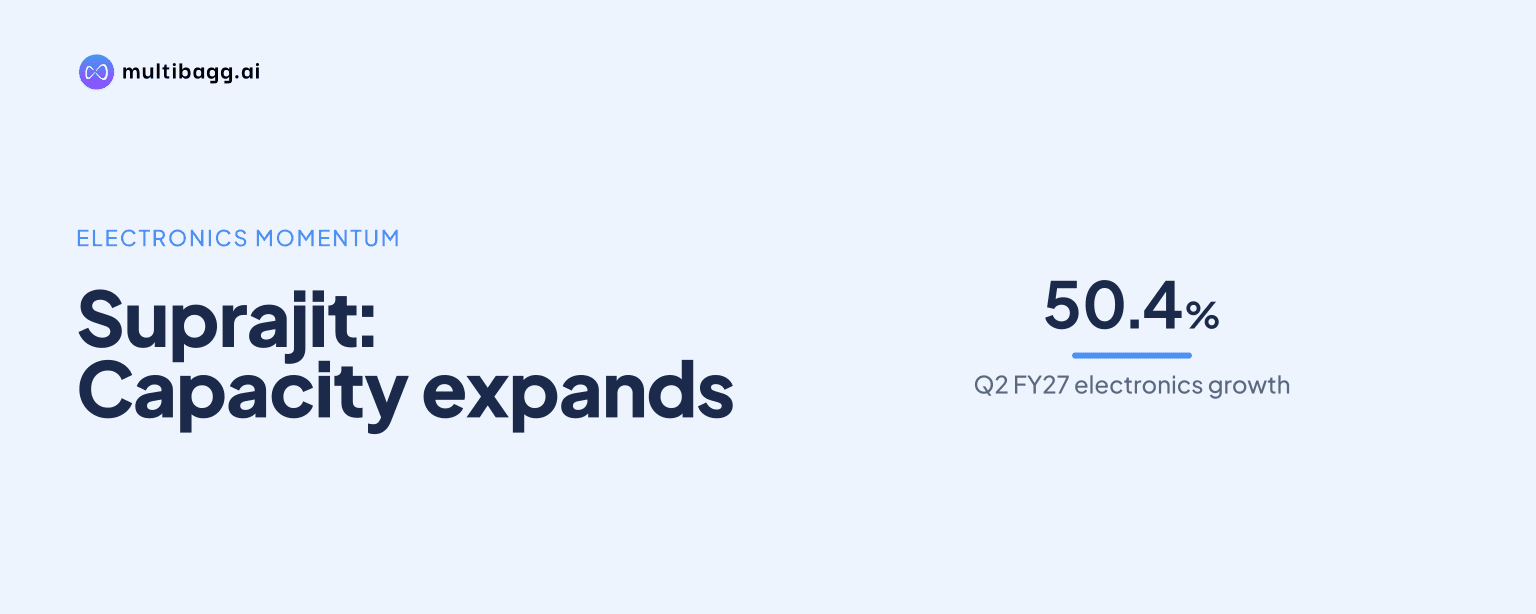
Suprajit Engineering Limited started expanding electronics capacity in Q2 FY27 after the division grew 50.4% year on year, led by digital clusters and Electronic Throttle Controls. Management said higher imported-component prices and added shipping and logistics costs compressed margins while it negotiated revised customer pricing.
Know Suprajit Engineering inside out
Results, valuation, peers and who's buying, in one view.
Why is Suprajit expanding its electronics facility?
Suprajit is expanding because management sees a clear path for further growth in its electronics division, launched about three years ago. Suprajit has already moved part of its operations into a rented facility, while construction has begun in the remaining vacated part of that plant to create a larger site for the Suprajit Electronics Division, or SED.
Management identified the SED expansion and a greenfield cable plant in Chennai for Suprajit Automotive Private Limited as the two major projects within FY27 capital expenditure of about Rs 200 crore. It said roughly half of this allocation had been spent shortly after the first half, while the new Suprajit Tech Center, or STC, building was scheduled for completion during the quarter.
The facility decision reflects a product pipeline rather than dependence on one customer, according to management. SED’s wins span multiple original equipment manufacturers, or OEMs, Indian two-wheelers and exports, across digital clusters, throttle controls, switches and display applications.
Suprajit said it did not disclose an SED order book, but management expects already-won business to support growth through FY27 and into the following year. Management did not commit to sustaining the Q2 FY27 rate of 50.4%, describing that level as ambitious, even as it cited strong project traction in electric vehicles.
What drove Suprajit’s 50.4% electronics growth?
Suprajit’s 50.4% year-on-year SED growth in Q2 FY27 was led by digital clusters and Electronic Throttle Controls, or ETCs. Management said this growth exceeded its expectations and that ETCs had become a key product after earlier uncertainty about the pace of adoption.
During the quarter, Suprajit launched a complex thin-film-transistor, or TFT, cluster jointly developed with Ultraviolette for an electric motorcycle. Management said the cluster uses a Qualcomm chip, two cameras, two antennas and radar, giving it more electronic content than a conventional two-wheeler digital display.
Suprajit is also targeting lower-volume applications with higher unit values. Management cited a central console designed and developed for an earth-moving or crane-type manufacturer, where each display could be priced at Rs 20,000 to Rs 25,000, compared with conventional two-wheeler display applications.
Management described the growth pipeline as broad-based across customers, products and geographies. Beyond clusters and ETCs, Suprajit said it was introducing a switch-cube product during the quarter, while its first drum-brake system was entering production for an electric two-wheeler customer in Bengaluru.
Got a follow-up? Ask IRIS
Why are Suprajit’s electronics margins under pressure?
Suprajit’s SED margins are under pressure because electronic components are imported and their prices have risen. Management said none of the division’s electronic components are made in India, exposing SED to inputs bought from multiple global suppliers rather than a single formula-based raw-material cost pass-through.
The 50.4% Q2 FY27 growth rate also increased shipping and logistics costs as cluster and ETC programmes ramped, management said. These costs weighed on SED profitability even as revenue growth demonstrated demand for higher-content displays and throttle-control products.
Price recovery is negotiated with customers rather than automatic. Suprajit said customer discussions generally occur every six months or annually, but it has sought earlier negotiations for SED because component-cost fluctuations were larger than normal at the November 12, 2026 earnings call.
Management said pending pricing discussions contributed to the SED margin dip in Q2 FY27 and expected the division to return to double-digit margins once revised pricing was in place. That outcome depends on the timing and result of negotiations, since management said the arrangement is not a fixed pass-through formula.
How does Suprajit’s wider performance support electronics expansion?
Suprajit reported consolidated revenue of Rs 2,205 crore for the half year ended September 30, 2026, up 22% from Rs 1,804 crore in the corresponding previous year. Consolidated operating EBITDA, or earnings before interest, tax, depreciation and amortisation, rose 40% to Rs 267 crore from Rs 191 crore.
Suprajit’s first-half operating EBITDA margin was 12.1%, within management’s FY27 guidance range of 12% to 13.5%. Management said second-half margins could be slightly above the first half, while qualifying that expectation by citing commodity prices and Middle East conflict developments.
Other divisions had different Q2 FY27 patterns. India Cable and Mechatronics revenue grew close to 14%, while OEM and beyond-cable business grew about 20% and margin recovered to 15.3% from 12.8% in Q1. Phoenix Lighting and Electricals revenue rose close to 15% and EBITDA increased 30%, lifting margin to 14.4% from 6.7% in Q1, although management said the 14.4% level was not necessarily sustainable.
Suprajit reported net debt of Rs 371 crore at September 30, 2026. Management said its payout range was 30% to 40% and estimated capital expenditure could use 3% to 4% of revenue, with the balance of cash generation expected to reduce debt after investments and payouts.
Conclusion
Suprajit’s capacity expansion follows rapid Q2 FY27 growth in clusters and ETCs, with additional potential from higher-value displays and new braking products. The key near-term issue is whether pricing negotiations catch up with imported-component, shipping and logistics costs, allowing SED’s margin to recover alongside revenue growth.
The next developments to watch are construction of the larger SED facility, completion of the STC building during the quarter, and the outcome of customer pricing discussions that management said could restore double-digit SED margins. Management also expects SED projects to ramp in coming quarters, while maintaining FY27 consolidated margin guidance of 12% to 13.5%.