










Suprajit maps ninefold 2W content expansion to Rs 2,240
Key highlights
- Suprajit maps Rs 2,240 of weighted content per 2W, 3W and OFH vehicle, versus Rs 240 from cables and halogen.
- Displays and clusters, actuators, and LED and electricals each contribute Rs 500 in Suprajit’s weighted 2W content map.
- Suprajit states maximum potential content of Rs 8,540 per 2W, 3W and OFH vehicle.
- Sensors, Electronics & Displays revenue increased 50.4% year on year to Rs 61.8 crore in Q2 FY27.
powered by IRIS
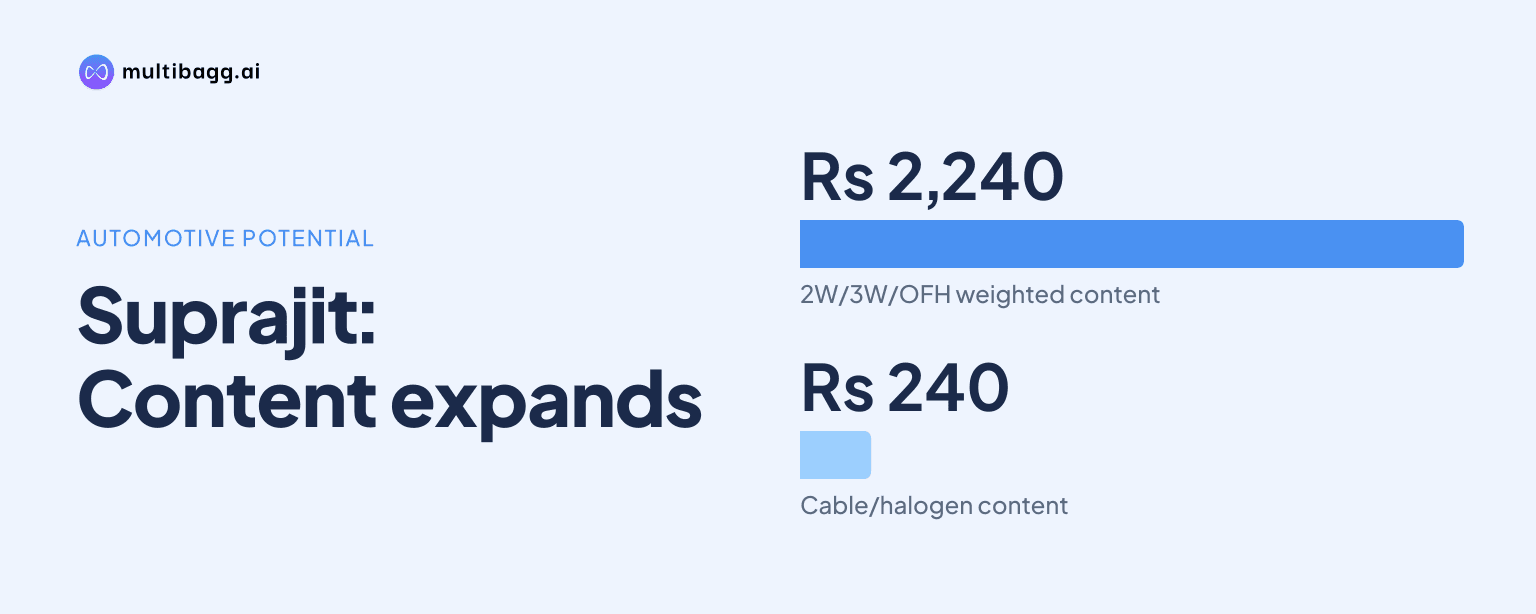
Suprajit maps weighted average content of Rs 2,240 per two-wheeler (2W), three-wheeler (3W) and off-highway vehicle (OFH), compared with Rs 240 from cables and halogen today. The presentation describes the Rs 2,000 addition from systems products as about nine times the current core content, while stating a maximum potential of Rs 8,540 per vehicle.
Know Suprajit Engineering inside out
Results, valuation, peers and who's buying, in one view.
How much content does Suprajit map per 2W, 3W and OFH vehicle?
Suprajit maps Rs 2,240 of weighted average product content per 2W, 3W and OFH vehicle, comprising Rs 240 of cables and halogen and Rs 2,000 from five additional product categories. This is a portfolio-content framework rather than reported revenue per vehicle or a contracted sales target.
The presentation separates weighted average value from the maximum content possible on a vehicle. Suprajit states total maximum content of Rs 8,540 for 2W, 3W and OFH applications, while the weighted figure is Rs 2,240. The difference reflects vehicle configuration and the stated maximum values for individual systems products.
Which products account for Suprajit’s additional Rs 2,000 content?
Suprajit assigns Rs 500 each to displays and clusters, actuators, and LED and electricals in its weighted 2W, 3W and OFH content map. These three categories together represent Rs 1,500 of the Rs 2,000 content identified beyond the Rs 240 cables-and-halogen base.
Throttles and switches add Rs 400 of weighted content, while braking systems add Rs 100. At the maximum-value level, displays and clusters, throttles and switches, and braking systems are each shown at Rs 2,000 per vehicle. Actuators have a stated maximum of Rs 1,500 and LED and electricals Rs 800.
How does Suprajit’s 2W content map compare with PV and CV?
Suprajit maps Rs 3,500 of weighted average content per passenger vehicle (PV) and commercial vehicle (CV), against a current Rs 1,100 cables-and-halogen base. This represents about three times current core content, compared with the roughly ninefold increase from Rs 240 to Rs 2,240 in 2W, 3W and OFH.
The PV and CV map includes Rs 1,500 of actuators, Rs 400 of shifter systems and Rs 500 of LED and electricals beyond the Rs 1,100 core content. Suprajit states a maximum value of Rs 5,900 per PV and CV, including Rs 2,500 for shifter systems and Rs 800 for LED and electricals. The percentage expansion is lower than in 2W, 3W and OFH because the starting core value is higher.
Got a follow-up? Ask IRIS
How is Suprajit moving from cables to technology products?
Suprajit’s roadmap begins with control cables in 1985 and includes analog clusters in 1996, halogen lamps through Phoenix in 2015, and electronic throttles through Wescon in 2016. It then lists homegrown digital clusters in 2021 and homegrown LED drop-in products in 2022.
The subsequent milestones include seat actuators through Kongsberg LDC in 2022, homegrown scooter actuators in 2024, and thin-film transistor (TFT) products and braking systems in 2025. Suprajit’s vehicle-function map describes braking, actuation and electronics as the three lines moving from traditional products toward premium systems.
What reported operating evidence supports the systems roadmap?
Suprajit reported 50.4% year-on-year revenue growth in Sensors, Electronics & Displays in Q2 FY27, or the second quarter of fiscal year 2027, to Rs 61.8 crore. The division, which includes clusters and electronic throttles, reported an earnings before interest, tax, depreciation and amortisation (EBITDA) margin of 8.4% and H1 FY27 revenue growth of 49.4%; Suprajit cited input-cost pressure and a rebuilt facility for its pipeline.
India Cables & Mechatronics reported Q2 FY27 revenue of Rs 387.7 crore, up 13.7% year on year, with a 15.3% EBITDA margin. Suprajit said original equipment manufacturer cable and beyond-cable business grew more than 20% and braking was scaling. Phoenix Lighting & Electricals reported revenue of Rs 108 crore, up 14.8%, while Global Cables & Mechatronics reported Rs 577.6 crore, up 24.3%; these results do not disclose revenue by each component of the Rs 2,240 map.
Conclusion
Suprajit’s content framework shows that the largest weighted additions in 2W, 3W and OFH come from three Rs 500 categories: displays and clusters, actuators, and LED and electricals. Throttles and switches contribute Rs 400 and braking systems Rs 100, making systems products the main source of the move beyond the Rs 240 cables-and-halogen base.
The next point to watch is whether the 2025 TFT and braking-system additions translate into broader sales conversion. Suprajit reported that braking was scaling in India Cables & Mechatronics and that its Sensors, Electronics & Displays facility had been rebuilt for the pipeline, while management forecast FY27 consolidated operational EBITDA margin of 12% to 13.5%, versus 10.4% in FY26.