










Suprajit says GCM restructuring lifted margin above 10%
Key highlights
- GCM revenue rose about 24% and EBITDA increased 69% in Q2 FY27.
- GCM EBITDA margin increased from 7.4% to above 10% in Q2 FY27.
- Suprajit reported first-half FY27 consolidated revenue of Rs 2,205 crore, up 22% year on year.
- Net debt stood at Rs 371 crore on September 30, 2026.
powered by IRIS
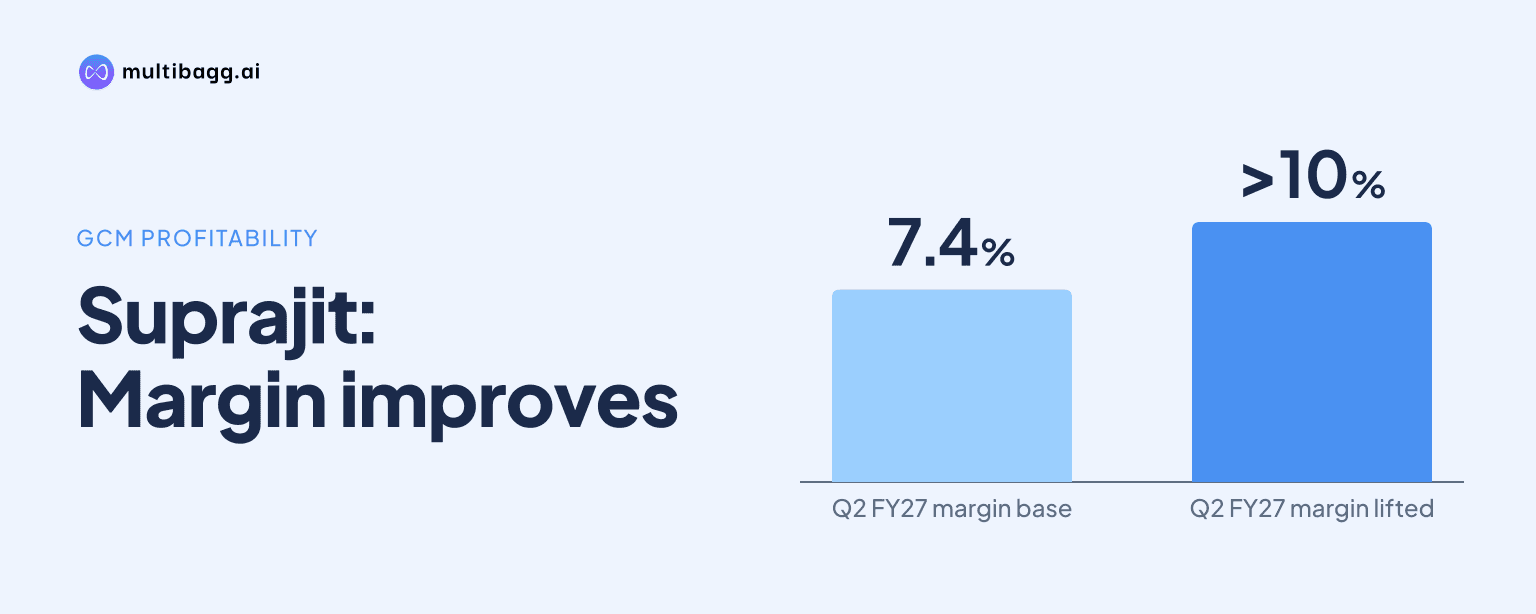
Suprajit Engineering Limited said its Global Cables and Mechatronics division completed its restructuring in Q2 FY27, as revenue rose about 24%, earnings before interest, tax, depreciation and amortisation (EBITDA) rose 69%, and EBITDA margin increased from 7.4% to above 10%. Management attributed the improvement primarily to restructuring and the production ramp-up of earlier contract wins.
Know Suprajit Engineering inside out
Results, valuation, peers and who's buying, in one view.
What changed at Suprajit’s Global Cables and Mechatronics business?
Suprajit said the main change was that restructuring at Global Cables and Mechatronics, or GCM, is now behind it. In Q2 FY27, GCM revenue increased around 24% and EBITDA increased 69%, taking the division’s EBITDA margin from 7.4% to more than 10%. Management described restructuring as the primary driver of those results.
The margin move coincided with previously won business entering operations. Suprajit said contracts secured in recent years had started flowing through production, while warehouse consolidation in Europe remained on track. Management also said it had projects under way to reduce material and logistics costs amid higher commodity prices and interest rates.
Management cautioned that GCM margin can vary quarter to quarter with product mix, seasonality and expedited freight. Asked about a sequential movement from 12% to 10%, Chairman Ajith Kumar Rai said it was not a trend and reiterated the division’s 10%-12% EBITDA margin guidance.
Is Suprajit growing despite weaker European automotive demand?
Suprajit said GCM is growing despite weak European automotive conditions because gains in the United States and China are offsetting the softer backdrop. Management called Germany and Europe a concern, but said the European business was holding steady and would still grow because new contracts exceeded the impact of lower vehicle volumes.
In the United States, management said underlying market growth was only about 1%-2%, but Suprajit had won contracts from competitors. In China, the company said the world’s largest electric-vehicle maker was increasing purchases. Of roughly 20 to 22 awarded projects with that customer, eight to nine had entered commercial production and another 10 to 12 were expected to enter production over the next year.
China remains a relatively small part of GCM, according to management, but it identified growth there as substantial. Suprajit said its global manufacturing footprint helps it compete with local cable suppliers when Chinese vehicle makers seek overseas supply chains and local content.
Management acknowledged that customers may have pulled forward some first-half orders as a precaution against freight delays. It therefore said second-half GCM growth might not match the 22%-24% first-half pace, but expected strong double-digit growth based on customer commitments visible in their SAP portals.
What does Suprajit’s wider FY27 performance show?
Suprajit reported consolidated revenue of Rs 2,205 crore for the half year ended September 30, 2026, up 22% from Rs 1,804 crore a year earlier. Consolidated operating EBITDA rose 40% to Rs 267 crore from Rs 191 crore, producing a 12.1% first-half margin that management said was within its full-year 12%-13.5% guidance range.
The business mix showed recovery beyond GCM. India Cable and Mechatronics revenue grew close to 14%, while original equipment manufacturer (OEM) and beyond-cable business grew about 20%. Its margin rose to 15.3% in Q2 from 12.8% in Q1 after pricing pressure, and management expected some further improvement in Q3.
Phoenix Lighting and Electricals, or PLE, reported revenue growth close to 15% and EBITDA growth of 30% in Q2. Its margin reached 14.4%, compared with 6.7% in Q1, helped by a ramp-up with the largest US retailer. Management said 14.4% was not necessarily sustainable in isolation and that Q1 and Q2 should be assessed together.
Suprajit Electronics Division, or SED, grew 50.4% year on year in Q2, led by digital clusters and Electronic Throttle Controls. Management said SED margins faced pressure from component-cost increases, shipping and logistics expenses, and slower-than-expected customer pricing negotiations for imported electronic parts.
Got a follow-up? Ask IRIS
What is Suprajit spending on growth and debt reduction?
Suprajit plans capital expenditure of about Rs 200 crore in FY27, of which management said about half had been completed shortly after the first half. The main projects are a greenfield cable plant in Chennai for Suprajit Automotive Private Limited, an additional SED facility, and completion of the Suprajit Technology Centre, or STC, building during the quarter.
The company reported net debt of Rs 371 crore as of September 30, 2026. Management said its payout policy was 30%-40%, with the remaining cash available for capital expenditure and debt reduction. It added that annual capital expenditure could be about 3%-4% of revenue, although it had not set the following year’s budget.
The Chennai plant supports cable-export expansion, while the enlarged SED site follows growth in clusters and throttles. Suprajit also said STC had signed a technology tie-up with a Japanese company for gear shifters, complementing its shifter-cable partnership. These investments are linked to disclosed capacity and product plans rather than a revenue target.
Can Suprajit sustain its FY27 margin outlook?
Suprajit maintained its consolidated FY27 EBITDA margin guidance of 12%-13.5% and said second-half margin could be slightly better than the 12.1% achieved in the first half. Management tied that view to GCM’s contract mix, recovery at India Cable and Mechatronics, improved PLE pricing, and continued US retailer ramp-up.
The outlook has stated limits. Management said commodity prices, the Middle East conflict, freight conditions and customer responses to input-cost volatility could affect results. GCM continues to face material and logistics inflation, while SED remains in pricing discussions with customers over volatile electronic-component costs.
For PLE, management expects full-year margin to be broadly similar to last year’s double-digit level, despite subdued Trifa sales for two to three quarters. At GCM, management’s 10%-12% range remains intact, and it said the aspiration is to move higher within that range as new business replaces older contracts with lower margins.
Conclusion
Suprajit’s first-half results show that the GCM restructuring outcome is contributing alongside recoveries in its Indian cable and PLE businesses. Consolidated operating EBITDA grew 40% to Rs 267 crore on 22% revenue growth, while the group’s 12.1% first-half EBITDA margin remained within management’s FY27 range of 12%-13.5%.
Next, investors should watch the production launch of 10 to 12 additional China projects over the next year, the US retailer ramp-up at PLE, and the outcome of SED pricing discussions. Management also plans about Rs 200 crore of FY27 capital expenditure and expects second-half margins to be slightly better than the first half, subject to commodity, freight and geopolitical conditions.