










Suprajit centralises purchasing and engineering across 13 centres
Key highlights
- Suprajit coordinates 13 Global Cables & Mechatronics operating centres across four regions.
- Europe and North Africa has 5 centres, compared with 4 in the Americas and 2 each in India and East Asia.
- Suprajit’s unified purchasing team covers 5 named commodity categories: metals, plastics, electronics, fasteners and components.
- Suprajit’s product engineering model shares work across India, China, North America and Europe.
powered by IRIS
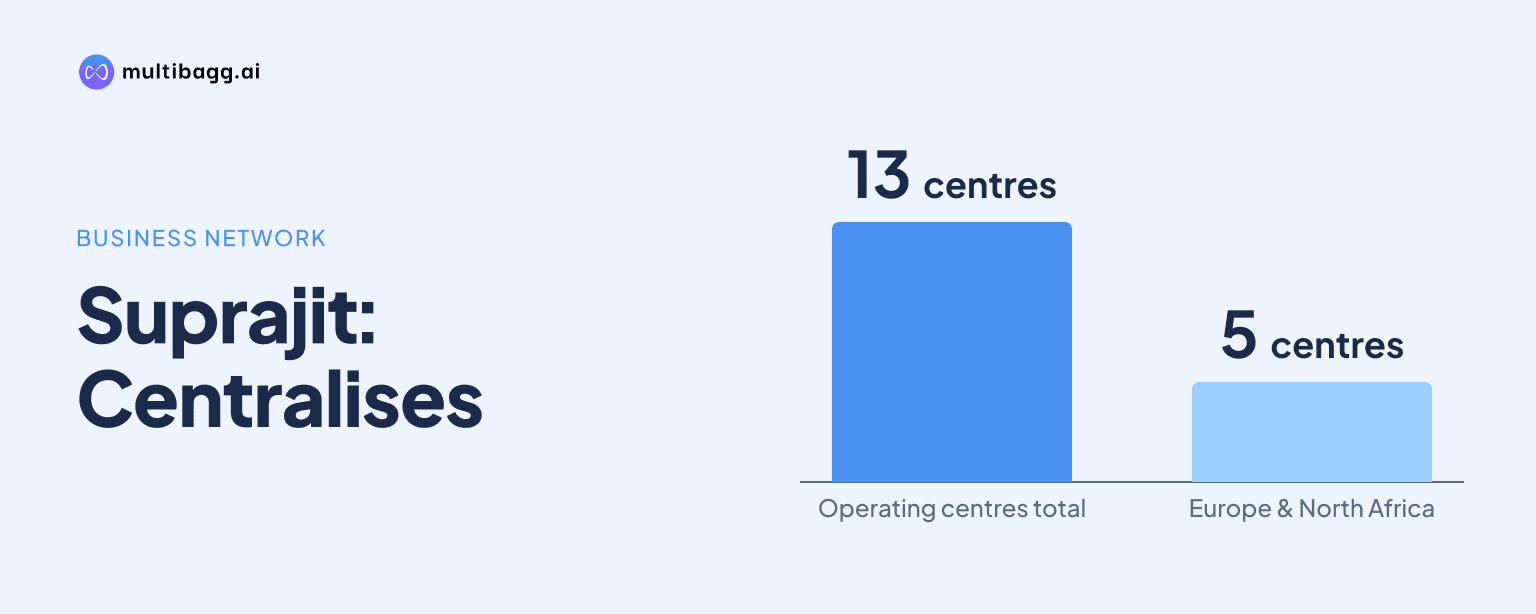
Suprajit is centralising purchasing and product engineering across 13 Global Cables & Mechatronics operating centres in four regions. The model combines global coordination with regional execution, using one contact point for global customers, a unified purchasing team and engineering work shared between India, China, North America and Europe.
Know Suprajit Engineering inside out
Results, valuation, peers and who's buying, in one view.
How is Suprajit organising its 13 global operating centres?
Suprajit is using a two-level Global Cables & Mechatronics, or GCM, structure in which global management sets strategy, drives performance and enables success, while regional operational management executes strategy and leads local operations. The 13 centres are therefore coordinated globally but run regionally, rather than being presented as independent regional businesses.
The footprint comprises five operating centres in Europe and North Africa, four in the Americas, two in China, Japan and East Asia, and two in India. Europe and North Africa is the largest cluster with five centres, one more than the Americas and three more than either India or the China, Japan and East Asia cluster.
Suprajit’s operating model has three stated mechanisms: global key-account management, global product engineering, and group-scale purchasing and engineering. Global key-account management is intended to give a global customer one point of contact across all four regions, while regional teams retain responsibility for local customer activity and operations.
A typical regional structure includes sales, engineering, purchasing, operations, quality, finance and human resources under a regional vice-president or managing director. Suprajit says functions can be added, combined or shared according to regional requirements, allowing the 13-centre network to adapt locally while retaining global coordination.
What does Suprajit’s unified purchasing team do?
Suprajit’s Global Manufacturing Purchasing Team combines global resources for mechanical and electrical manufacturing purchasing into one team. Its stated purpose is to achieve optimal material cost across five named commodity categories: metals, plastics, electronics, fasteners and components.
The purchasing programme is one of two strategic initiatives operated through eight MAX Team disciplines: sales and marketing, product engineering, purchasing, manufacturing engineering, quality, finance, human resources, and information systems and technology. The teams are focused on optimisation, standardisation, best practice, leveraged resources and strategic targets across the global business.
This mechanism is intended to apply group scale across GCM’s four regions while retaining local speed and entrepreneurship. Suprajit’s GCM road map specifically identifies global purchasing and product engineering as the means to improve supply cost, service, profit and geopolitical agility across the 13-centre footprint.
The presentation identifies inflation, currency headwinds, geopolitical turbulence involving Ukraine, the Red Sea and Iran, and the tariff landscape as GCM challenges. Against those conditions, the unified purchasing team is Suprajit’s disclosed organisational response for the five material categories, although the presentation does not provide a savings target or expected procurement-cost reduction.
Got a follow-up? Ask IRIS
How is Suprajit using India in global product engineering?
Suprajit places India at the core of its Global Product Engineering Team, which shares work with China, North America and Europe. The model is designed to use engineering capacity, capabilities across four locations and manpower-cost arbitrage to develop cables and electrical actuators.
The team’s stated markets are automotive, powersports, agriculture and construction. In automotive, GCM serves vehicle manufacturers and Tier 1 and Tier 2 customers across internal-combustion-engine and electric vehicles, with cable applications and electro-mechanical actuators forming part of its product scope.
In non-automotive markets, Suprajit identifies off-highway equipment, powersports, agriculture and construction as a diversified customer base with varied cable applications. It also identifies wins involving throttles, parking brakes and levers, and gearboxes, alongside a transition from mechanical to electrical products.
The engineering structure extends beyond cable design because GCM’s stated journey moves from acquiring Kongsberg LDC and SCS, through integration, restructuring, relocations, turnarounds and system upgrades, toward core growth and beyond-cables mechatronics and electronic products. Suprajit does not disclose an acquisition date, engineering headcount, development budget or output target for the global engineering team.
What are Suprajit’s next priorities for GCM?
Suprajit’s GCM plan has three primary product legs: cables, cable systems and beyond-cables products. Management intends to use its global cable business to expand or transition products for customer benefit, linking the existing cable base to mechatronic and electronic offerings.
For innovation, Suprajit says GCM will act as a global gateway for its technology offerings and highlights lower-force, quieter actuators. The presentation says vehicle manufacturers have shown interest in offers with global partners, but it does not name customers or disclose programme volumes, launch timing or revenue expectations.
Operationally, the plan calls for market-wide products based on proven standard design elements, low-cost locations and local service. Its return on capital employed, or ROCE, agenda is to price to protect and gain share, use economies of scale and purchasing and selling power, and pursue existing-capacity and vertical-integration opportunities.
At group level, Suprajit’s Strategy Meet 2026 set a target to beat the markets it serves by more than 10%. GCM’s contribution is planned through the 13-centre footprint and the two global MAX Team initiatives, while the wider group plan also calls for one SAP system and one analytics and artificial-intelligence platform across divisions and geographies.
Conclusion
Suprajit’s 13-centre GCM structure combines regional operating accountability with global management of customer relationships, purchasing and engineering. The change is from acquired and restructured cable businesses toward a coordinated network: five centres in Europe and North Africa, four in the Americas, and two each in East Asia and India are intended to share resources across common mechanisms.
The next issue to watch is execution of the disclosed GCM road map, particularly the Global Manufacturing Purchasing Team, India-centred engineering model, expansion from cables into cable systems and beyond-cables products, and use of existing capacity. Management’s group target is to beat served markets by more than 10%, but the presentation provides no GCM-specific timetable or financial target for purchasing savings, engineering output or margin recovery.