










Suprajit revenue grew 20.1% annually, outpacing market
Key highlights
- Suprajit reported a 20.1% FY22-FY26 revenue CAGR versus 4.7% for global vehicle production.
- Suprajit’s FY26 revenue index reached 208 versus 120 for global vehicle production, with FY22 set at 100.
- Suprajit states that its passenger-vehicle cable share is more than 10%, but below 3% in China.
- Suprajit states that its two-wheeler cable share is more than 30% and identifies Indonesia, Vietnam and Thailand as future markets.
powered by IRIS
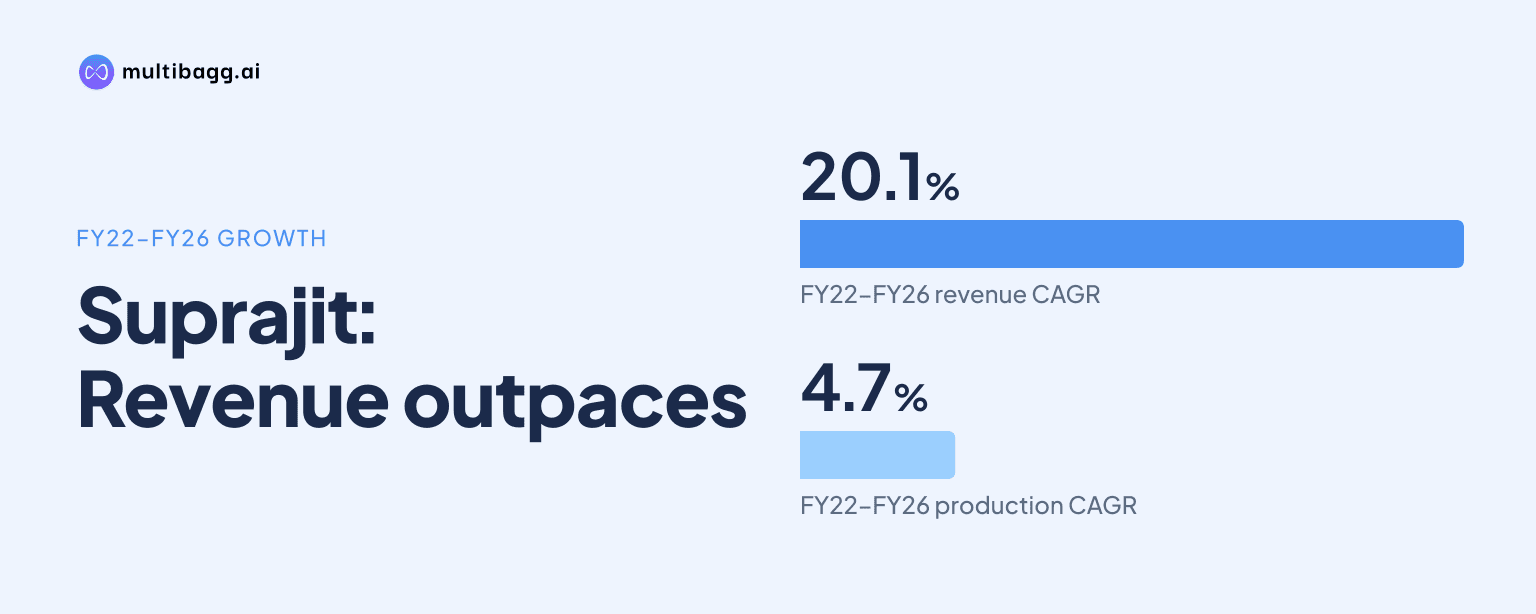
Suprajit grew consolidated revenue at a 20.1% compound annual growth rate, or CAGR, from FY22 to FY26, compared with 4.7% for global vehicle production, a 15.4-percentage-point lead. Its FY26 revenue index reached 208 from a FY22 base of 100, while the global vehicle-production index reached 120.
Know Suprajit Engineering inside out
Results, valuation, peers and who's buying, in one view.
How fast did Suprajit grow versus global vehicle production?
Suprajit grew revenue faster than the global vehicle-production benchmark during FY22 to FY26. The presentation reports a 20.1% CAGR for Suprajit consolidated revenue against 4.7% for world vehicle production, producing a 15.4-percentage-point difference over the four-year period.
The indexed comparison shows global vehicle production increasing by 20 points from FY22 to FY26, while Suprajit revenue increased by 108 points from the same base. Revenue and vehicle production are different measures, and the presentation does not quantify the respective effects of customer additions, product mix, pricing, geographical expansion or inorganic growth on the difference.
Suprajit’s strategy-meet record also shows revenue rising from Rs 1,641 crore in 2021 to Rs 2,752 crore in 2023 and Rs 3,825 crore in 2026. The record places that growth alongside the 2021 move into machine building and automation, the 2023 focus on braking products and the 2026 plan to broaden the portfolio beyond cables.
Where does Suprajit see room to expand its cable business?
Suprajit sees its largest cable-market expansion opportunities in passenger-vehicle markets where its current presence is limited. It states that its passenger-vehicle cable share is more than 10%, with strength in Europe and the North American Free Trade Agreement region, but share below 3% in China and no presence in Japan or Korea.
The company’s stated route into Japan is a partnership with Chuo Spring, which it says opens access to Japanese original-equipment manufacturers, or OEMs. Suprajit also cites near-shore plants as a mechanism to win business connected to OEM localisation and supply-resilience initiatives, though it does not disclose the related order value, customer names or implementation dates.
The position differs in two-wheeler cables, where Suprajit states its share is more than 30% and describes itself as dominant in India, the largest two-wheeler market. Indonesia, Vietnam and Thailand are identified as possible future markets, but the presentation provides no country-level sales, market-share targets or timetable for entry.
Suprajit’s competitor comparison is based on five capabilities: cable scale, low-cost research and development, global sales and engineering, actuator technology, and resilient supply options. It marks itself as present in all five areas, while describing several competitors as single-country suppliers, regional suppliers or businesses with cables outside their core focus; these are Suprajit’s assessments rather than independently reported market rankings.
How will Suprajit expand beyond cables?
Suprajit plans to grow through three legs: cables, cable systems and products beyond cables. Its 2026 strategy identifies actuators, braking, shifters, electronics and new lighting as products to be expanded across passenger vehicles, commercial vehicles and off-highway applications.
The product roadmap records control cables from 1985, analog clusters from 1996, halogen lamps from 2015 and electronic throttles from 2016. More recent additions include digital clusters in 2021, LED drop-in lighting and seat actuators in 2022, scooter actuators in 2024, and thin-film-transistor displays and braking systems in 2025.
The potential content expansion is illustrated through weighted average value per vehicle. For passenger and commercial vehicles, Suprajit shows core cables and halogen lighting at Rs 1,100 per vehicle and a broader product opportunity of Rs 3,500, with a maximum indicated value of Rs 5,900. For two-wheelers, three-wheelers and off-highway vehicles, it shows Rs 240 of current core content and Rs 2,240 of broader content, with a maximum indicated value of Rs 8,540.
The proposed expansion relies on product categories that are already listed in Suprajit’s portfolio roadmap, rather than an announced revenue forecast. The presentation does not state how much of the Rs 3,500 or Rs 2,240 weighted average content has been secured through customer programmes, making these figures an indication of potential vehicle content rather than reported sales.
Got a follow-up? Ask IRIS
What operating model supports Suprajit’s growth plan?
Suprajit says its operating model is intended to combine global scale with product engineering centred in India. Its global manufacturing purchasing team covers metals, plastics, electronics, fasteners and components, with the stated aim of achieving optimal material costs across mechanical and electrical manufacturing.
Its global product-engineering team shares work among India, China, North America and Europe to develop cables and electrical actuators for automotive, powersports, agriculture and construction applications. The model is designed to use available capacity, engineering capabilities and manpower-cost differences, although the presentation does not provide procurement savings, engineering-cost targets or capacity-utilisation data.
The 2026 strategy also calls for one SAP system and one analytics and artificial-intelligence platform across divisions and geographies. At plant level, Suprajit lists in-house machine building, automation, Internet of Things systems, total productive maintenance and digitisation, but gives no scheduled completion date or financial target for these initiatives.
Suprajit’s partner-led approach focuses on bringing technologies to market through its India scale, electronics capability and global market access. It describes itself as a global gateway for SED and STC technologies and says STC offers lower-force, quieter actuators; the presentation notes OEM interest in offers with global partners without disclosing orders, programme launches or revenue.
What does Suprajit target after FY26?
Suprajit’s overall group target is to beat the markets it serves by more than 10%. That objective follows FY22-FY26, when its reported 20.1% revenue CAGR was 15.4 percentage points above the 4.7% CAGR reported for global vehicle production.
The 2026 strategy calls for product wins in Japan, Korea, Southeast Asia and the Americas, while its operational programme focuses on manufacturing and digital systems across plants. The source does not provide a numerical revenue target by product, geography, partner or acquired business, so the more-than-10% objective is the principal disclosed group-level growth benchmark.
Conclusion
Suprajit’s FY22-FY26 performance shows consolidated revenue rising faster than global vehicle production, with a 20.1% CAGR versus 4.7%. The company’s strategy combines underpenetrated passenger-vehicle cable markets in China, Japan and Korea with a broader push into actuators, braking, shifters, electronics and lighting.
What to watch next is progress against Suprajit’s target to beat its served markets by more than 10%. The presentation points to the Chuo Spring partnership, expansion in East Asian and Southeast Asian markets, and commercialisation of beyond-cable products, but leaves order values, country-level revenue targets and launch timelines unresolved.