










Suprajit builds four beyond-core lines around vehicle content
Key highlights
- Suprajit’s ICM, PLE and SED divisions generated combined revenue of Rs 1,025 crore in H1 FY27.
- ICM reported Rs 719 crore of H1 FY27 revenue and a 14.2% EBITDA margin.
- SED reported Rs 107 crore of H1 FY27 revenue and an 8.8% EBITDA margin.
- Suprajit lists more than 40 passenger-vehicle OEM and Tier 1 customer relationships.
powered by IRIS
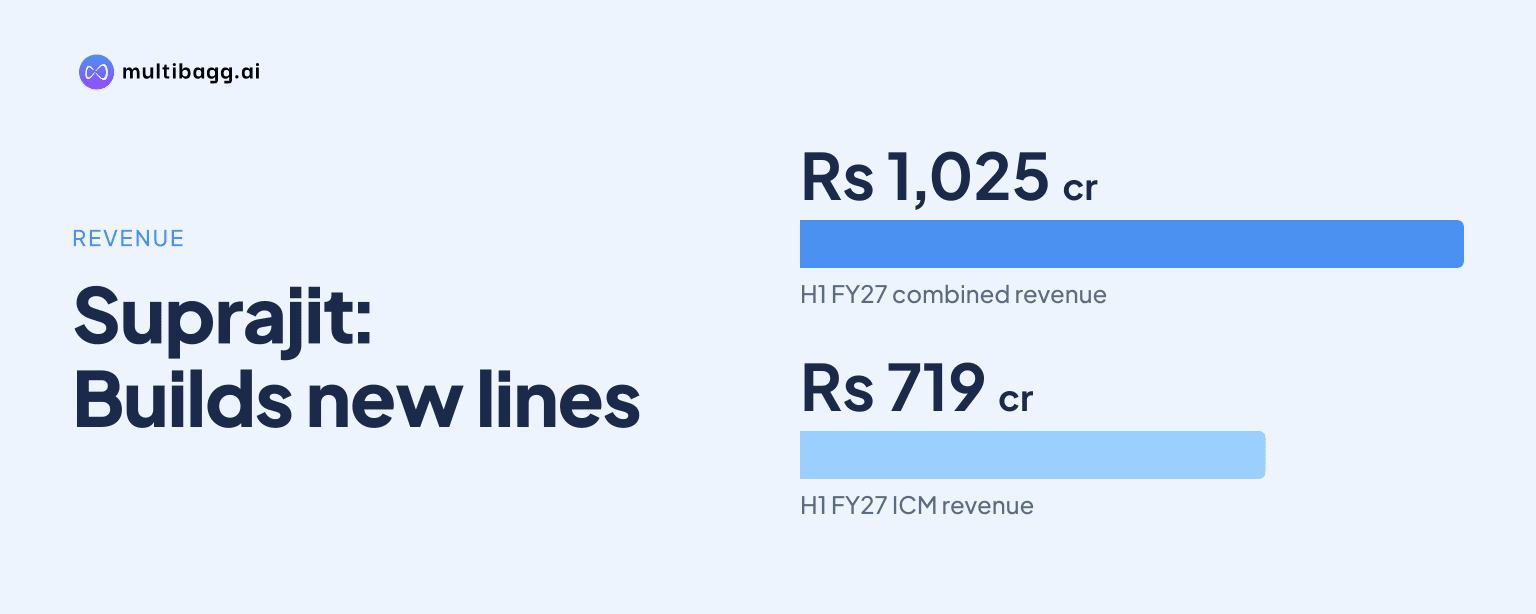
Suprajit Engineering Limited is building four beyond-core product lines in braking, digital clusters and sensors, electro-mechanical actuation, and lighting and electricals. The company is using the Suprajit Technology Center and existing manufacturing divisions for the expansion, while its ICM, PLE and SED divisions generated combined revenue of Rs 1,025 crore in H1 FY27.
Know Suprajit Engineering inside out
Results, valuation, peers and who's buying, in one view.
What are Suprajit’s four beyond-core product lines?
Suprajit’s four stated beyond-core lines are braking and brake release, digital clusters and sensors, electro-mechanical actuation, and lighting and electricals. The company says it is evolving its core portfolio towards industry needs and increasing content per vehicle through capabilities it already has, rather than identifying a separate fifth operating division.
The braking range includes drum, mechanical and hydraulic braking and brake-release systems developed by the Suprajit Technology Center, or STC, in Bengaluru. Digital products include thin-film transistor, or TFT, clusters, PMVA colour liquid-crystal displays, LCD-plus-stepper screens, electronic throttles and position sensors. Actuation covers mechanical, motor-based and solenoid-based latches and actuators, while the lighting range includes LED, fog and driving lamps and horns.
STC provides shared research and development, intellectual property and new products to all four divisions, and Suprajit identifies India as a proving ground for multiple STC products. ICM has 12 plants in India, PLE has three India plants, and SED has one India plant, giving the four product categories established production bases.
How large are Suprajit’s divisions behind these products?
Suprajit’s ICM, PLE and SED divisions reported combined revenue of Rs 1,025 crore in H1 FY27, compared with Rs 1,180 crore for GCM. India Cables & Mechatronics, or ICM, was the largest of the three India Operations divisions at Rs 719 crore, while its listed activities include cables, latches and braking.
SED, which makes clusters, throttles, sensors and actuators, was smaller than ICM and PLE in H1 FY27. It represented 4.9% of group revenue and reported an earnings before interest, tax, depreciation and amortisation, or EBITDA, margin of 8.8%, compared with ICM’s 32.6% revenue share and 14.2% margin. The presentation separately identifies SED electronics industrialisation as a company highlight.
PLE provides the operational base for LED lamps, auxiliary lamps and horns, reporting Rs 199 crore in H1 FY27 revenue. Suprajit says its LED offering builds on its number-two global position in halogen lamps, but it does not disclose separate revenue, programme volumes or margins for LED lamps, auxiliary lamps or horns.
Which digital products does Suprajit have in production?
Suprajit lists digital clusters, throttle systems and sensor products in production through SED in India. The portfolio includes TFT displays, PMVA colour LCDs, LCD-plus-stepper-motor screens, throttle-position sensors with switch cubes, rotary sensors for thumb or foot throttles, and electronic foot throttles.
The named production customers include Ultraviolet Automotive, MTD, Escorts, VST Tillers Tractors, Bad Boy, Toro, John Deere, TVS, Mahindra Last Mile Mobility, Ampere and Ola Electric. This customer list covers two-wheelers, electric vehicles, agricultural equipment and off-highway equipment, rather than only passenger vehicles.
SED’s Rs 107 crore H1 FY27 revenue is the reported scale for the electronics division, but Suprajit does not split the figure between clusters, throttles, sensors and actuators. The company’s market discussion records about 3.5 million electric-vehicle registrations in FY26, while also noting that e-two-wheeler penetration fell from 6.7% to 5.5% amid the GST 2.0 backdrop.
Got a follow-up? Ask IRIS
What braking and actuation systems does Suprajit make?
Suprajit makes mechanical, motor-based and solenoid-based actuation systems, including seat tumble-and-fold actuators for four-wheelers, seat-latch actuators for two-wheelers, fuel-lid actuators, headrest-fold actuators, electro-mechanical clutches, charging-gun locks and steering-lock actuators. These systems are manufactured in India, Mexico, China and Hungary.
The production customer list for actuation includes Mercedes-Benz, Volvo, Ford, GM, Jaguar, Land Rover, TVS, Honda, Ather and Ola Electric. The product mix therefore includes passenger-vehicle mechanisms such as fuel-lid and seat systems, alongside electric-vehicle charging-gun locks and two-wheeler applications.
Suprajit’s braking range includes levers and combined braking systems, anti-lock braking systems, railway and metro brake-release systems, friction materials such as brake shoes and pads, and parking-brake systems. It identifies Bybrake as its anti-lock braking system partner and names Kubota, Alstom, Bombardier, John Deere, TVS, Honda, Ather, Ola Electric and Ampere as customers in production.
Braking products are manufactured through ICM and GCM operations in India and the United States. ICM reported Rs 719 crore in H1 FY27 revenue and a 14.2% EBITDA margin, while GCM reported Rs 1,180 crore and an 11.4% margin. Suprajit does not disclose braking revenue separately from cables, latches and other mechatronics products.
How is Suprajit developing the four product lines?
Suprajit is using STC for premium products and systems across cables, electronics, electro-mechanical products and brakes. Its organisation structure assigns the chief technology officer responsibility for those four technology areas, matching the stated beyond-core product categories.
India Operations oversees ICM, PLE and SED, while Global Operations covers the Americas, Europe, China and India. This structure places India-made electronics, lighting and ICM braking activities within the product divisions, while actuation production spans four countries and brake manufacturing also includes the United States.
Suprajit also lists more than 40 passenger-vehicle original equipment manufacturers, or OEMs, and Tier 1 suppliers, more than 10 two-wheeler OEMs and Tier 1 suppliers, more than 20 off-highway OEMs and Tier 1 suppliers, and more than 15 lighting Tier 1 customers. The company says the customer list is not exhaustive, so these figures represent its stated customer-code coverage rather than active programme counts.
Conclusion
Suprajit’s plan is to add vehicle content through four adjacent product lines while retaining cables and mechatronics as the largest part of its reported business. H1 FY27 data place ICM at Rs 719 crore, PLE at Rs 199 crore and SED at Rs 107 crore, with SED providing the direct organisational platform for clusters, throttles and sensors.
The next disclosures to watch are further SED industrialisation and any product-specific information on braking, lighting or STC-developed systems in India. Suprajit also identifies technology changes, raw-material volatility and supply-chain disruptions as operating issues, while CAFE-III norms are scheduled to apply from April 2027.