










Protean shifts BFSI sales to bundled onboarding journeys
Key highlights
- Protean signed more than 20 adjacent BFSI mandates and has more than 30 opportunities in its immediate pipeline.
- Protean's Identity Services revenue rose 24% year on year to Rs 27 crore in Q2FY27, while volumes increased 26%.
- RISE with Protean processed 3.3 crore API transactions in Q2FY27.
- eSignPro signed more than 25 enterprise customers in its first quarter of full monetisation.
powered by IRIS
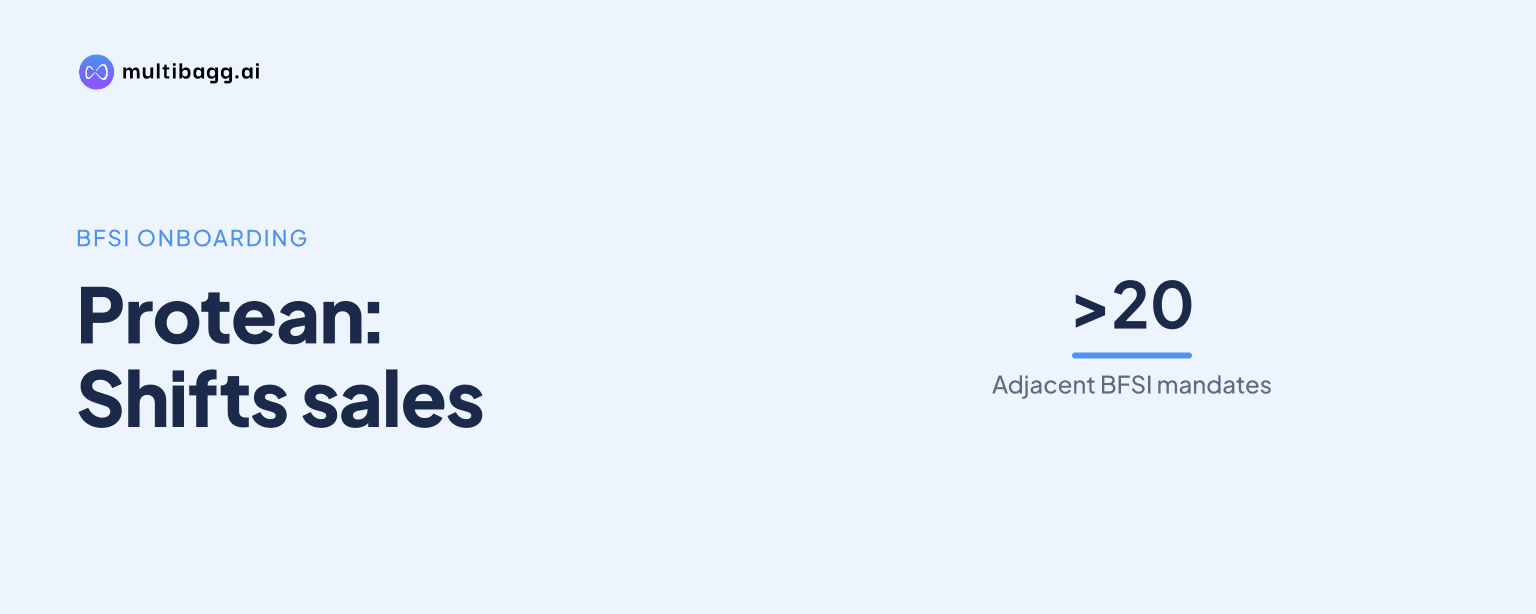
In Q2FY27, Protean eGov Technologies Limited said it had signed more than 20 banking, financial services and insurance, or BFSI, mandates for bundled onboarding and compliance workflows, with more than 30 opportunities in its immediate pipeline. The strategy follows 24% year-on-year Identity Services revenue growth to Rs 27 crore and shifts enterprise sales from individual application programming interfaces, or APIs, to integrated customer journeys.
Know Protean eGov Technologies inside out
Results, valuation, peers and who's buying, in one view.
How is Protean changing its BFSI sales model?
Protean is changing its enterprise model from selling standalone APIs to selling an integrated journey from customer application to activation. In Q2FY27, management said individual offerings such as Permanent Account Number, or PAN, verification, electronic know-your-customer, or eKYC, Aadhaar authentication and eSign had historically been separately integrated and priced per API call.
The revised proposition combines identity, verification, consent, data analytics, customer personalisation, credit analysis, documentation, continuing compliance and servicing in one configured flow. Protean said the commercial model is intended to move from pricing per API call to pricing per journey and outcome, while its components remain configurable for different BFSI products.
For a bank, management said the previous approach could involve separate providers for eKYC, document verification, fraud and anti-money-laundering checks, bank-statement analysis, account aggregation, e-signing, e-stamping and Central KYC reporting. Protean’s proposed alternative is one contract and one integration, rather than a multiple-vendor, multi-month integration programme.
Management said embedding the journey in a client’s origination system is expected to deepen customer relationships and increase the share of each client’s spending captured by Protean. This is management’s strategy rather than a disclosed financial forecast: the company did not provide contract values, pricing, implementation schedules or conversion rates for the 20-plus signed mandates.
What does Protean's bundled onboarding journey include?
Protean’s retail-lending example begins with a borrower applying through a lender’s app, where its Central KYC, or CKYC, solution and Aadhaar authentication establish identity. With customer consent, Account Aggregator services can pull bank statements, which Protean’s analyser converts into income and cash-flow information for underwriting.
The documentation stage uses eSignPro, Protean’s digital documentation suite. Management said a lender can generate sanction letters and loan agreements from templates, apply the appropriate state electronic stamp and use Aadhaar-based eSign before disbursal, bringing identity, underwriting inputs and execution into a single workflow.
Protean said the same set of components can be configured for digital lending, insurance, wealth products, investments, small and medium enterprise onboarding, and current-account and savings-account, or CASA, opening. This indicates potential applications across BFSI, but management did not quantify the addressable market or identify revenue from each product category in Q2FY27.
The operating evidence cited for this approach was Identity Services, where Q2FY27 revenue rose 24% year on year to Rs 27 crore and combined volumes across four digital-identity services increased 26%. Management linked the volume increase to customers adopting an integrated suite rather than only standalone identity products.
Why does CKYCRR 2.0 matter to Protean's BFSI strategy?
CKYCRR 2.0 matters because Protean is modernising a financial-identity registry while offering the APIs and connections that regulated entities will use to access it. Management said the mandate supports a model in which KYC is completed once, with consent, and then used across financial interactions.
Protean said nearly 9,000 regulated entities, or REs, will need to connect to the modernised registry to search, download, report and build compliant onboarding journeys. The company said it has built API on-ramps that can be bundled with its wider enterprise stack, creating a potential recurring opportunity beyond the fee-based registry mandate.
The company described the on-ramps as an annuity opportunity across thousands of REs, but did not disclose fees per connection, expected revenue per entity or a timetable for commercial adoption. The 20-plus signed mandates and 30-plus immediate pipeline relate to adjacent value-added BFSI offerings, rather than disclosed CKYCRR 2.0 on-ramp revenue.
CKYCRR 2.0 was one of two large request-for-proposal, or RFP, projects that management said were nearing implementation completion in Q2FY27. The other was the Aadhaar Seva Kendra, or ASK, project, and management said both required substantial upfront capital and employee bandwidth before associated revenue scaled.
Got a follow-up? Ask IRIS
What evidence supports Protean's bundled enterprise strategy?
Protean said customer activity is visible across APIs, identity and documentation products. RISE with Protean, its API stack, processed 3.3 crore transactions in Q2FY27, while eSignPro signed more than 25 enterprise customers in its first quarter of full monetisation, including BFSI and telecom companies.
These measures show adoption of the building blocks Protean plans to combine, but they do not establish the value or duration of enterprise contracts. Management cited more than 20 signed BFSI mandates and a 30-plus immediate pipeline as early evidence, without providing bookings, annual contract value or renewal data.
New Initiatives also increased their contribution to the group’s revenue mix, reaching 16% of revenue in H1FY27 from 12% in H1FY26 and growing 56% year on year. The chief financial officer said this revenue is project-led and can be recognised in a single quarter, making quarter-to-quarter comparisons potentially uneven.
At the group level, Q2FY27 revenue from operations was Rs 271 crore, up 8% both year on year and sequentially. Tax Services grew 13% year on year to Rs 121 crore, while CRA Services, comprising largely annuity revenue, grew 2% to Rs 80 crore amid regulatory pricing changes.
How are project costs affecting Protean's margins and execution?
Protean reported Q2FY27 earnings before interest, tax, depreciation and amortisation, or EBITDA, of Rs 43 crore, compared with Rs 44 crore in Q2FY26, for a 15% margin. Management said the reported result included Rs 10 crore of upfront investment in strategic RFP projects; excluding this amount, EBITDA would have been Rs 53 crore and margin 18%.
For H1FY27, reported EBITDA was Rs 71 crore versus Rs 89 crore in H1FY26, reflecting Rs 28 crore of upfront project spending and cost inflation. Excluding those costs, management said H1FY27 EBITDA was Rs 99 crore, up 12% year on year, with an 18% margin.
The ASK rollout is a key factor in management’s margin outlook. By September 2026, 150 ASK centres were open, and by October 2026, 187 of the mandated 192 centres were live; management expects ASK revenue to exceed related costs over the next couple of quarters as transaction volumes increase.
Protean had zero debt and approximately Rs 750 crore of cash and marketable securities as of September 30, 2026. Property, plant and equipment rose to Rs 150 crore in September 2026 from Rs 63 crore in March 2026 because of ASK investment, while days sales outstanding increased to 93 days from 64 days, mainly due to project receivables.
Conclusion
Protean’s BFSI plan is to use its identity, consent, analytics, registry and digital-documentation products as a combined onboarding and compliance workflow rather than as separately sold APIs. The early evidence is 20-plus signed mandates, a 30-plus immediate pipeline, 3.3 crore RISE transactions and 24% growth in Identity Services revenue to Rs 27 crore in Q2FY27.
Next, investors should watch whether the signed mandates and immediate pipeline become recurring enterprise revenue, particularly as CKYCRR 2.0 connections are required by nearly 9,000 REs. Management also expects the ASK network, with 187 of 192 centres live by October 2026, to move to revenue exceeding cost over the next couple of quarters.