










Prudent says proposed rules put 12% of profit at risk
Key highlights
- Prudent said insurance contributes roughly 12% of profit and could be directly affected if the draft rules are adopted unchanged.
- The proposal cited by Prudent sets health-policy renewal commission at 10% for IDAs and 5% for IDEs.
- Prudent’s insurance revenue rose 35% sequentially in Q2 FY27, with fresh general-insurance premium up 54%.
- More than 90% of Prudent’s mutual-fund distributors and insurance POSPs overlap at a family level, management said.
powered by IRIS
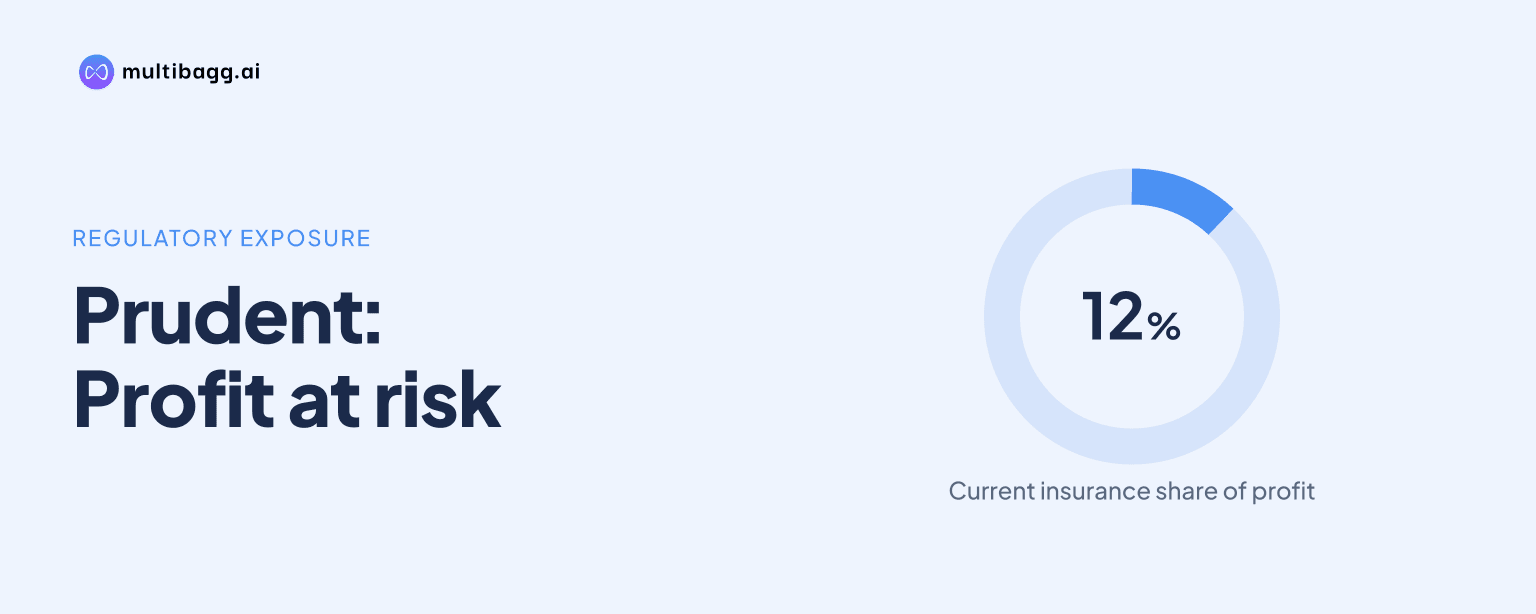
In its October 29, 2026 Q2 FY27 earnings call, Prudent Corporate Advisory Services Limited said insurance contributes roughly 12% of profit and could face a direct impact if proposed distribution rules are adopted unchanged, including a 5% health-insurance renewal commission for entities versus 10% for individual agents.
Know Prudent Corporate Advisory Services inside out
Results, valuation, peers and who's buying, in one view.
What would the draft insurance rules mean for Prudent?
Prudent said the proposal could directly affect roughly 12% of its profit contribution from insurance if it takes effect exactly as drafted, an outcome management called “very unlikely.” The consultation paper separates independent distribution agents, or IDAs, from independent distribution entities, or IDEs. Prudent falls in the IDE category, alongside corporate agents and insurance brokers, while individual agents would be classified as IDAs.
The central difference is the proposed renewal commission for health insurance. Under management’s example, an IDA would receive 10% while an IDE such as Prudent would receive 5% for the same renewal business. Prudent said that a 50% lower commission would make the point-of-sale person, or POSP, model difficult to sustain because it must fund claims support, technology, customer servicing and payments to POSPs from its commission income.
Prudent did not say the entire 12% profit contribution would disappear immediately. Management said its renewal book would continue while agents decide whether to surrender one of their health-insurance licences or work through an IDE to access products from multiple insurers. It also said the final revenue effect would depend on how customers, POSPs and insurers respond after any final rules are issued.
Why does Prudent expect the final rules to change?
Prudent expects a workable middle ground because industry associations and the company have made representations seeking at least a level playing field with individual agents. Management said the regulator has been receptive to data on persistence, claims management, technology and servicing costs, rather than having reached an inflexible final position. The company did not provide a date for a final regulation.
Management cited life-insurance 60-month persistency of about 85% to 86%, compared with a 48% headline figure it said the regulator had considered. Prudent’s argument is that an IDE performs continuing service beyond selling a policy, including administration and claims support, and therefore needs a commission at least similar to, or somewhat higher than, an individual agent’s rate to cover those functions and share income with POSPs.
The company also pointed to an access difference in the draft framework. Management said an individual agent currently can work with one general insurer and one standalone health insurer, but may have to surrender one licence for health insurance if the proposal is implemented as described. Prudent believes customers seeking multiple insurer choices could therefore still require an IDE, although management acknowledged that higher volume might not fully offset lower commission rates.
Got a follow-up? Ask IRIS
Can Prudent reduce the earnings effect if commissions are cut?
Prudent can pass lower renewal receipts through to POSPs because renewal contracts are reset annually, management said. If health-policy renewal commissions decline from April under a new regime, the company said its payable commission to POSPs would also change, though its absolute margin would still be affected. That mechanism limits a mismatch between what Prudent receives and what it pays, rather than eliminating the reduction in revenue.
The company also has substantial overlap between its mutual-fund distributors and insurance POSPs. Management estimated that more than 90% overlap at a family level, and said it generally recruits distributors for mutual funds before adding insurance. This overlap supports its view that partners facing lower insurance income could be used productively in mutual funds, though management gave no quantified estimate of the resulting revenue or profit offset.
Prudent said it has around 700 sales employees, a pan-India branch network and a technology platform that could help insurance agents add mutual-fund distribution as a second income stream. Management’s view is that pressure across the insurance channel could prompt agents to seek complementary products. It also said regional leadership time currently devoted to insurance could be redeployed to mutual funds, where it already has scale.
How material is insurance within Prudent’s current operating growth?
Insurance was a fast-growing part of Prudent’s Q2 FY27 revenue mix before the proposed rule risk. Insurance revenue rose 35% sequentially, supported by 54% growth in fresh general-insurance premium and 37% growth in fresh life-insurance premium. Year on year, fresh life premium rose 45% and fresh general-insurance premium increased 62%, showing that the regulatory issue concerns a growing business rather than a shrinking one.
The wider operating result was also ahead of reported profit growth. Revenue from operations increased 11.8% sequentially and operating profit rose 15.4%, lifting operating margin by 80 basis points to 26.4%. Reported profit after tax, however, fell 4.1% sequentially to Rs 71.7 crore because other income declined about 82%, from Rs 20.8 crore in the prior quarter to Rs 3.8 crore, after mark-to-market movements in the treasury portfolio.
For the first half of FY27, Prudent reported revenue from operations of Rs 736 crore, up 20% year on year, and operating profit of Rs 192 crore, up 37.6%. Operating margin reached 26.1% versus 22.7% a year earlier, while profit after tax rose 39.1% to Rs 146.5 crore. These figures place the potential insurance exposure alongside a larger mutual-fund-led operating base, but they do not quantify how much of the 12% contribution could ultimately be retained.
Conclusion
Prudent has identified a specific regulatory downside: a draft 5% health-insurance renewal rate for IDEs compared with 10% for IDAs could affect the insurance business that contributes roughly 12% of profit. Management nevertheless argues that service requirements, product choice and its more than 90% family-level overlap between POSPs and mutual-fund distributors may preserve part of the business and create cross-selling opportunities.
The next issue to watch is the final insurance-distribution framework and whether it narrows the proposed commission gap, which management has not quantified as a final outcome. Separately, Prudent is applying for a mutual-fund portfolio-management-services licence through its renamed subsidiary, Prudent Asset Management Private Limited, with the framework expected to become operational from April 2027.