










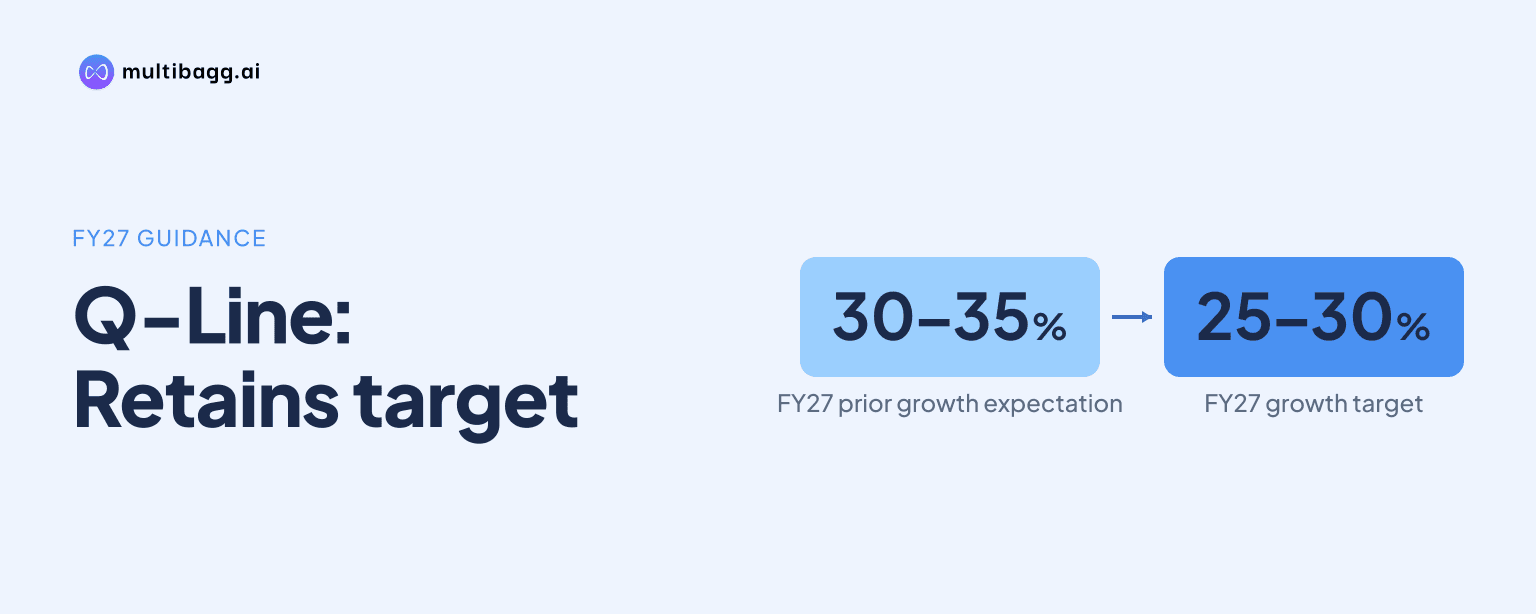
Q-Line retains FY27 25%-30% target despite 5.83% H1 growth
Key highlights
- H1 FY27 revenue increased 5.83% to Rs 152 crore from Rs 143 crore in H1 FY26.
- Q-Line management retained its 25%-30% FY27 growth expectation after previously discussing 30%-35% growth.
- H1 FY27 EBITDA margin rose to 26.0% from 25.1%, while gross margin increased to 62.2% from 57.7%.
- Instrument revenue declined 29%, while reagent revenue grew 19.23% and trade-market business increased 20.13%.
powered by IRIS
Q-line Biotech Limited retained management’s 25%-30% year-on-year FY27 growth target after H1 FY27 revenue rose 5.83% to Rs 152 crore, versus Rs 143 crore a year earlier. Management expects delayed government instrument installations, a seasonally larger H2, new products and a €2.3 million European instrument order to support the second half.
Know Q-Line Biotech inside out
Results, valuation, peers and who's buying, in one view.
What is Q-Line’s FY27 growth outlook?
Q-Line’s current FY27 outlook is 25%-30% year-on-year growth, according to management, compared with the 30%-35% range discussed in the previous earnings call. The revised expectation follows H1 FY27 revenue growth of 5.83% to Rs 152 crore, a pace below the growth rate implied by the earlier range.
Management also said it currently intends to maintain a similar 25%-30% growth range for FY28. It cited new reagent products, molecular diagnostics, semi-knocked-down, or SKD, instrument assembly and technology transfers, while noting that certifications and global-market entry for instruments take time.
The expectation relies on a substantially better second half. Management said H2 has historically represented about 60%-70% of Q-Line’s full-year revenue and that Q3 and Q4 are generally stronger for its business because government budgets are more active later in the financial year. Product launches that did not occur in H1 have also shifted into H2.
Why did Q-Line’s H1 FY27 growth remain limited?
Delayed execution of government instrument orders was the principal reason for slower H1 FY27 growth, management said. Instrument revenue declined 29% because certain government orders could not be installed on time owing to consignee-related delays, although management said the orders were in hand and instruments were ready.
Government installations have been a material part of Q-Line’s instrument business. Management said such installations generated approximately Rs 50 crore to Rs 60 crore of revenue annually in each of FY24-25 and FY25-26. It is working with consignee institutions to improve execution, but did not disclose a completion date for the delayed orders.
Other lines grew despite the instrument setback. Reagent revenue rose 19.23% in H1 FY27 and trade-market business increased 20.13%, while management described government business overall as broadly stable year on year. The contrast indicates that recurring reagent demand and trade activity increased while project-linked instrument deliveries constrained total revenue growth.
How did Q-Line’s margins rise while profit after tax declined?
Q-Line increased earnings before interest, tax, depreciation and amortisation, or EBITDA, by 10.02% to Rs 39.57 crore in H1 FY27 from Rs 35.97 crore in H1 FY26. EBITDA margin rose to 26.0% from 25.1%, and gross margin increased to 62.2% from 57.7%.
Management attributed the gross-margin change to a higher reagent mix. Reagents accounted for 71% of sales in H1 FY27, compared with 63% in H1 FY26, alongside 19.23% growth in the reagent business. This product mix supported margins even as instrument revenue fell 29%.
Profit after tax nevertheless declined to Rs 19.60 crore from Rs 21.32 crore. Management said depreciation rose to Rs 7.89 crore from Rs 4.09 crore after the Unit 4 facility was capitalised in Q4 FY26, while H1 FY26 included a Rs 1.95 crore one-time tax writeback that did not recur in H1 FY27.
Got a follow-up? Ask IRIS
Can product launches and exports support Q-Line’s H2 plan?
Q-Line expects newly commercialised products and its contract development and manufacturing organisation, or CDMO, programme to contribute in H2 FY27, although revenue timing depends on approvals, customer adoption and logistics. Microlab 300, a semi-automated analyser, was commercialised in October, and management said Q-Line had sold a few units in India.
The company also received approvals for its haemoglobin meter and said commercial invoicing was planned by the end of the month of the call. Its portfolio additions include hepatitis B virus, hepatitis C virus and HIV molecular kits; a combined HIV, hepatitis B surface antigen and hepatitis C virus test; eight to 10 enzyme-linked immunosorbent assay and rapid-test assays; and a high-throughput haematology analyser.
For exports, Q-Line disclosed confirmation of a €2.3 million import order from its European principal for Selectra Pro M fully automated analysers and Microlab 300 semi-automated analysers. Management said the instruments would be manufactured under technical-collaboration arrangements, but added that regulatory documentation and country-specific certifications can delay export execution.
Management had targeted nearly fivefold growth in export revenue during FY27. However, it said geopolitical conditions in West Asia had created supply-chain and logistics challenges that could slow the planned expansion, making the €2.3 million order a disclosed order rather than confirmation of the export-growth target.
What should investors expect from Q-Line’s Unit 4?
Q-Line expects Unit 4 in Lucknow to become fully operational during H2 FY27 and support manufacturing of reagents, testing kits and instruments. Management said product licences at the facility had increased from nine as of September 30 to almost 36 at the time of the call, with further licences under approval.
Management said five to six products had been manufactured at the facility for about four months and that around 30 additional products would be added from the current month. It expects monthly kit production to increase from about 8,000-10,000 kits to 35,000-40,000 kits, while using about 25%-30% of Plant A and Plant B capacity by March 27.
Management said Unit 4 could generate at least Rs 150 crore to Rs 160 crore of business in FY27, but clarified that this would not all be incremental. Products currently made at the older Bawana plant are transitioning to Unit 4 as licences are received, while molecular diagnostics, rapid-test original equipment manufacturing and reagent CDMO are additional planned initiatives.
Conclusion
Q-Line’s retained 25%-30% FY27 target depends on a marked H2 acceleration after H1 revenue rose 5.83%. Reagent and trade-market growth of 19.23% and 20.13%, respectively, supported a 99-basis-point improvement in EBITDA margin, while a 29% decline in instrument revenue exposed the effect of delayed government installations.
Investors should watch whether delayed government orders are installed, whether Unit 4 reaches the stated 25%-30% capacity use by March 27, and whether the €2.3 million European order converts into revenue. Management also plans to launch chemiluminescence products in the last quarter of FY27, subject to the disclosed commercial and regulatory execution process.