










Q-Line sees Unit 4 handle Rs 250 crore reagents by FY28
Key highlights
- Q-Line expects almost Rs 250 crore of reagent business to be conducted from Unit 4 in FY28.
- Q-Line said Unit 4's annual output could reach Rs 250 crore to Rs 300 crore with Class C and Class D licences.
- Q-Line reported prior-year reagent revenue of Rs 232 crore, including about Rs 60 crore of haematology reagents.
- Management expects almost Rs 4 crore to Rs 5 crore of second-half interest-cost savings after loan repayments.
powered by IRIS
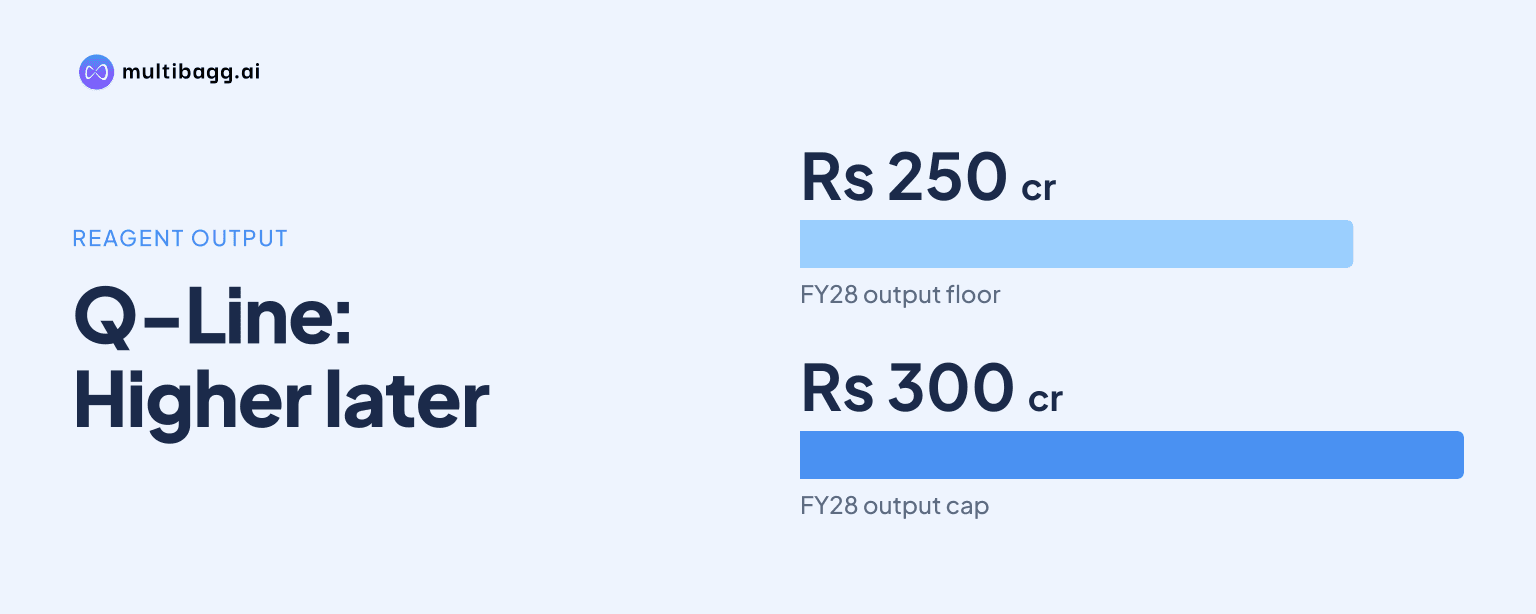
Q-Line said Unit 4 could conduct about Rs 250 crore of reagent business in FY28 and could reach Rs 250 crore to Rs 300 crore of annual output if it receives Class C and Class D licences. Management expects most reagent revenue to move to the facility by FY28 after it was capitalised in Q4 FY26.
Know Q-Line Biotech inside out
Results, valuation, peers and who's buying, in one view.
How much reagent business can Unit 4 handle by FY28?
Q-Line expects Unit 4 to undertake almost Rs 250 crore of reagent business in FY28. Management said most of the group's reagent revenue would shift to the facility by then, combining existing products with new launches. It separately said FY28 manufacturing would exceed Rs 120 crore at a minimum before considering Class C and Class D licences.
The upper potential is Rs 250 crore to Rs 300 crore annually, but management tied that range to receiving the two higher-class product licences. The Rs 250 crore statement is also close to Q-Line's prior-year total reagent revenue of Rs 232 crore, indicating that Unit 4 is intended to become the principal location for the existing reagent portfolio as well as incremental products.
Management used both manufacturing and reagent-business measures in its answers, so the figures should not be read as identical accounting definitions. Its clearest operational comment was that almost Rs 250 crore of reagent business would be undertaken from Unit 4 in FY28, while the Rs 300 crore endpoint remains dependent on licensing.
What licences must Q-Line receive for the higher output range?
Q-Line needs Class C and Class D licences to access the stated Rs 250 crore to Rs 300 crore annual output potential. Management said Unit 4 would be able to manufacture all Class B products in FY26, with annual Class B manufacturing of about Rs 100 crore and about Rs 55 crore expected by 31 March.
For non-critical, non-infectious Class B products, management said a licence can take about 90 to 120 days when production is ready. It said critical parameters, including tuberculosis and cancer markers, may require testing at government laboratories and could take about four to six months. Q-Line did not give an expected approval date for Class C or Class D products.
Licensing is therefore the main disclosed execution variable between the minimum FY28 manufacturing indication of more than Rs 120 crore and the larger annual output range. Management also said some molecular tests need sensitive samples for validation, which can add complexity before products such as cancer-marker tests are commercialised.
Which reagent lines are expected to move to Unit 4?
Q-Line said its prior-year reagent revenue of Rs 232 crore included about Rs 60 crore of haematology reagents and about Rs 180 crore of clinical chemistry reagents. Management said this existing portfolio, along with new products, would support almost Rs 250 crore of Unit 4 reagent business in FY28.
Clinical chemistry is the larger disclosed current category, based on management's approximate revenue split. Q-Line said all fine chemicals for haematology reagents are sourced in India, while around 60% of clinical chemistry inputs by value, including chemical salts and solvents, are sourced domestically. Enzymes, substrates, cellulose and proteins were identified as imported critical inputs.
Management said it has developed four products in-house using critical raw materials and has started testing them. It did not disclose a target date or target percentage for local sourcing. At present, Q-Line said 60% to 65% of critical components by rupee value are imported, with the remainder sourced in India.
Got a follow-up? Ask IRIS
How does Unit 4 fit Q-Line's reagent-led commercial strategy?
Unit 4 supports Q-Line's plan to use instruments to generate repeat demand for reagents. Management said instrument sales can generate about 5% to 10% profit in some cases, whereas domestically produced reagents can retain around three to four times the profit. It identified reagent sales, rather than hardware sales, as the primary commercial objective.
For larger laboratory accounts, Q-Line said it may place instruments under agreements linked to reagent commitments. Management cited an illustrative monthly reagent commitment of about Rs 2 lakh per account and named the Astira CX400, an autoloader haematology five-part analyser and high-performance liquid chromatography systems as equipment that can support higher-workload accounts.
Management's longer-term aim is for reagents to contribute 65% to 70% of business. It said government dependence was about 55% to 60% currently, while the government-to-non-government mix was nearly 50-50. By March 2027, management expects a 40-60 mix if contract development and manufacturing organisation, or CDMO, orders, exports and trade business rise as planned.
Existing government contracts will continue to provide reagent demand during that shift. Management said Q-Line made about 1,500 to 2,000 government installations in the prior year and remains bound to supply reagents to those customers for the next five to six years. New business is being directed toward trade, exports and CDMO activity rather than away from existing contractual commitments.
What is the near-term earnings effect of Unit 4?
Unit 4 reduced margins in the near term because it was capitalised in Q4 FY26, according to management. Depreciation and operating expenses from the facility affected the result, although management said earnings before interest, tax, depreciation and amortisation, or EBITDA, grew 10% and gross margin also increased.
Management said EBITDA was 26% currently, compared with 28% in the prior year, and expected to maintain the 28% level. It attributed part of the near-term pressure to the newly capitalised Unit 4, rather than to a disclosed fall in reagent demand. The transcript does not provide Unit 4's separate depreciation charge, operating cost or utilisation rate.
Q-Line also said loan repayments after its initial public offering were completed in June and July, although foreclosure charges were incurred. Management expects lower interest costs of almost Rs 4 crore to Rs 5 crore in the second half, which it said should offset the increase from Unit 4 depreciation. That is management's forward-looking expectation rather than a first-half reported saving.
Conclusion
Unit 4 is central to Q-Line's plan to concentrate reagent production and scale the consumables-led business. Management's FY28 indication of almost Rs 250 crore of reagent business at the facility compares with Rs 232 crore of total reagent revenue in the prior year, while the Rs 250 crore to Rs 300 crore output range requires Class C and Class D licences.
The next disclosures to watch are progress from the FY26 Class B base of about Rs 100 crore annually, the timing of Class C and Class D approvals, and whether the expected Rs 4 crore to Rs 5 crore second-half interest-cost saving offsets Unit 4 depreciation. Management's March 2027 target of a 40-60 government-to-non-government mix also depends on planned growth in trade, exports and CDMO orders.