










QMS keeps Rs 210-220 crore FY27 target, defers EBITDA guidance
Key highlights
- QMS reported Rs 109 crore of consolidated revenue in H1 FY27, including Rs 61 crore from products and Rs 48 crore from services.
- QMS retained its FY27 revenue expectation of Rs 210 crore to Rs 220 crore.
- Management withheld FY27 EBITDA guidance after citing product-side hits in Q2.
- QMS said its consolidated services business operates at EBITDA of more than 20%.
powered by IRIS
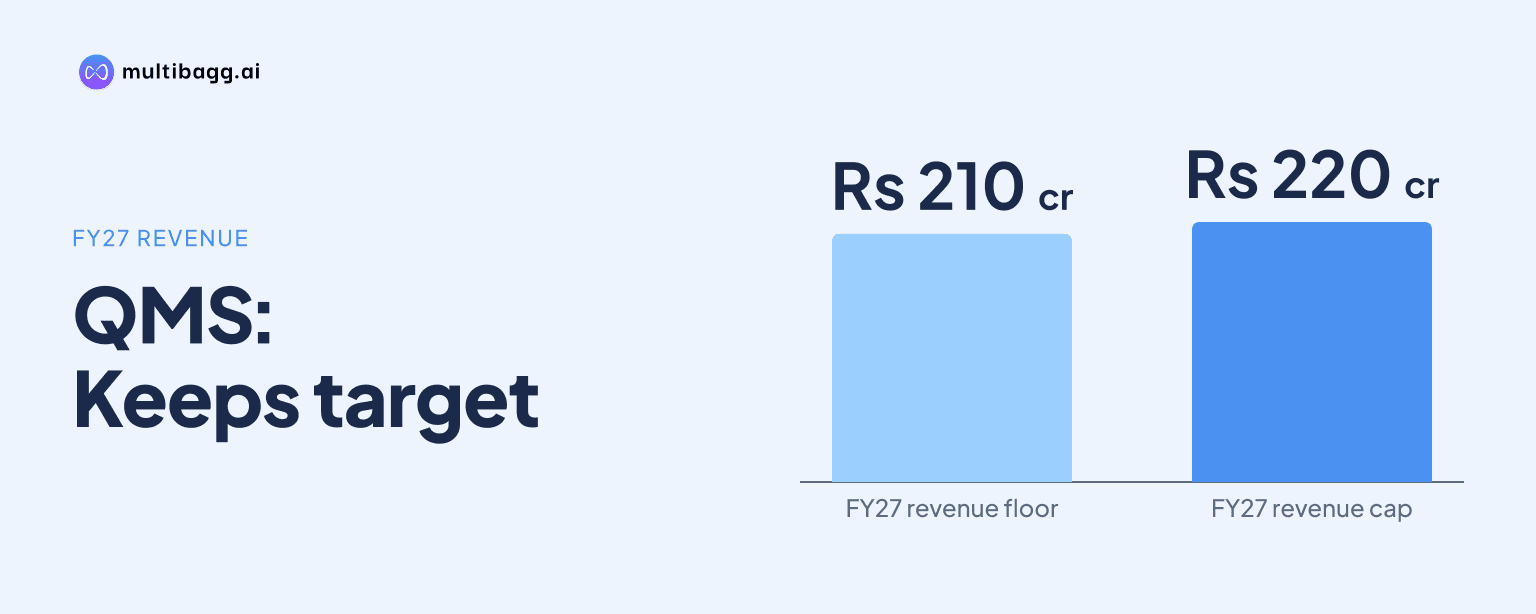
QMS Medical Allied Services Limited retained its Rs 210 crore to Rs 220 crore FY27 revenue target after reporting Rs 109 crore of consolidated H1 FY27 revenue, but it withheld full-year EBITDA guidance after product-side hits in Q2. Services generated Rs 48 crore in six months, nearly matching the Rs 54 crore recorded in all of FY26.
Know QMS Medical Allied Services inside out
Results, valuation, peers and who's buying, in one view.
Why is QMS keeping its FY27 revenue target?
QMS is keeping its Rs 210 crore to Rs 220 crore FY27 revenue target because management said H1 and H2 revenue should be almost similar. The company reported Rs 109 crore of consolidated revenue in H1 FY27, placing the midpoint of the stated full-year range at Rs 215 crore and implying roughly Rs 101 crore to Rs 111 crore in the second half.
Products accounted for Rs 61 crore of H1 FY27 revenue and services contributed Rs 48 crore. Products remained the larger division in absolute terms during the half year, but management said services were growing faster, lifting their share of consolidated revenue while the product-sales mix declined.
The clearest period comparison is in services: QMS generated Rs 48 crore in H1 FY27 compared with Rs 54 crore in the whole of FY26. Management attributed the increase to service contracts with pharmaceutical companies, under which incremental employees are deployed to specified programmes and their cost is covered by customer billing plus QMS's margin.
Why did QMS withhold FY27 EBITDA guidance?
QMS withheld FY27 EBITDA, or earnings before interest, tax, depreciation and amortisation, guidance because Q1 was better while Q2 faced certain hits on the product side, according to management. The finance team said it wanted to wait for one further quarter before providing a full-year EBITDA view, leaving the Rs 210 crore to Rs 220 crore revenue outlook without a corresponding earnings forecast.
Management said the consolidated services business operates at EBITDA of more than 20%, but product-side challenges prevented the faster service growth from fully translating into group margins. In response to an analyst's characterisation of product profitability, management confirmed that the product business was in the high-single-digit EBITDA range for the quarter discussed on the call.
An analyst cited employee expense rising from nearly Rs 3 crore to about Rs 12 crore year on year and increasing sequentially. Management did not independently restate those amounts, but confirmed that employee expense represented about 20-odd percent of H1 revenue and said service hiring was linked to contracts rather than made without revenue visibility.
QMS also said it was using internal accruals to reduce debt and lower interest cost, while noting that depreciation could not be managed in the same way. Management further assured an analyst that both divisions expected after the planned separation would be profit-after-tax positive, but it did not provide profit amounts, debt figures or a timetable for that position.
Got a follow-up? Ask IRIS
Which businesses are driving QMS's revenue growth?
QMS expects patient service programmes, or PSPs, to drive service growth, with management identifying Rs 100 crore to Rs 110 crore of PSP revenue from QMS and Rs 70 crore to Rs 80 crore from HCAH. Those component ranges indicate Rs 170 crore to Rs 190 crore of combined PSP revenue, while the analyst on the call referred to a cumulative projection of Rs 180 crore.
Management said Rs 50 crore to Rs 60 crore could come in the second half from PSP-related activity. HCAH, which management said is merging with QMS rather than being acquired, recorded Rs 55 crore of revenue in the previous year after about Rs 52 crore in the year before, and the finance team projected Rs 75 crore to Rs 80 crore for FY26-27.
Point-of-care contributed about Rs 15.5 crore in H1 FY27, including about Rs 9 crore in the quarter cited during the call. PSPs, educational programmes and other business-to-business services contributed approximately Rs 37 crore, while management identified pharma as the largest individual revenue source because it is a business-to-business sales channel.
Q-Devices contributed around Rs 4.5 crore from product sales in the first half, versus around Rs 14 crore from its business-to-business platform in the prior year. Management also cited online Q-Devices sales of approximately Rs 1.8 crore annually, but did not disclose a FY27 revenue target for that business.
When could QMS's product business improve?
QMS said its five-year exclusive HEINE distribution agreement starts on 1 January, although management expects the larger product-business impact in the next financial year. It said the old distribution channel was slow because it needed to clear inventory, and that some HEINE-related results could be visible in the final quarter, especially in its last two months.
Management said HEINE was generating about Rs 30 crore of revenue in India and would exceed that figure in the current financial year. QMS expects to start the next year with an approximate Rs 30 crore base and at least double revenue from the partnership over five years, which management presented as an expectation dependent on building an all-India distribution network.
BeamOptics is central to management's plan to change product economics through product development, market validation, manufacturing and distribution under one platform. QMS said it currently deploys more working capital in distributed medical devices because it does not receive credit and shares margin with manufacturers; management expects retaining more of that margin in-house to improve capital and process control.
Management said the HEINE and BeamOptics opportunities remained at an early stage and that benefits should start emerging in FY27-28. It gave no quantified FY27 product-revenue, working-capital or margin target, and said the more material product-business effects should occur in the next financial year.
Conclusion
QMS's H1 FY27 revenue of Rs 109 crore supports its maintained Rs 210 crore to Rs 220 crore full-year target, led by Rs 48 crore of service revenue against Rs 54 crore for all of FY26. Profitability remains less defined because services operate at more than 20% EBITDA while Q2 product-side pressure led management to defer consolidated EBITDA guidance.
The next disclosed milestone is one more quarter of performance before management considers issuing FY27 EBITDA guidance. Investors can also watch the 1 January HEINE distribution start, potential product effects in the final quarter, and management's expectation that BeamOptics-related benefits begin in FY27-28.