










QMS targets Rs 180 crore FY27 patient-services platform revenue
Key highlights
- QMS targets approximately Rs 180 crore of FY27 revenue for the proposed patient-services platform, versus approximately Rs 109 crore in FY26.
- HCAH’s patient-service programme division reported about Rs 55 crore of FY26 revenue and a little less than Rs 8 crore of EBITDA.
- The proposed QMS platform would include more than 160 active programmes, more than 1.2 million patients and over 2,000 healthcare professionals.
- QMS reported Rs 109.40 crore of H1 FY27 revenue, including about Rs 61 crore from products and Rs 48 crore from services.
powered by IRIS
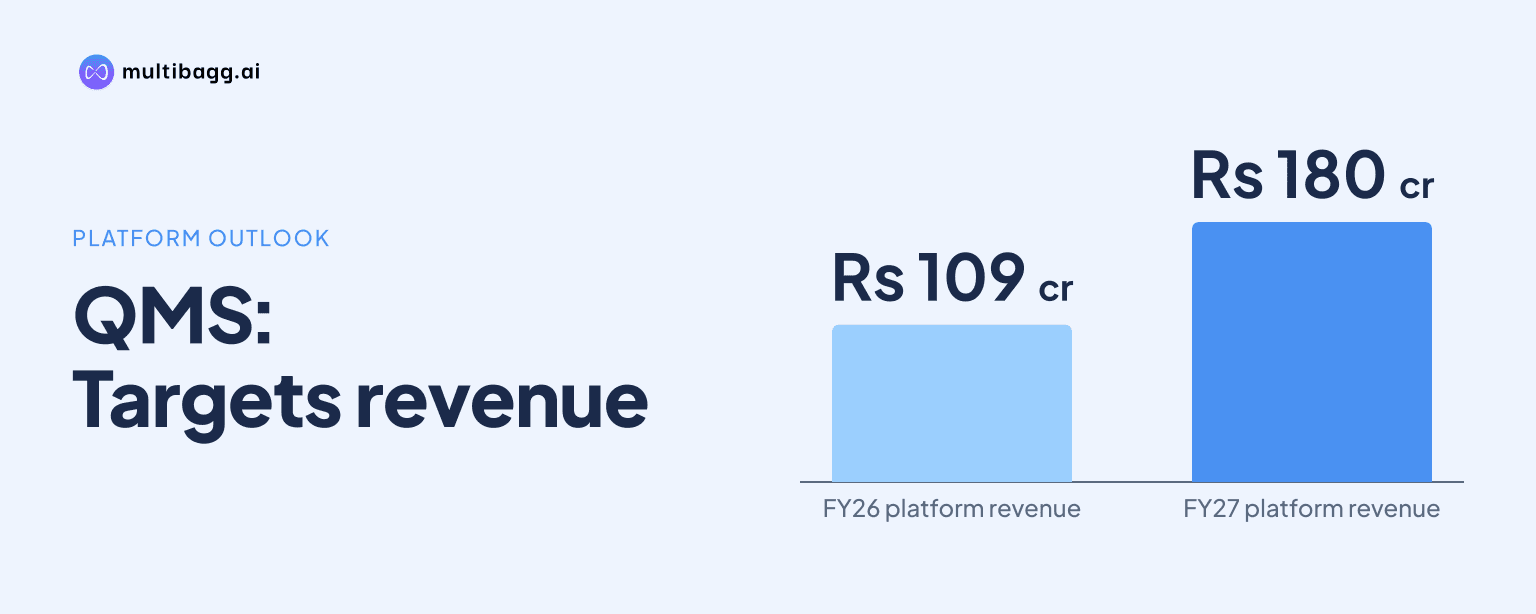
QMS Medical Allied Services Limited is targeting approximately Rs 180 crore of FY27 revenue from the proposed Saarathi Healthcare and Health Care at Home Limited patient-services combination, compared with approximately Rs 109 crore reported by the combined service business in FY26. The separate National Stock Exchange listing remains subject to regulatory and stakeholder approvals.
Know QMS Medical Allied Services inside out
Results, valuation, peers and who's buying, in one view.
What is QMS planning for its patient-services business?
QMS plans to merge Health Care at Home Limited’s patient-support programme vertical into Saarathi Healthcare through an all-share swap and separately list the enlarged services business on the National Stock Exchange. The boards of QMS and Health Care at Home Limited, or HCAH, approved the composite scheme on September 25, 2026, after QMS acquired Saarathi’s remaining 24% stake in September 2026.
Approximately 1.32 crore shares would be issued to HCAH shareholders under the proposed transaction. Management said the process would first demerge the existing listed QMS entity and create mirror shareholding, after which the services entity would issue shares to HCAH shareholders, leaving QMS as the products-focused listed business.
How large will QMS’s combined patient-services platform be?
QMS said the proposed platform would have more than 160 active patient-support programmes, more than 1.2 million patients reached and over 2,000 healthcare professionals across 35-plus cities. Its scope would cover patient screening, enrolment, treatment adherence, disease management, patient education and ongoing engagement across chronic and specialised therapy areas.
The platform would combine three operating bases: QMS, Saarathi and HCAH’s patient-support division. Management said their anchor customers differ, creating cross-selling opportunities, while a combined technology team and administrative structure could replace separate systems and partially utilised functions at the three businesses.
What revenue and profit has QMS disclosed for the combination?
QMS is targeting approximately Rs 180 crore of FY27 revenue for the combined service business, after reporting approximately Rs 109 crore in FY26. The target is approximately Rs 71 crore above the FY26 base, or about 65%, although management did not provide a complete FY26 revenue split between Saarathi, QMS services and HCAH.
HCAH’s patient-service programme division generated about Rs 55 crore of revenue and a little less than Rs 8 crore of earnings before interest, tax, depreciation and amortisation, or EBITDA, in FY26. The finance team expects HCAH’s division to reach about Rs 80 crore of revenue in FY27, but did not disclose profit after tax because it operates within the wider HCAH entity.
Management’s longer-term ambition is a 20% to 25% compound annual growth rate, or CAGR, for the combined business. It attributed that plan to new programme additions, deeper pharmaceutical relationships, new therapeutic areas and operating leverage, rather than issuing a year-by-year revenue forecast beyond FY27.
What supports QMS’s Rs 180 crore FY27 target?
QMS said programme retention and increased spending from existing pharmaceutical clients are the main foundations for the FY27 target. Management said Saarathi and QMS have historically retained 95% of their operating programmes, and that contracts for existing work have already been signed for multiple years.
Healthcare camps are another stated growth area, with management describing a progression from a camp assignment to a higher-ticket, smaller patient-support programme and then to a larger programme. QMS is also exploring insurance and corporate customers, but management gave no revenue target or timetable for these non-pharmaceutical opportunities.
Services accounted for about Rs 48 crore of QMS’s consolidated Rs 109 crore H1 FY27 revenue, while products contributed about Rs 61 crore. Management said pharmaceutical business-to-business product sales remain the largest revenue stream, but services are growing faster, increasing their proportion of the group revenue mix.
Got a follow-up? Ask IRIS
When could QMS report merger synergies and separate results?
QMS expects operational synergies to start in FY28, while management expects approvals from the National Stock Exchange, Securities and Exchange Board of India and National Company Law Tribunal to take 12 to 13 months from November 2026. Management said post-corporate-action consolidated numbers should begin reflecting the transaction from Q4 FY28, with balance-sheet effects visible thereafter.
A single patient-data and compliance platform is a principal planned mechanism for integration because pharmaceutical clients require reliable data management. Management also expects manpower optimisation, saying two employees with 60% and 40% utilisation at different entities could handle a combined workload without an equivalent increase in staff.
QMS’s reported Q2 FY27 results show the current investment phase. Revenue from operations rose 17.5% year on year to Rs 52.50 crore, but EBITDA fell to Rs 6.50 crore from Rs 6.90 crore and profit after tax fell to Rs 2.40 crore from Rs 3.60 crore as employee expenses rose to Rs 12.60 crore from Rs 3 crore.
How will QMS’s products business operate after the separation?
QMS said there would be two distinct listed businesses after the restructuring: a services entity including Saarathi and the HCAH operation, and the existing QMS entity focused on products. Management said Mahesh Makhija would remain chairman and managing director, while the services entity would move toward professional management that includes a chief executive from HCAH.
The products operation has more than 900 stock-keeping units, over 130 institutional clients and reach across more than 5,000 pin codes. QMS has also signed a five-year exclusive agreement to market and distribute HEINE Opto primary diagnostic instruments from January 1, 2027, while its September 25, 2026 binding memorandum of understanding for BeamOptics Scientific has no disclosed valuation yet.
Conclusion
QMS has set out a Rs 180 crore FY27 revenue target for a proposed patient-services platform that would unite more than 160 programmes and more than 1.2 million patients. The plan combines HCAH’s FY26 patient-service revenue of about Rs 55 crore with Saarathi and QMS capabilities, while seeking scale through programme retention, client cross-selling, camps and shared technology.
The next disclosed milestones are regulatory and stakeholder approvals expected to take 12 to 13 months from November 2026, followed by operational synergies in FY28 and potential consolidated reporting effects from Q4 FY28. Management’s ability to retain programmes, expand client wallet share and turn higher employee spending into operating efficiencies will determine progress toward the target.