










QMS targets doubling HEINE India diagnostic revenue in five years
Key highlights
- QMS aims to at least double HEINE’s Rs 30 crore India revenue base within five years.
- QMS’s exclusive India distribution rights for HEINE begin on January 1, 2027, and run for five years.
- QMS products generated Rs 61 crore of consolidated H1 FY27 revenue, compared with Rs 48 crore from services.
- BeamOptics has filed 7 patents, including 2 commercialised patents, and QMS has signed an MOU to acquire 100% of it.
powered by IRIS
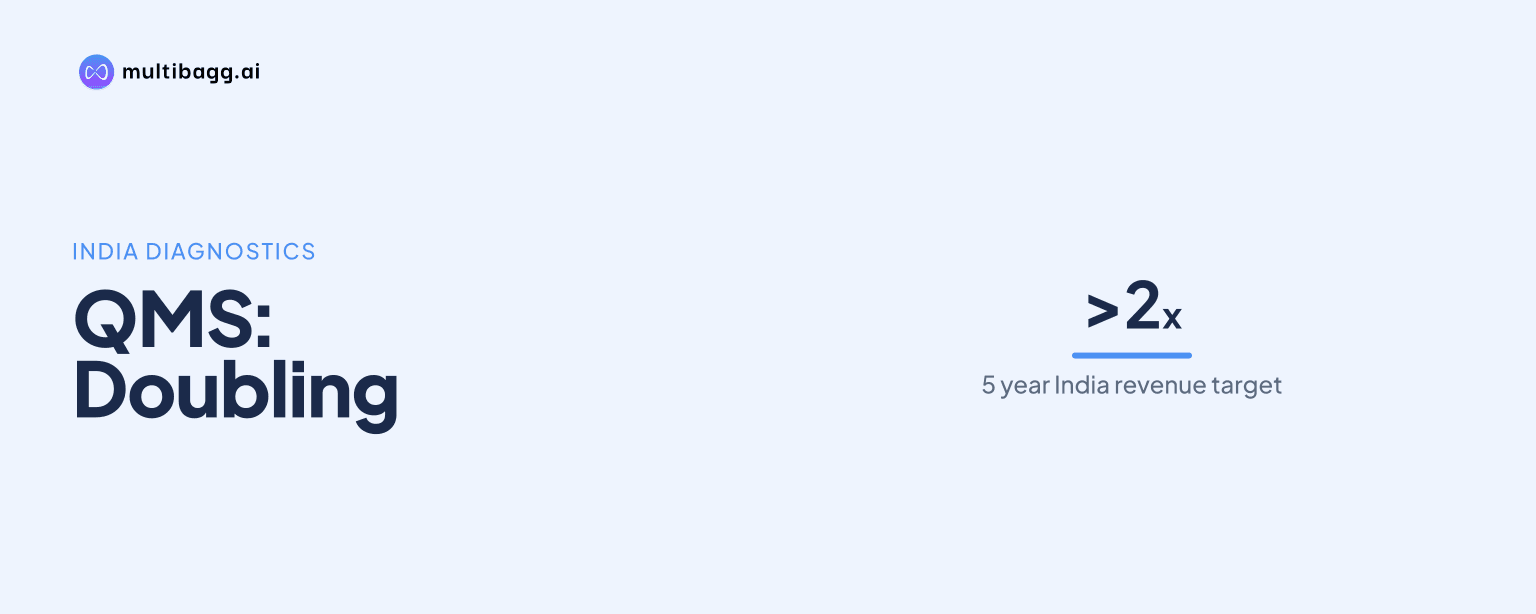
QMS Medical Allied Services Limited aims to approximately double HEINE diagnostic-products revenue over five years from HEINE’s Rs 30 crore India revenue base in 2026. The plan relies on QMS’s exclusive India distribution rights from January 1, 2027, alongside a proposed BeamOptics Scientific acquisition intended to add product-development and manufacturing capabilities.
Know QMS Medical Allied Services inside out
Results, valuation, peers and who's buying, in one view.
What is QMS’s HEINE diagnostic revenue target?
QMS aims to at least double HEINE’s India revenue within five years, starting from the approximately Rs 30 crore that HEINE generated in India in 2026. Management gave that ambition during the November 17, 2026 earnings call and said HEINE was expected to exceed its 2026 India revenue in the current financial year, without providing a revised revenue figure.
The target is based on QMS’s existing commercial reach rather than on a disclosed annual sales commitment from HEINE. QMS said its products business carries more than 900 stock-keeping units, or SKUs, serves more than 130 institutional clients including more than 50 pharmaceutical companies, and reaches over 5,000 pin codes across India. The company did not disclose minimum purchases, inventory commitments or product-level margins under the agreement.
HEINE will enter a products division that produced Rs 61 crore of consolidated revenue in H1 FY27, against Rs 48 crore from services. QMS reported consolidated revenue from operations of Rs 109.40 crore in H1 FY27, up 20% from Rs 91.20 crore in H1 FY26. Management said services are becoming a larger share of the mix because they are growing faster than business-to-business product sales.
The Rs 13 crore difference between products and services indicates that products remained the larger division in H1 FY27. However, management said existing distribution-channel inventory was being cleared before the HEINE arrangement begins, affecting near-term product activity. It described the five-year HEINE objective as a strategic expansion plan, not a revenue contribution already reflected in the half-year results.
When will QMS start distributing HEINE instruments?
QMS will begin exclusive marketing and distribution of HEINE primary diagnostic instruments throughout India on January 1, 2027, under a five-year agreement. Management described HEINE as a global primary-diagnostic-instruments company and said the arrangement adds an established international brand to QMS’s products portfolio.
The arrangement may use less incremental working capital than QMS’s traditional product model, according to management, because HEINE provides credit. QMS said its established products model often requires it to buy inventory upfront, stock it and sell to customers on credit, whereas the services division has minimal inventory needs but faces corporate-payment cycles of 90 to 100 days.
Management said the legacy distribution channel’s stock clearance has slowed current product business, while the HEINE business model starts only in January 2027. It said some impact could emerge in the final quarter of FY27, but the larger products effect is expected in the following financial year. QMS guided to FY27 revenue of Rs 210 crore to Rs 220 crore, after reporting Rs 109.40 crore in H1 FY27.
Q2 FY27 revenue from operations increased 17.5% year-on-year to Rs 52.50 crore, but earnings before interest, tax, depreciation and amortisation, or EBITDA, declined to Rs 6.50 crore from Rs 6.90 crore in Q2 FY26. The Q2 EBITDA margin was 12.4%, and management cited product-side challenges while declining to issue full-year EBITDA guidance after the quarter.
Got a follow-up? Ask IRIS
How will BeamOptics change QMS’s product strategy?
QMS plans to add indigenous technology, engineering and manufacturing capabilities through its proposed acquisition of 100% of BeamOptics Scientific. QMS signed a binding memorandum of understanding, or MOU, on September 25, 2026, and said BeamOptics specialises in optical systems, in-vitro diagnostics and analytical instruments.
BeamOptics brings in-house research and development, product engineering, manufacturing and regulatory capabilities, according to management. It has filed seven patents, of which two have been commercialised, and has developed optical-sensing and Fourier-transform infrared, or FTIR, spectroscopy platforms. Management identified RedCheck and QCare universal readers among its product platforms.
Management’s stated model is to connect BeamOptics’ development and manufacturing with QMS’s sales, customer relationships and nationwide distribution. Pharmaceutical companies could provide early product validation, while the broader trade market represents an additional sales channel. Management also said the HEINE-led distribution network could support the eventual sale of products developed with BeamOptics.
No valuation or final consideration has been disclosed for the proposed BeamOptics transaction. QMS said it expects to appoint valuers after the corporate action involving the services business is effective, which management estimated could take 12 to 13 months from November 2026. It said consideration could involve shares or a mix of shares and cash, but management was leaning towards a share exchange to avoid cash outflow.
What is the financial base for QMS products?
QMS’s products division generated Rs 61 crore in consolidated H1 FY27 revenue, including about Rs 15.50 crore from point-of-care business. Management said pharmaceutical business-to-business sales remain its largest revenue source, although their share is declining as services expand faster.
The services division generated Rs 48 crore in H1 FY27, compared with Rs 54 crore for the full FY26, according to management. Q2 FY27 employee expense rose to Rs 12.60 crore from Rs 3 crore in Q2 FY26 as service delivery expanded. Management said incremental personnel for patient programmes are employed against customer contracts designed to cover staff cost and QMS’s margin.
At the consolidated level, H1 FY27 EBITDA increased 11% to Rs 14.80 crore from Rs 13.40 crore in H1 FY26, while the EBITDA margin was 13.6%. Profit after tax fell to Rs 6.40 crore from Rs 6.70 crore and the profit-after-tax margin was 5.8%. Management said the service business operates at EBITDA margins above 20%, while product-side issues affected consolidated margin conversion during Q2.
QMS said it is working to reduce the product division’s working-capital cycle in the coming year. Management attributed a temporary rise in borrowings to internal accruals being allocated to complete the September 2026 acquisition of the remaining 24% stake in Saarathi Healthcare. It said future internal accruals would be directed towards reducing borrowings, with no other disclosed monetary capital commitments.
Conclusion
QMS is combining two product initiatives with different roles: HEINE provides a five-year route to market for primary diagnostic instruments, while BeamOptics is intended to add technology and manufacturing. The stated revenue ambition is to double HEINE’s Rs 30 crore India base over five years, while QMS’s products division contributed Rs 61 crore of the group’s Rs 109.40 crore H1 FY27 revenue.
The next event to watch is the January 1, 2027 launch of HEINE distribution and whether it contributes to Q4 FY27 product performance. Investors can also track the proposed BeamOptics valuation process, which management expects only after corporate actions that may take 12 to 13 months from November 2026, and management’s view that wider benefits should begin to emerge in FY28.