










QMS targets roughly Rs 180 crore services revenue in FY27
Key highlights
- QMS and HCAH approved the Composite Scheme of Arrangement on September 25, 2026.
- The combined services entity generated Rs 109 crore of FY26 revenue and has a management target of about Rs 180 crore for FY27.
- HCAH shareholders are proposed to receive 1.32 crore new Saarathi Healthcare shares, representing 40.5%.
- The proposed services platform covers more than 160 programs, 1.2 million patients, 2,000 professionals and 35 cities.
powered by IRIS
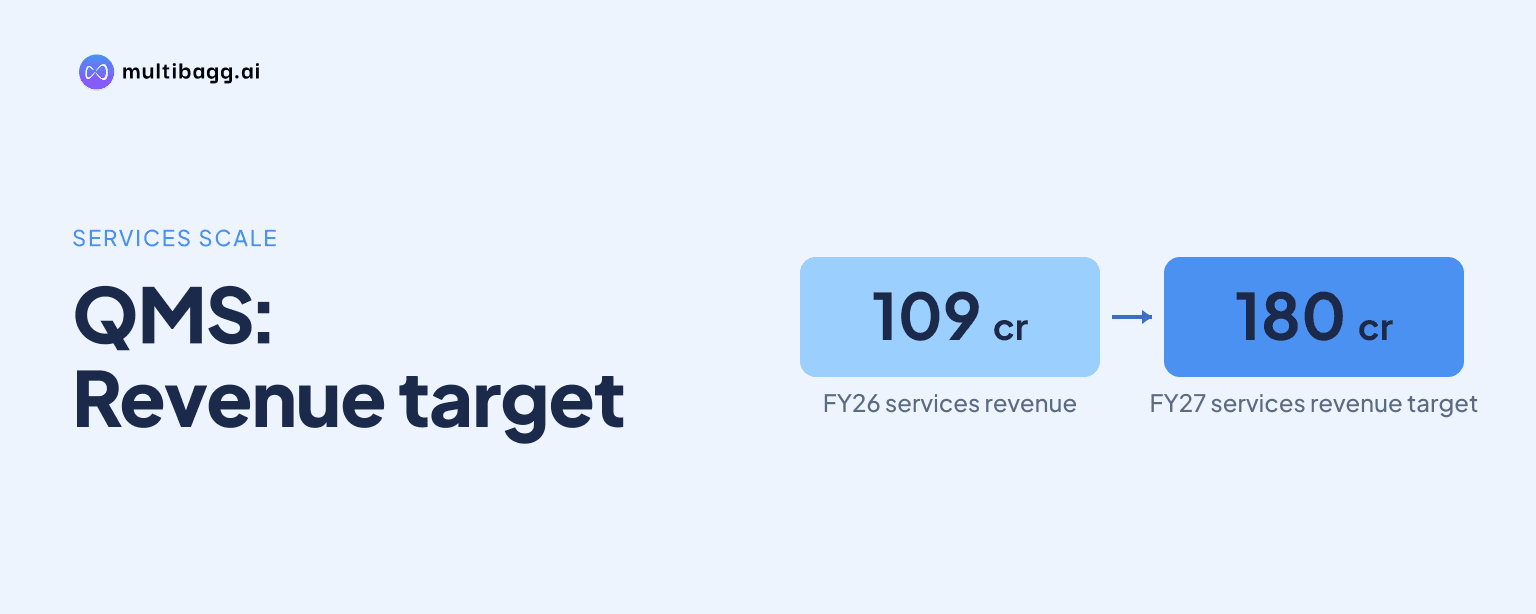
QMS Medical Allied Services Ltd plans to combine its services business with Health Care At Home India Pvt. Ltd.’s (HCAH) Patient Support Program division in Saarathi Healthcare, targeting roughly Rs 180 crore of FY27 revenue after the combined entity generated Rs 109 crore in FY26. The all-share scheme, approved on September 25, 2026, keeps QMS’s product business in the listed parent.
Know QMS Medical Allied Services inside out
Results, valuation, peers and who's buying, in one view.
How will QMS separate its services and product businesses?
QMS will demerge its services business into Saarathi Healthcare and combine it with HCAH’s Patient Support Program, or PSP, division through an all-share swap. QMS and HCAH approved the Composite Scheme of Arrangement on September 25, 2026, and the presentation says the resulting Saarathi Healthcare entity is intended to list separately on the National Stock Exchange of India, or NSE.
The structure retains QMS’s product business in the currently listed company, with no change to its existing shareholding stated in the presentation. Saarathi Healthcare is shown as a 100% QMS subsidiary before the transaction, but HCAH shareholders are to receive 1.32 crore newly issued shares in the services platform, giving them 40.5% of that entity after the proposed arrangement.
The share table shows that QMS promoters would hold 68.1% of the continuing product business, while public shareholders would hold 31.9%. In Saarathi Healthcare, those same groups would hold 40.5% and 19.0%, respectively, with the balance allocated to HCAH shareholders through the fresh issue. The proposal therefore creates a different ownership mix for the services platform without altering the stated ownership of QMS’s product business.
What operations will Saarathi Healthcare combine?
Saarathi Healthcare will combine QMS’s services activities, including Saarathi, with HCAH’s PSP division to provide screening, patient enrolment, adherence support, camps, distribution and patient engagement under one platform. The combined operation is presented as having more than 160 patient support programs, impacting more than 1.2 million patients through over 2,000 professionals across more than 35 cities.
The services operation generated combined FY26 revenue of Rs 109 crore, including QMS services, Saarathi and the HCAH PSP division. Management’s FY27 revenue target is approximately Rs 180 crore, or about Rs 71 crore above the FY26 base. That target is a management objective rather than a reported result, and the presentation does not provide a quarterly revenue split for the three contributing businesses.
Management says Mahesh Makhija will oversee the business in coming years, alongside a board structure and formal governance intended to support growth. Its stated commercial plan is to deepen pharmaceutical partnerships, broaden patient reach and service offerings, and use QMS’s healthcare network for market penetration and cross-selling across the 35-plus-city footprint.
What market opportunity does QMS identify for services?
QMS identifies pharmaceutical-company spending of Rs 10,000 crore to Rs 12,000 crore as the total addressable market for the combined PSP platform. The presentation says the business aims to capture a double-digit market share, but it does not state a timetable, revenue threshold or market-share percentage for that aspiration.
In management commentary, the Indian PSP market is described as projected to grow at a 15% to 20% compound annual growth rate, or CAGR. Management links the proposed combination to HCAH’s clinical and out-of-hospital recovery capabilities and QMS’s pharmaceutical relationships, with the stated aim of reducing structural duplication and sharing technology infrastructure across more than 160 active programs.
The operational proposition is an end-to-end service for domestic and multinational pharmaceutical partners, covering patient contact and program delivery as well as distribution. Management has said its immediate integration priority is continuity of patient care and of the pharmaceutical product business, which matters because the proposed Rs 180 crore FY27 services target depends on combining the QMS and HCAH operations without disruption.
Got a follow-up? Ask IRIS
What remains in QMS after the services demerger?
QMS will retain its product business, which the presentation describes as a full-stack diagnostics operation spanning research and development, manufacturing, sales, marketing, distribution and last-mile customer access. Its sales network covers business-to-business point-of-care diagnostics for clinics, laboratories and screening programs, while its marketing and distribution capabilities are described as built over more than 30 years.
Separately, QMS signed a binding memorandum of understanding on September 25, 2026 to acquire 100% of Pune-based BeamOptics Scientific. The presentation says BeamOptics brings diagnostic-device research and development, regulatory and quality systems, and in-house manufacturing; it also states that the company has filed seven patents. Consideration may be paid in cash, shares or a combination, based on an independent valuation.
The BeamOptics acquisition remains subject to mutual fulfilment of terms and conditions and to completion of the National Company Law Tribunal, or NCLT, process for the HCAH composite scheme. QMS says the proposed acquisition is not a related-party transaction and that its promoter group has no interest in the target. The presentation does not disclose a purchase price, valuation or completion date.
What approvals must QMS obtain before Saarathi Healthcare can list?
QMS must obtain approvals from the NSE and the Securities and Exchange Board of India, or SEBI, followed by NCLT and stakeholder approvals, before the proposed Saarathi Healthcare listing can occur. The presentation lists these four steps in sequence but gives no expected dates for the regulatory review, stakeholder vote, NCLT order or eventual NSE listing.
The all-share issuance of 1.32 crore shares to HCAH shareholders is consequently part of a proposed scheme rather than a completed allotment. Management’s stated task is a seamless operational integration while maintaining ongoing patient care across more than 1.2 million patients and preserving the separate product business, but the presentation does not quantify integration costs or identify a post-listing date.
Conclusion
QMS’s restructuring would separate its products and services into two focused businesses: a continuing listed product company and a separately listed Saarathi Healthcare services platform. The principal disclosed services measure is the move from Rs 109 crore of combined FY26 revenue toward management’s approximately Rs 180 crore FY27 target, supported by a base of more than 160 programs and 1.2 million patients impacted.
What to watch next is the NSE and SEBI review, NCLT and stakeholder approvals, and the intended NSE listing of Saarathi Healthcare. QMS also needs to complete the proposed 1.32 crore-share issuance to HCAH shareholders and may finalise its 100% BeamOptics acquisition after the NCLT process and mutual transaction conditions are met.