










Qualiance FY26 EBITDA margin reached 21.9% as revenue doubled
Key highlights
- Qualiance’s revenue from operations rose to Rs 77 crore in FY26 from Rs 53 crore in FY25 and Rs 37 crore in FY24.
- EBITDA increased to Rs 17 crore in FY26 from Rs 8 crore in FY25, lifting the EBITDA margin to 21.9%.
- Operating cash flow turned positive at Rs 8.2 crore in FY26 after an outflow of Rs 4.5 crore in FY25.
- Switzerland accounted for 81% of Qualiance’s FY26 revenue, while imported raw materials made up 60% of sourcing.
powered by IRIS
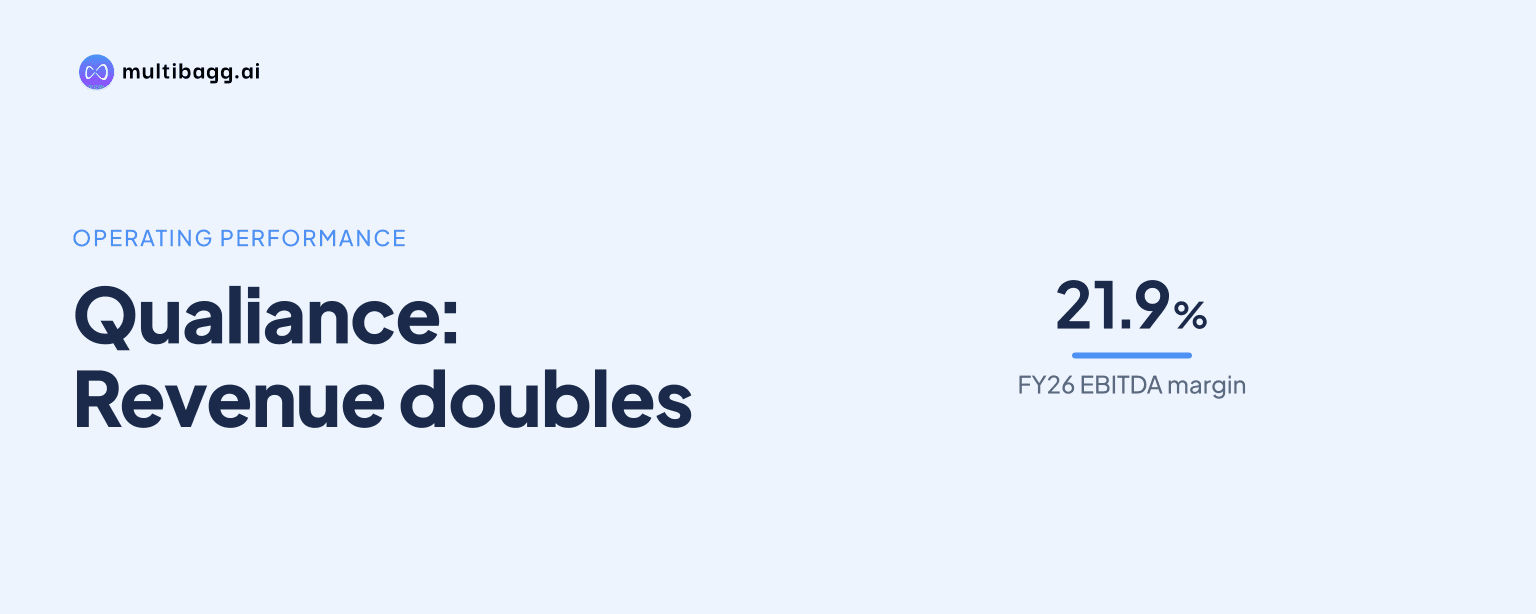
Qualiance International Limited lifted its earnings before interest, tax, depreciation and amortisation (EBITDA) margin to 21.9% in FY26 from 13.2% in FY24, while revenue from operations rose to Rs 77 crore from Rs 37 crore. Profit after tax (PAT) reached Rs 12 crore and operating cash flow turned positive at Rs 8.2 crore.
Know Qualiance International inside out
Results, valuation, peers and who's buying, in one view.
How did Qualiance’s revenue and profit change in FY26?
Qualiance reported revenue from operations of Rs 77 crore in FY26, compared with Rs 53 crore in FY25 and Rs 37 crore in FY24. Revenue increased by Rs 24 crore in FY26 after a Rs 16 crore increase in FY25, taking the FY26 figure to more than twice the FY24 level.
EBITDA rose to Rs 17 crore in FY26 from Rs 8 crore in FY25 and Rs 5 crore in FY24. EBITDA margin rose by 6.6 percentage points from 15.3% in FY25 and by 8.7 percentage points from 13.2% in FY24, reaching 21.9%. Profit before tax increased to Rs 16 crore from Rs 6 crore, while finance cost rose to Rs 4 crore from Rs 3 crore.
PAT was Rs 12 crore in FY26, compared with Rs 5 crore in FY25 and Rs 3 crore in FY24. PAT margin, which measures profit after tax as a share of revenue, reached 15.4%, from 9.2% in FY25 and 7.6% in FY24. Tax expense rose to Rs 4 crore in FY26 from Rs 1 crore in each of the previous two years.
What changed in Qualiance’s FY26 operating costs?
Qualiance’s gross profit increased to Rs 44 crore in FY26 from Rs 32 crore in FY25, although gross margin declined to 56.7% from 59.6%. Cost of goods sold increased by Rs 1 crore to Rs 32 crore while revenue increased by Rs 24 crore. Changes in inventories moved to Rs 1 crore in FY26 after negative Rs 10 crore in FY25.
Employee benefits expense increased to Rs 17 crore in FY26 from Rs 14 crore in FY25 and Rs 10 crore in FY24. Other expenses fell to Rs 9 crore from Rs 10 crore in FY25, despite revenue rising to Rs 77 crore. The movement in gross profit, employee costs and other expenses coincided with EBITDA increasing by Rs 9 crore in FY26.
Other income rose to Rs 4 crore in FY26 from Rs 2 crore in FY25 and Rs 1 crore in FY24. Depreciation and amortisation expense remained Rs 1 crore in each of the three years, while earnings before interest and tax increased to Rs 20 crore from Rs 9 crore. Its margin rose to 25.8% from 17.2%, although finance cost increased by Rs 1 crore.
Qualiance’s FY26 product mix was 72% woven products and 28% knitted products. Imported raw materials accounted for 60% of sourcing, with domestic materials accounting for 40%. Switzerland contributed 81% of FY26 revenue, followed by the United States at 17%, the United Kingdom at 2% and India at 1%.
Got a follow-up? Ask IRIS
How did Qualiance’s returns, borrowings and balance sheet move?
Qualiance reported return on equity (ROE) of 34% and return on capital employed (ROCE) of 31% in FY26. These measures increased from 20% and 17%, respectively, in FY25, and from 14% and 13% in FY24. The reported debt-to-equity ratio declined to 0.82 times in FY26 from 1.22 times in FY25, after 0.94 times in FY24.
Shareholders’ funds increased to Rs 34.7 crore at March 2026 from Rs 24.4 crore at March 2025 and Rs 20.3 crore at March 2024. Reserves and surplus rose to Rs 24.8 crore from Rs 14.5 crore, while share capital remained Rs 9.9 crore across all three dates. Total liabilities and assets each reached Rs 69 crore at March 2026, compared with Rs 57.5 crore a year earlier.
Long-term borrowings declined to Rs 4.9 crore at March 2026 from Rs 10.3 crore at March 2025, while short-term borrowings increased to Rs 23.6 crore from Rs 19.4 crore. Inventories fell to Rs 24.1 crore from Rs 29.5 crore, but trade receivables rose to Rs 16 crore from Rs 2.1 crore. Property, plant and equipment was Rs 18 crore at March 2026, compared with Rs 18.4 crore a year earlier.
Did Qualiance generate cash from operations in FY26?
Qualiance generated net cash flow from operating activities of Rs 8.2 crore in FY26, compared with an outflow of Rs 4.5 crore in FY25 and an inflow of Rs 2.8 crore in FY24. The return to positive operating cash flow occurred in the year when PAT increased to Rs 12 crore and inventories declined by Rs 5.4 crore from the March 2025 balance.
Net cash used in investing activities was Rs 2.7 crore in FY26, lower than Rs 4.4 crore used in FY25. Financing activities used Rs 4.9 crore in FY26 after providing Rs 7.7 crore in FY25. The cash-flow statement reports a Rs 0.3 crore net increase in cash and cash equivalents in FY26, ending the period at Rs 0.8 crore.
The balance sheet recorded cash and bank balances of Rs 0.8 crore at March 2026, compared with Rs 0.7 crore at March 2025 and Rs 1.7 crore at March 2024. Current assets increased to Rs 46.6 crore from Rs 35.5 crore over FY26, while current liabilities increased to Rs 28.3 crore from Rs 22 crore. The rise in trade receivables to Rs 16 crore was a significant balance-sheet movement alongside the reported operating cash inflow.
Conclusion
Qualiance’s FY26 results show revenue rising from Rs 37 crore in FY24 to Rs 77 crore, EBITDA increasing from Rs 5 crore to Rs 17 crore and EBITDA margin reaching 21.9%. PAT margin also rose to 15.4%, while ROE and ROCE reached 34% and 31%. Operating cash flow was Rs 8.2 crore, compared with an FY25 outflow.
The next disclosed operating milestone is the Tiruppur factory, which is planned to begin commercial operations in July 2027. The Rs 39.14 crore project is designed for annual capacity of 10.8 lakh pieces, or 2.4 times existing capacity, with Rs 38 crore planned from initial public offering proceeds. Management’s FY28 plan is to ramp up the facility and pursue larger value-added programmes from institutional clients and private brands.