










R Systems says AI modernisation is reshaping deal pipeline
Key highlights
- R Systems reported Q3 FY 2026 revenue of Rs 615.2 crore, up 23.4% year on year.
- Management estimated that AI-related work contributed well over 35% of R Systems’ revenue in Q3 FY 2026.
- Adjusted EBITDA margin was 20.2% in Q3 FY 2026, compared with 16.9% a year earlier.
- Nine-month adjusted EBITDA rose 49.7% year on year to Rs 360.9 crore.
powered by IRIS
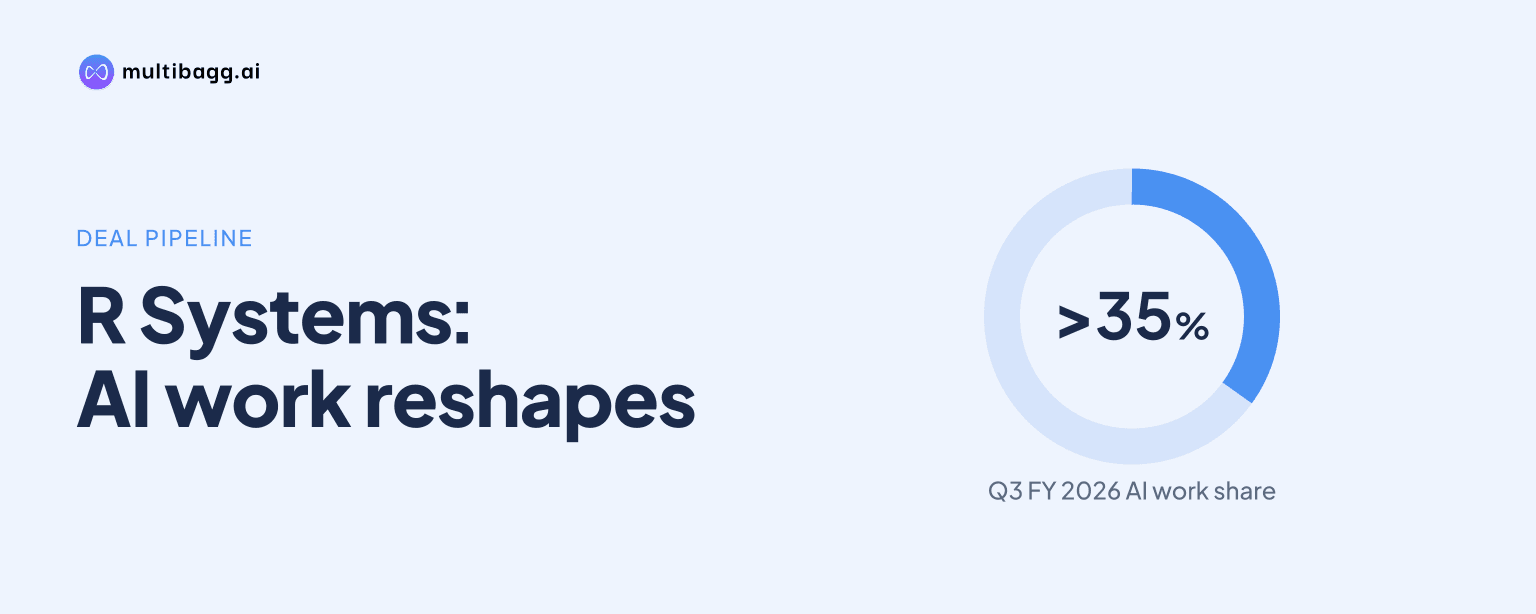
R Systems International Limited said in Q3 FY 2026 that AI-related work represented well over 35% of revenue, as its deal pipeline moved toward AI-led modernisation, data foundations and agentic business operations. R Systems reported revenue of Rs 615.2 crore, up 23.4% year on year, while citing telecom, lending and data-platform engagements.
Know R Systems International inside out
Results, valuation, peers and who's buying, in one view.
How is R Systems changing its deal pipeline?
R Systems is shifting net-new work from conventional product-development assignments toward data readiness for AI, legacy modernisation and agentic implementations. Managing Director and Chief Executive Officer Nitesh Bansal said traditional product development was not shrinking, but projects were being delayed as technology companies reduced staff and adopted AI in their own product-development processes during Q3 FY 2026.
The newer work differs from staffing a client pod with Java engineers or testers because it covers transformation of data landscapes, technology estates and operating systems. R Systems said it can contract on fixed-price or outcome-based terms, but disclosed neither the value nor duration of the individual Q3 FY 2026 engagements.
The transition also coincides with a wider enterprise focus beyond technology clients. The Americas accounted for 70.6% of Q3 FY 2026 revenue, compared with 16.0% from Asia-Pacific, 9.4% from Europe and 4.0% from the Middle East and Africa. The top 10 customers supplied 24.4% of revenue, and the largest customer remained in the 5.8% to 6.0% range.
Which Q3 FY 2026 wins show R Systems’ new focus?
R Systems cited five Q3 FY 2026 wins spanning cloud modernisation, data infrastructure, lending, customer operations and payments connectivity. The company did not name the clients or provide contract values, so the revenue contribution from each engagement cannot be calculated from the call.
A European telecom operator selected R Systems to modernise mission-critical services in a next-generation network transformation programme. The assignment includes transitioning legacy applications to cloud-based architectures and using AI to accelerate delivery, with targets covering scalability, service reliability, operational efficiency and faster service innovation.
In the Middle East, R Systems is working with a global management consulting firm on a data lakehouse for a housing and real-estate organisation. Management described the project as an enterprise data foundation for advanced analytics, machine learning and agentic AI, making its immediate objective data readiness rather than application conversion.
A Saudi financial-services client engaged R Systems on a new-generation core lending platform, including solution architecture, a digital-transformation roadmap, application development and technology modernisation. Separate Q3 FY 2026 assignments include Salesforce-based commercial and customer operations for a global entertainment and games business, plus host-to-host connectivity and payment workflow automation for an insurance-services provider.
How large is R Systems’ AI work and booking activity?
R Systems estimates that AI-related work accounts for well over 35% of overall revenue, combining AI product-development lifecycle work, agentic implementations and machine-learning activity. Management said it may begin separately reporting AI revenue after it has accumulated three or four quarters of data, so the Q3 FY 2026 estimate is not yet a reported financial line item.
Trailing-12-month annual contract value of bookings remained broadly flat for the past three quarters, even as the mix moved toward fewer and more transformative engagements. Management said the company must win more business to accelerate growth, although it believes the quality of the pipeline has improved.
Some AI agentic-workflow and business-operations deals took longer to close than management had anticipated, moving into the next quarter. However, management said newer assignments can sometimes be delivered in three or four months, rather than through longer conventional project cycles, potentially increasing the pace of revenue recognition once work begins.
R Systems said it had deliberately built data and AI bench capacity two quarters before Q3 FY 2026, and that capacity was used as projects were won. Management plans to expand those teams and add some bench again while seeking to keep utilisation above 80%, which it described as its operating target.
Got a follow-up? Ask IRIS
Why are production AI deployments important to R Systems?
R Systems said clients are moving from experimentation to production-grade AI deployment, creating demand for enterprise implementations rather than limited proof-of-concept work. Its EXIQO AI studio, industry templates and agent frameworks are being used in Q3 FY 2026 client work that management said is focused on measurable business outcomes.
Management said AI PDLC, or AI in the product development lifecycle, is replacing the traditional SDLC, or software development lifecycle, in client organisations. R Systems is being asked to install tools, provide training and best practices, and operate parallel AI pods across headquarters and global capability centres.
The company also said it uses engineering-velocity measures and reusable agents in new project estimates. Management said this approach can deliver two times, and sometimes more than two times, the productivity for clients, but it did not disclose customer savings or the proportion of contracts carrying such commitments.
Legacy modernisation remains a large addressable opportunity across legacy code bases, data estates and reporting landscapes, according to management. Bansal also said discussions with private-equity operating partners indicated preference for customised AI development and agentic transformation at portfolio companies, rather than buying vertical AI platforms.
What do R Systems’ financial results show about the shift?
R Systems reported Q3 FY 2026 revenue of Rs 615.2 crore, up from Rs 498.6 crore in Q3 FY 2025 and Rs 601.7 crore in Q2 FY 2026. Management attributed the year-on-year increase to volume growth supported by rupee depreciation, and said its cloud, AI and automation investments were contributing to larger deal conversions.
Adjusted earnings before interest, tax, depreciation and amortisation, or EBITDA, rose 47.4% year on year to Rs 124.4 crore, lifting the margin to 20.2% from 16.9%. Adjusted net profit increased 53.1% to Rs 66.5 crore, while adjusted basic earnings per share rose to Rs 5.6 from Rs 3.7 a year earlier.
For the nine months ended September 2026, revenue reached Rs 1,791.7 crore, up 27.7% from Rs 1,403.1 crore in the corresponding 2025 period. Adjusted EBITDA increased 49.7% to Rs 360.9 crore and its margin rose to 20.1% from 17.2%; these figures cover the whole company rather than AI work alone.
Gross margin was 38.6% in Q3 FY 2026, compared with 39.2% in Q2 FY 2026 and 35.5% a year earlier. Chief Financial Officer Nand Sardana attributed the sequential decline to revenue mix and lower European utilisation during the holiday season, partly offset by rupee depreciation; selling, general and administrative expense fell to Rs 113 crore from Rs 115.3 crore sequentially.
Conclusion
R Systems’ Q3 FY 2026 disclosures indicate that its pipeline is moving toward work closer to clients’ core operations, including telecom systems, enterprise data, lending infrastructure, commercial processes and payment workflows. The shift accompanied 23.4% year-on-year revenue growth, a 20.2% adjusted EBITDA margin and management’s estimate that AI-related work has exceeded 35% of company revenue.
The next measure will be whether the newer mix translates into faster booking growth and revenue conversion. Management said some agentic and business-operations deal closures slipped into the next quarter, while newer assignments can be delivered in three or four months; it also plans further AI-team and bench investment and may report AI revenue separately after three or four quarters of data.