










R Systems says deal delays held Q3 growth below expectations
Key highlights
- R Systems reported Q3 revenue of Rs 615.2 crore, up 2.2% sequentially and 23.4% year on year.
- Management said delayed AI-agent and business-operations deal closures left Q3 growth slightly below expectations.
- R Systems is working toward 3%-4% sequential growth without issuing formal guidance.
- Management said well over 35% of R Systems revenue is from AI-related work.
powered by IRIS
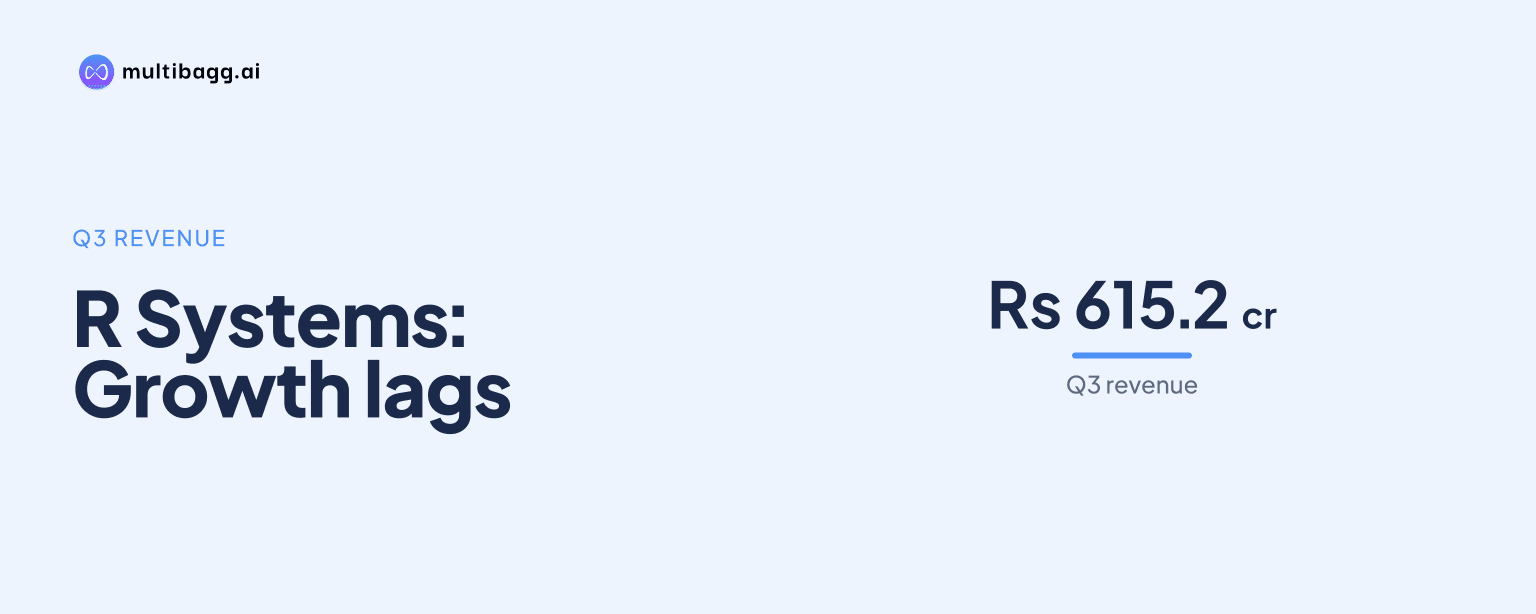
R Systems International Limited said Q3 revenue increased 2.2% sequentially to Rs 615.2 crore, but growth was slightly below management’s expectation because AI-agent workflow and business-operations deals took longer to close. R Systems is seeking to move from roughly 1%-2% quarterly growth toward a sustained 3%-4% range, without issuing formal guidance.
Know R Systems International inside out
Results, valuation, peers and who's buying, in one view.
Why did R Systems miss its Q3 growth expectation?
R Systems said delayed closure of AI-agent workflow and AI-based business-operations deals caused Q3 growth to come in slightly below its expectation. Management said some contracts shifted into the next quarter, although it saw pipeline conversion continue after a longer-than-anticipated sales process.
Revenue was Rs 615.2 crore in Q3, compared with Rs 601.7 crore in the previous quarter and Rs 498.6 crore in the year-earlier quarter. That represented 23.4% year-on-year growth, which management attributed to volume growth supported by rupee depreciation. The analyst asking the question noted that the second and third calendar quarters are usually seasonally stronger, while management described the Q3 outcome as low-single-digit sequential growth.
Profitability did not move in line with sequential revenue growth. Gross margin declined 0.6 percentage points from 39.2% to 38.6%, reflecting a change in revenue mix and lower utilisation in Europe during the holiday season, partly offset by rupee depreciation. Adjusted EBITDA, or earnings before interest, tax, depreciation and amortisation, increased 0.1 percentage point to 20.2%, while net profit after tax rose Rs 8.6 crore sequentially to Rs 64.2 crore.
Can R Systems reach 3%-4% sequential growth?
R Systems said it is working to accelerate from about 1%-1.5% quarterly growth to a secular 3%-4% range that could support double-digit annual growth. Management presented this as an operating endeavour rather than guidance and said it avoids setting formal revenue guidance.
Management said shorter delivery cycles for newer contracts could improve revenue realisation. Some engagements included in trailing-12-month annual contract value, or ACV, can be delivered in three or four months, rather than over a full year. R Systems said this faster conversion from bookings to revenue can increase revenue density, but also said it must win more business to deliver higher growth.
Trailing-12-month ACV was broadly flat for three quarters, even as the business mix changed, according to management. R Systems said it was generating that ACV from fewer, more transformative deals involving data readiness, modernisation and agentic systems rather than traditional product-development work. Management called the pipeline better in quality but did not provide an ACV target or a quarterly revenue forecast.
Growth is expected to come from both existing and new accounts. R Systems said larger clients offer wallet-share opportunities as its work shifts from product development to transformation projects. Management also identified enterprise-logo additions in data and modernisation as opportunities beyond its earlier reliance on technology customers.
Got a follow-up? Ask IRIS
Which offerings are expected to support R Systems growth?
R Systems expects data readiness for artificial intelligence, agentic implementations and legacy modernisation to support growth as conventional product-development projects face delays. Management said technology companies are reducing headcount while investing in AI infrastructure and adopting artificial intelligence in product-development processes, delaying rather than eliminating traditional project demand.
Management said well over 35% of revenue now comes through AI-related work, including AI product-development lifecycle work, agentic implementations and machine learning. R Systems said it may begin reporting AI revenue once it has three or four quarters of data. Its EXIQO AI studio, industry templates and agent frameworks are intended to help clients move from experimentation to production-grade deployments.
R Systems said project estimates now include AI-enabled delivery, engineering velocity tools and reusable agents that can deliver two times, and sometimes more than two times, productivity for clients. In its project-led model, management said renewals mean winning each new project rather than extending a sustain-and-maintain contract. It said the company has maintained a renewal rate above 85% by winning additional projects from existing clients.
The enterprise sales motion is another component of the plan. Management estimated enterprise clients account for about 15% of revenue, while noting that the company does not yet track the measure separately. Over two to three years, management said a 25%-35% enterprise revenue mix would provide greater diversification from technology, media and telecommunications, or TMT, clients.
What could affect R Systems’ growth plan?
R Systems said competition is intensifying as large systems integrators, AI-native platform companies, open-weight players and frontier-model providers pursue AI work. Management said AI both opens new markets and increases competition. Its stated response is to pursue AI product-development lifecycle work, modernisation, agentic systems and a broader enterprise go-to-market approach.
The company is refreshing some field sales personnel as it pivots toward enterprise buyers, while saying its leadership team has otherwise been stable after hiring a chief revenue officer two quarters earlier. Management said on-site hiring in North America is tied to transformation and agentic projects, where teams need to work directly with client business functions to design and implement systems.
R Systems also cited ongoing uncertainty affecting Novigo’s Middle East operations. Management said Novigo had grown broadly in tandem with R Systems, but described the Middle East conflict as unresolved on the November 4, 2026 call. It said client teams continued to operate on the ground and receive business extensions, but did not identify a point at which the regional uncertainty would end.
Conclusion
R Systems reported 2.2% sequential Q3 revenue growth to Rs 615.2 crore, with delayed AI-agent and business-operations deals preventing a result that management had expected to be higher. Its growth argument rests on shorter revenue cycles from newer AI engagements, broader modernisation work and an enterprise push, while adjusted EBITDA margin was 20.2% despite a sequential gross-margin decline to 38.6%.
The next results should show whether delayed deal closures help move growth toward management’s 3%-4% sequential objective. Investors can also watch for AI revenue disclosure after three or four quarters of data, progress toward management’s two-to-three-year enterprise-mix aim of 25%-35%, and the effect of unresolved Middle East conditions on Novigo.