










R Systems targets 25%-35% enterprise revenue in three years
Key highlights
- R Systems targets enterprise revenue of 25%-35% within two to three years, versus an estimated 15% now.
- Management said R Systems delivered about 2.2% quarter-on-quarter growth in each of the prior two quarters.
- R Systems believes well over 35% of overall revenue now comes through AI-related work.
- Management’s company-wide margin reference is 18.6%-18.7%.
powered by IRIS
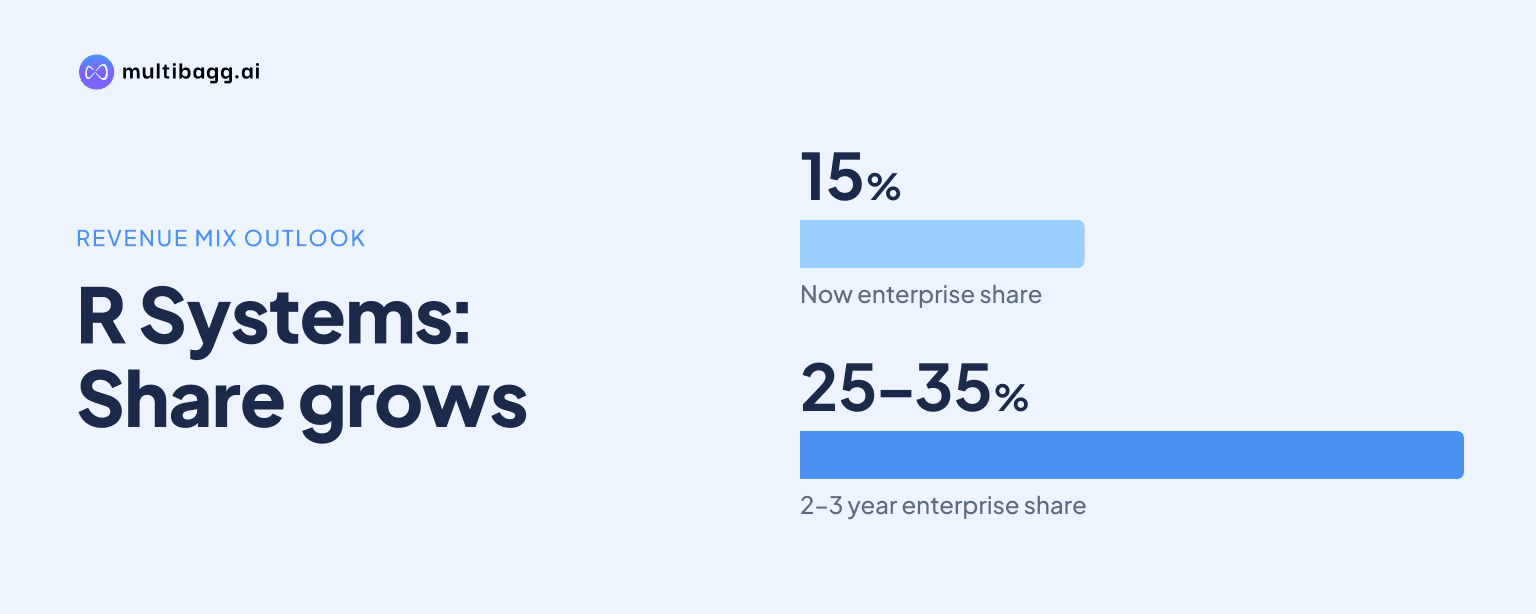
R Systems International Limited aims to increase enterprise customers from an estimated 15% of revenue to 25%-35% within two to three years, management said on November 4, 2026. The target is intended to reduce reliance on technology, media and telecommunications, or TMT, clients through enterprise sales of data, modernization and artificial intelligence, or AI, work.
Know R Systems International inside out
Results, valuation, peers and who's buying, in one view.
What is R Systems’ enterprise revenue target?
R Systems’ target is for enterprises to generate 25%-35% of revenue within two to three years, up from management’s estimate of about 15% currently. Management said a share above 25% would make the enterprise business meaningful enough to make R Systems reasonably less dependent on the TMT side of its client base.
The 15% baseline is an estimate rather than a separately reported category. When asked about the current enterprise share, management said R Systems had not started tracking it separately and that 15% was probably the level. The 25%-35% objective is therefore a strategic revenue-mix goal, not a target measured against a formally disclosed enterprise segment.
The target implies an increase of at least 10 percentage points at the bottom of the range and up to 20 percentage points at the top. Management did not disclose enterprise revenue, the number of enterprise accounts, or annual milestones for the two-to-three-year period, leaving the mix rather than a rupee revenue figure as the disclosed measure of progress.
Why is R Systems moving toward enterprise customers?
R Systems is pursuing enterprises to expand beyond TMT and to address new demand for data and modernization services. Management said growth can come from larger existing accounts, where work is shifting from product development to transformation, and from new enterprise logos in the total addressable market, or TAM, for data and modernization.
The sales build-out is part of that shift. Management said R Systems hired a Chief Revenue Officer two quarters before the November 4 call and was refreshing go-to-market staff for enterprise selling. It also said the Novigo acquisition, completed about three quarters earlier, helped build enterprise sales motions that R Systems is now taking to market.
Banking, financial services and insurance, or BFSI, was the clearest enterprise vertical identified by management. It said BFSI had grown sequentially for the previous two quarters, with at least one or two BFSI deals announced in each of the last couple of quarters. Management linked those wins to the sector’s adoption of AI and spending on core platforms.
Health care is also an enterprise priority, ahead of manufacturing, according to management. It described recent health care and manufacturing weakness as temporary project-ending effects, while citing agentic revenue-cycle management, machine learning for wearables and AI work on a diagnostic device for peripheral arterial disease as relevant health care capabilities.
Will enterprise contracts affect R Systems’ margins?
Management said enterprise work does not currently show a large profitability gap, but it also said the eventual result is not known. Its leading indicators suggest that fixed-price and outcome-based enterprise contracts can provide levers to retain margins and sometimes seek higher margins than technology-sector time-and-materials work.
That view is based on commercial indicators rather than reported enterprise profitability. R Systems did not disclose enterprise gross margin, fixed-price contract margins, win rates or a comparison with time-and-materials margins. The outcome will depend on how the enterprise revenue mix develops from the estimated 15% starting level.
For the overall company, management said it had previously identified a sustainable margin range in the high 18s, specifically 18.6%-18.7%. It said currency movements had lifted margins and that it had retained that benefit rather than using it for investments, while considering earnings above the high-18% range a cushion for continued AI investment.
Enterprise and AI transformation work also have delivery implications. Management said such projects require some full-time employees, or FTEs, to work with clients, understand business processes and implement agentic systems. It said this had increased on-site capability building, mainly in North America, rather than reflecting a structural shift in that market.
Got a follow-up? Ask IRIS
How does enterprise expansion support R Systems’ growth plan?
R Systems is using enterprise expansion as one route toward sustainable double-digit growth. Management said it was working to accelerate from roughly 1%-1.5% sequential growth to a more sustained 3%-4% range, which it believes could support double-digit year-over-year growth.
Management said the prior two quarters delivered about 2.2% quarter-on-quarter growth and were slightly below its expectations. It attributed part of the shortfall to longer closure times for AI agentic-workflow and business-operations deals, with some contracts shifting into the next quarter even as pipeline conversion continued.
AI is central to the enterprise proposition and the wider growth strategy. Management said it believed well over 35% of overall revenue was now coming through AI-related work, including AI product development life cycle, agentic work and machine learning. It said R Systems may begin reporting that measure after it has accumulated three or four quarters of data.
Management also described repeat work as winning new projects rather than merely renewing maintenance contracts. It said R Systems has maintained an 85%-plus renewal rate through further project wins from existing clients, but did not disclose whether the rate differs between TMT and enterprise customers.
What should show whether R Systems’ enterprise plan is working?
The clearest evidence would be separate measurement of enterprise revenue, because the present 15% figure is only management’s estimate. More enterprise-logo wins and a higher annual contract value, or ACV, for new business would also indicate whether the enterprise sales motion is translating into revenue in coming quarters.
BFSI and health care are important areas to monitor because management linked both verticals to the enterprise strategy. BFSI produced sequential growth for two quarters and recurring deal announcements, while health care is supported by work in agentic revenue-cycle management and AI-enabled diagnostic technology despite project-ending effects in recent results.
Competition is an unresolved factor. Management said AI is intensifying competition from large providers, AI-native platform companies, open-weight players and frontier-model companies. Its response is to sell AI product development life cycle services, Optima AI agents and productivity outcomes as part of new-project proposals.
Acquisitions could also support the strategy, although no new transaction was announced on the call. Management said inorganic growth remains a core part of R Systems’ strategy and that it would pursue opportunities that improve strategic positioning, market standing or delivery capability, as it said Novigo had done about three quarters earlier.
Conclusion
R Systems has set a defined enterprise-mix objective, targeting 25%-35% of revenue in two to three years from an estimated 15% now. The plan combines enterprise-focused sales hiring, Novigo-supported sales capabilities, and data, modernization and AI offerings, with BFSI and health care identified as relevant verticals. Management’s view that fixed-price enterprise work can preserve margins remains unproven by disclosed enterprise profitability data.
The next markers are whether R Systems begins separately tracking enterprise revenue and starts reporting AI-related revenue after the stated three or four quarters of data. Management is also seeking to move from roughly 1%-1.5% sequential growth toward 3%-4%, while maintaining its company-wide high-18% margin reference of 18.6%-18.7%.