










R Systems reaches record 20.2% EBITDA margin in Q3 2026
Key highlights
- R Systems reported Q3 2026 revenue of Rs 615.2 crore, up 23.4% year on year.
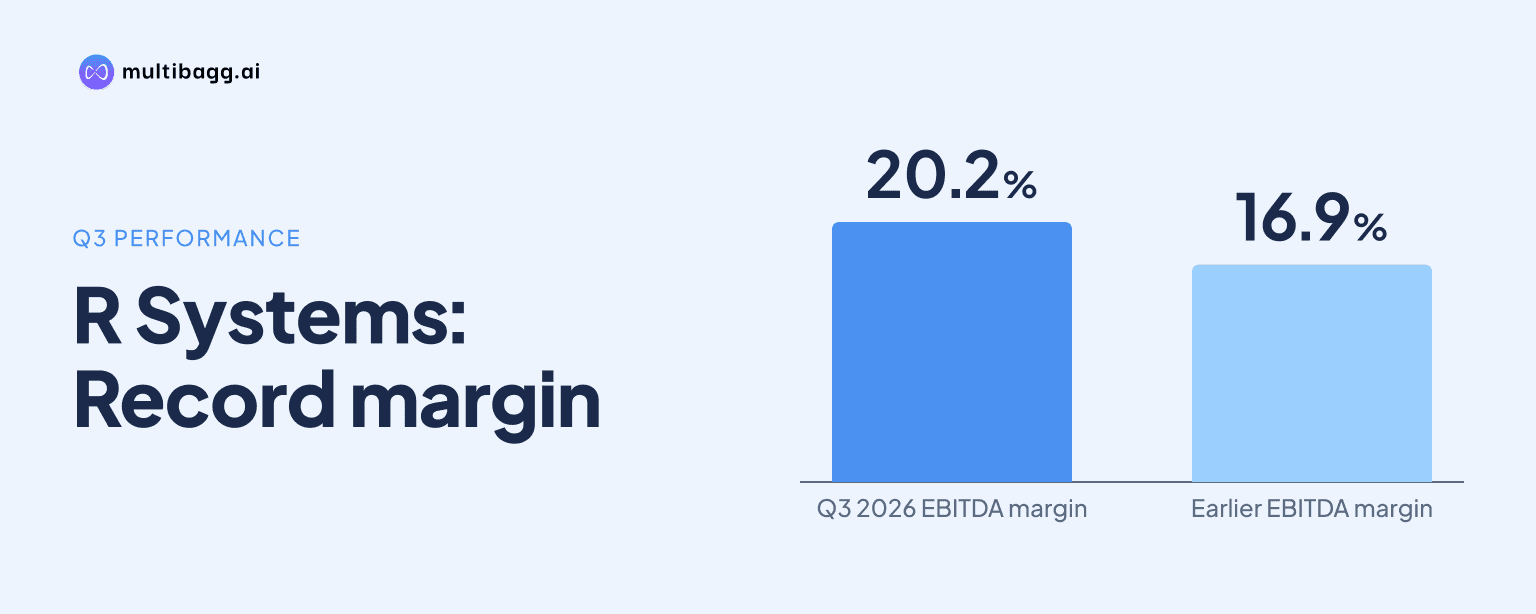
- R Systems’ Q3 2026 adjusted EBITDA margin reached 20.2%, versus 16.9% a year earlier.
- R Systems generated Q3 2026 adjusted net profit of Rs 66.5 crore, up 53.1% year on year.
- R Systems’ nine-month adjusted EBITDA rose 49.7% to Rs 360.9 crore.
powered by IRIS
R Systems International Limited reported a record adjusted earnings before interest, tax, depreciation and amortisation (EBITDA) margin of 20.2% in the July-to-September 2026 quarter, as revenue rose 23.4% year on year to Rs 615.2 crore and adjusted EBITDA increased 47.4% to Rs 124.4 crore. Management said this was R Systems’ seventh consecutive quarter of growth.
Know R Systems International inside out
Results, valuation, peers and who's buying, in one view.
How did R Systems perform in Q3 2026?
R Systems increased revenue, adjusted EBITDA and adjusted net profit from both Q3 2025 and Q2 2026. Revenue was Rs 615.2 crore in Q3 2026, compared with Rs 498.6 crore a year earlier and Rs 601.7 crore in the preceding quarter. Management attributed the year-on-year increase to volume growth supported by rupee depreciation.
Adjusted EBITDA grew faster than revenue, rising 47.4% year on year and 3.1% quarter on quarter to Rs 124.4 crore. Adjusted net profit reached Rs 66.5 crore, up 53.1% from Rs 43.4 crore in Q3 2025 and 5.7% from Rs 62.9 crore in Q2 2026. Adjusted basic earnings per share (EPS) was Rs 5.6, against Rs 3.7 a year earlier and Rs 5.3 in the previous quarter.
Reported profit after tax was Rs 64.2 crore in Q3 2026, compared with Rs 55.6 crore in Q2 2026, while reported basic EPS was Rs 5.42 versus Rs 4.69. Management said its adjustments were largely related to restricted stock unit (RSU) costs and other non-recurring items, which accounts for the difference between reported and adjusted profit measures.
What drove R Systems’ record EBITDA margin?
R Systems’ record 20.2% adjusted EBITDA margin reflected operational leverage and favourable exchange rates, while higher artificial intelligence (AI) talent costs partly offset those gains. The margin was 3.3 percentage points above 16.9% in Q3 2025 and 0.1 percentage point above 20.1% in Q2 2026. Management described the Q3 result as an all-time high.
Management said currency added about Rs 7 crore to the increase in net EBITDA during Q3 2026. It also said hiring costs for AI talent caused a slight dip in operating margin because a large share of current revenue is AI-influenced or AI-led. R Systems said it intends to expand its AI team and may add bench capacity after deploying previously built capacity on new projects.
Gross margin was 38.6% in Q3 2026, below 39.2% in Q2 2026 but above 35.5% in Q3 2025. Management attributed the sequential decline to a changed revenue mix and lower utilisation in Europe during the holiday season, partly offset by rupee depreciation. This indicates that the EBITDA-margin improvement included lower costs beyond the gross-margin line.
Selling, general and administrative expenses were Rs 113 crore in Q3 2026, compared with Rs 115.3 crore in Q2 2026. Management attributed the decline primarily to support-count optimisation. RSU expense under the management incentive plan fell to Rs 3.2 crore from Rs 6.2 crore, and EBITDA after RSU expense was 19.7%, compared with 19.0% in Q2 2026.
Got a follow-up? Ask IRIS
What does the nine-month comparison show for R Systems?
R Systems’ revenue for the nine months ended September 2026 increased 27.7% year on year to Rs 1,791.7 crore, while adjusted EBITDA rose 49.7% to Rs 360.9 crore. The faster EBITDA growth lifted adjusted EBITDA margin to 20.1% from 17.2% in the corresponding nine months of 2025.
Adjusted net profit for the nine-month period rose 54.0% to Rs 205.1 crore from Rs 133.2 crore. Adjusted basic EPS increased 53.8% to Rs 17.3 from Rs 11.3. Management said revenue growth contributed to the margin outcome and that currency gains exceeding Rs 78 crore formed part of the nine-month EBITDA bridge.
Below EBITDA, Q3 depreciation and amortisation was Rs 22.9 crore, including Rs 10.6 crore for intangibles from past acquisitions, while interest expense was Rs 9.6 crore. Tax expense was Rs 23.9 crore. Management put the effective tax rate at about 27% and said its normalised effective tax-rate range was 28% to 29%.
Which operating measures and wins support R Systems’ plan?
R Systems maintained billed days sales outstanding of 55 days in Q3 2026, or 76 days including unbilled revenue, which management said was similar to recent quarters. Utilisation increased as AI and data-and-AI transformation work consumed capacity that had been deliberately built two quarters earlier. Management said its strategy remains to maintain utilisation above 80%.
The Americas accounted for 70.6% of revenue, Asia-Pacific contributed 16.0%, Europe represented 9.4%, and the Middle East and Africa accounted for 4.0%. Management compared these figures with 15.3% for Asia-Pacific, 9.7% for Europe and 3.6% for the Middle East and Africa previously, while saying the broad geographic mix had not materially changed.
Client concentration also remained broadly stable by management’s measures. The top 10 clients generated 24.4% of revenue, while the top five represented 16.8% and the top three accounted for 11.9%. The largest client was in the 5.8% to 6.0% range of revenue.
Management highlighted wins involving cloud modernisation for a European telecom customer, a data lakehouse for a Middle Eastern housing and real-estate organisation, and a core lending platform for a Saudi financial-services provider. Other cited work included Salesforce transformation for an entertainment and games company and payment-connectivity solutions for an insurance-services provider. R Systems reported trailing-12-month annual contract value of bookings of $82.9 million, but did not provide a comparable earlier figure in the call.
Conclusion
R Systems paired 23.4% Q3 revenue growth with a 3.3-percentage-point year-on-year expansion in adjusted EBITDA margin to 20.2%. The nine-month figures showed the same pattern, with revenue up 27.7%, adjusted EBITDA up 49.7%, and adjusted net profit up 54.0%. Currency, operational leverage and lower selling, general and administrative expenses contributed, while AI hiring costs and European holiday-season utilisation affected the operating result.
The next disclosed item to watch is R Systems’ plan to expand AI talent and potentially add bench capacity after increased utilisation in Q3 2026. Management also cited a pipeline shaped by clients moving from AI experimentation towards production-grade deployments, alongside $82.9 million of trailing-12-month annual contract value bookings.