










Rail Vikas Nigam Limited expands beyond railway nominations
Key highlights
- RVNL reported a Rs 93,492 crore order book in Q1FY27.
- Q2FY27 consolidated revenue rose 9% quarter on quarter to Rs 4,700.96 crore.
- RVNL operates across eight infrastructure verticals and reports presence in 22 Indian states and four countries.
- BharatNet is RVNL’s largest non-railway order at Rs 13,236 crore, with a 10-year maintenance mandate.
powered by IRIS
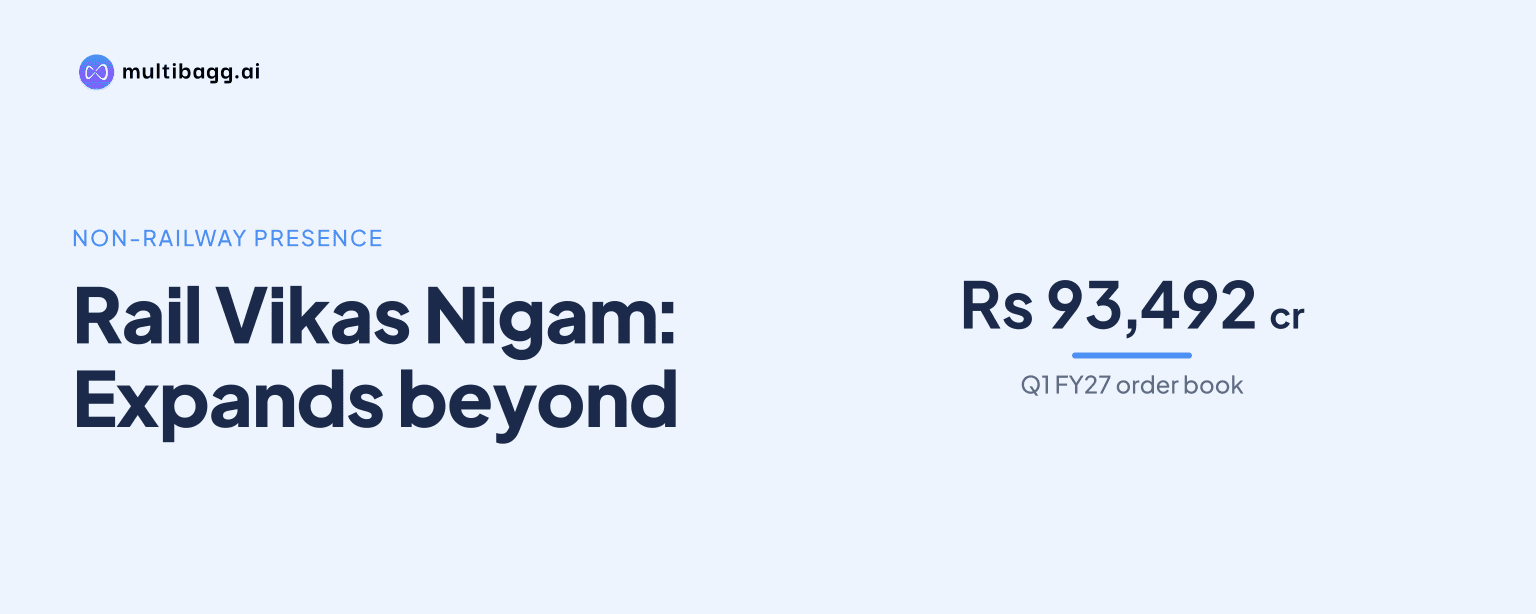
Rail Vikas Nigam Limited’s post-2021 shift expanded it from railway nominations into eight infrastructure verticals, with a Rs 93,492 crore order book reported in Q1FY27. RVNL identifies competitive open bidding, work in 22 Indian states and four countries, and long-term maintenance commitments as components of its broader operating model.
Know Rail Vikas Nigam inside out
Results, valuation, peers and who's buying, in one view.
How did RVNL’s business-winning model change after 2021?
RVNL’s source of business changed from Ministry of Railways nominations before 2021 to competitive open bidding after 2021. The presentation identifies the Indore Metro project in 2021-22 as its first bidding project, marking a move away from reliance principally on railway nominations for work allocation.
Before 2021, RVNL’s sector focus was pure railway infrastructure and its geographic footprint was domestic only. After 2021, RVNL describes its addressable work as including metros, highways, solar, ports and BharatNet, while extending its footprint internationally. This changed both the way contracts are won and the markets in which RVNL seeks them.
The scale reported alongside the post-2021 model includes a Rs 93,492 crore order book in Q1FY27. Consolidated revenue from operations increased 9% quarter on quarter, or QoQ, to Rs 4,700.96 crore in Q2FY27, while profit after tax increased 59% to Rs 253.71 crore from Rs 159.52 crore in Q1FY27.
The sequential financial figures do not isolate the contribution of new sectors or overseas contracts. They show that revenue, earnings before interest, tax, depreciation and amortisation, and profit were higher in Q2FY27 than in Q1FY27. Profit after tax margin rose by 171 basis points to 5.40% from 3.69% over the same period.
Which sectors and markets now define RVNL’s expansion?
RVNL identifies eight verticals across transport, energy and communications, compared with its pre-2021 focus on railway infrastructure. The verticals are railways, urban transport, highways, ports, energy and sustainability, hydro and irrigation, manufacturing and logistics, and communications.
The railway vertical continues to cover capacity doubling, new construction, gauge conversion, stations, electrification and signalling. Outside rail, urban transport includes metro, suburban transport, buildings and station redevelopment, while highways cover bridges, tunnels, stations, hybrid annuity model projects and build-operate-transfer projects. The presentation does not disclose revenue or order-book shares for individual verticals.
RVNL reports projects or operations in 22 Indian states and four countries across two continents. Its first overseas project is the UTF Harbour project in the Maldives, involving port and marine works. The overseas portfolio also includes a 250 megawatt Nur Bukhara solar photovoltaic project in Uzbekistan through a joint-venture entity and a transmission-network project in Rwanda.
Oman is the fourth country presented in RVNL’s overseas map, where RVNL Infra Middle East operates as a subsidiary. The presentation also lists RVNL Middle East Contracting in Dubai, Rail Vikas Nigam Co. Ltd in Saudi Arabia and Rail Vikas Nigam LLC in Uzbekistan among its subsidiaries, indicating that the international approach includes local entities as well as individual contracts.
Got a follow-up? Ask IRIS
How does RVNL execute projects beyond railway nominations?
RVNL says it executes five stages in-house, from concept through commissioning, rather than limiting its role to a single construction phase. The stages are concept development, design and estimate, contracting, execution and final commissioning for commercial operations.
At the design-and-estimate stage, RVNL cites delegated authority to sanction estimates within prescribed limits. At contracting, it uses procedures compliant with multilateral-funding requirements, while its execution model involves concurrent project management without dependence on zonal railways for drawing approvals. These are the mechanisms RVNL presents for bidding and executing across sectors.
RVNL also uses subsidiaries, joint ventures and special purpose vehicles to enter new areas. It lists nine subsidiaries and 10 joint ventures, including Chennai and Bangalore multi-modal logistics park ventures. Its strategic associate, Kinet Railway Solutions Ltd, is the manufacturing platform for the Rs 14,400 crore, 120-train Vande Bharat sleeper programme with Russia’s TMH.
Portfolio expansion has also included closures. RVNL’s Board approved closure of RVNL Infra South Africa on 25 July 2026 and approved closure of the Kyrgyzindustry-RVNL joint venture on 25 May 2026. The presentation describes the South Africa decision as part of active portfolio rationalisation.
Which projects demonstrate RVNL’s new sector and lifecycle model?
RVNL’s BharatNet Middle Mile project in Uttar Pradesh is its largest non-railway order at Rs 13,236 crore. Awarded by Bharat Sanchar Nigam Limited in FY25, the contract covers 82,607 kilometres of optical fibre in Uttar Pradesh East and West and includes a 10-year design, build, operate and maintain mandate.
BharatNet was 10% physically complete in FY26, according to the presentation. RVNL says it incurred Rs 20 crore of pre-bid spending on consultancy and surveys and won against established telecom firms. Management says the operations-and-maintenance phase needs less capital and provides steadier margins than engineering, procurement and construction work, although no projected margin figure is disclosed.
The Vande Bharat sleeper programme adds a second long-duration maintenance component. The Rs 14,400 crore programme covers 120 trainsets at Latur through Kinet, with RVNL’s share stated at Rs 8,640 crore. The first prototype is due in June 2027, followed by a 35-year operations-and-maintenance commitment.
Other projects show the continuing rail base alongside diversification. The Rs 37,000 crore Rishikesh-Karnaprayag rail link was 79% complete and is due for completion in December 2028; it covers 125 kilometres, about 85% of which is underground. The 95-kilometre Dallirajhara-Rowghat line, valued at Rs 1,881 crore, was commissioned in June 2026, with goods traffic beginning on 17 June 2026 and passenger approval still awaited.
Conclusion
The presentation places RVNL’s transition alongside project structures that extend beyond construction activity. BharatNet carries a 10-year maintenance commitment, while the Vande Bharat sleeper programme has a 35-year maintenance commitment, giving the broader platform exposure to longer-duration operating work as well as project execution.
The next disclosed milestones are operational. Investors can watch BharatNet’s progress beyond its FY26 level of 10%, the Vande Bharat sleeper prototype due in June 2027, and the Rishikesh-Karnaprayag rail link due in December 2028. Passenger approval for the Dallirajhara-Rowghat line remains unresolved after goods operations began in June 2026.