










Rail Vikas Nigam Limited: 59% order book is competitive
Key highlights
- RVNL reported a ₹90,099 crore order book at Q2FY27, equivalent to about 4.1 times FY26 revenue.
- Competitive bidding accounted for approximately 59% of RVNL’s Q2FY27 order book, compared with 41% from nominations.
- Railways was RVNL’s largest order-book segment at ₹56,816 crore, followed by signalling at ₹12,224 crore.
- RVNL reported ₹7,132 crore of standalone H1FY27 order inflow and a ₹37,400 crore bid pipeline at Q2FY27.
powered by IRIS
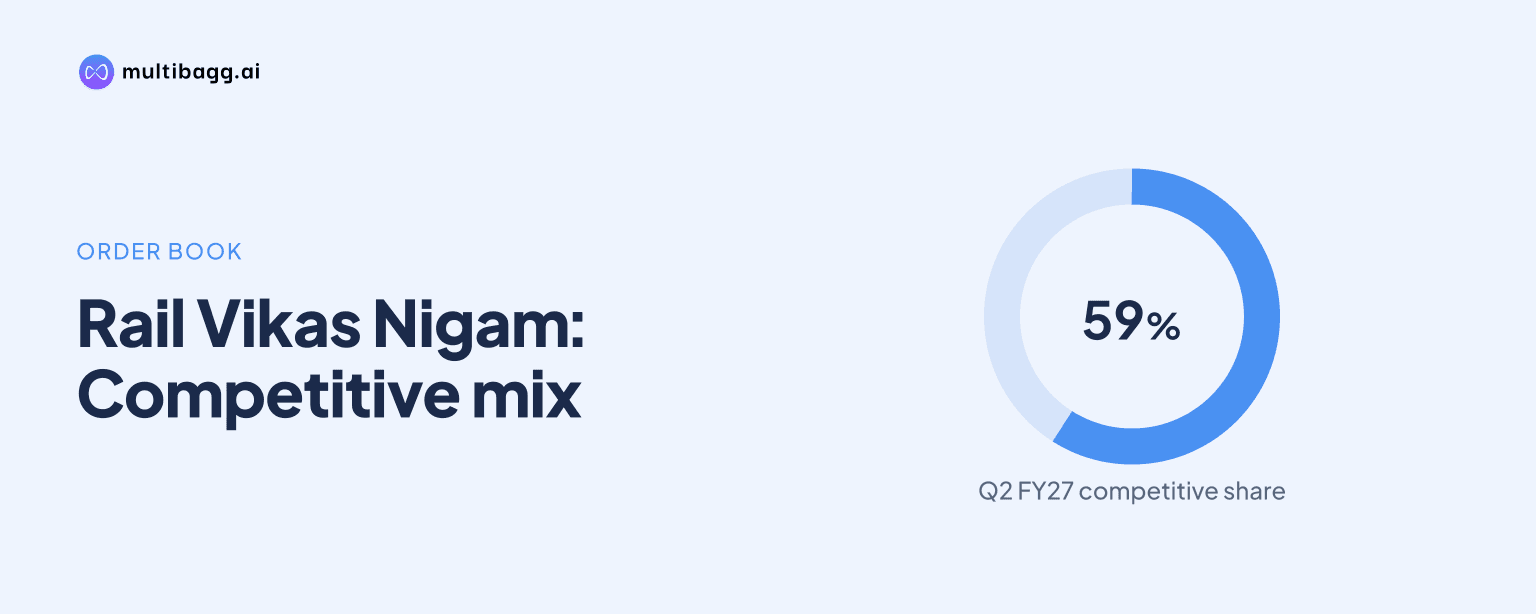
Rail Vikas Nigam Limited (RVNL) reported a ₹90,099 crore order book at Q2FY27, with approximately 59% sourced through competitive bidding and 41% through nominations. Railways remained the largest segment at ₹56,816 crore, while the company said the backlog equalled about 4.1 times FY26 revenue and represented roughly four years of work already won.
Know Rail Vikas Nigam inside out
Results, valuation, peers and who's buying, in one view.
What is RVNL’s current order book and revenue cover?
RVNL’s order book stood at ₹90,099 crore at Q2FY27, equivalent to approximately 4.1 times FY26 revenue and about four years of work already won. The presentation describes the order book as up around 6% year on year, indicating a higher backlog than at the comparable point in the previous year.
The disclosed annual data show that opening order book declined to ₹87,582 crore in FY26 from ₹91,806 crore in FY25. Total orders received also fell to ₹5,777 crore in FY26 from ₹23,561 crore in FY25, while the ₹90,099 crore Q2FY27 figure provides the later reported backlog position rather than a full-year inflow comparison.
The ₹90,099 crore amount is contracted work remaining to be executed, not revenue for one reporting period. RVNL’s comparison with FY26 revenue measures the scale of that execution requirement, while its roughly four-year estimate indicates the expected duration of the work already in hand.
How is RVNL’s order book split between bidding and nominations?
RVNL’s Q2FY27 order book was approximately 59% competitively bid and 41% nomination-based, making competitively won work the larger disclosed sourcing channel. The company describes the mix as roughly equal, although the stated proportions place competitive bidding 18 percentage points above nominations.
The presentation does not disclose separate rupee values for the competitive and nomination portions of the ₹90,099 crore order book. It does state that RVNL had contested bids worth more than ₹3,00,000 crore through H1FY27, indicating the scale of bidding activity behind the competitively sourced component.
For H1FY27, RVNL reported approximately ₹1,953 crore of contracts won through bidding and approximately ₹4,777 crore through nominations. These figures describe orders won during the six-month period, whereas the 59:41 split describes the sourcing composition of the total order book as at Q2FY27; standalone order inflow for H1FY27 was ₹7,132 crore.
Got a follow-up? Ask IRIS
Which segments account for RVNL’s ₹90,099 crore backlog?
Railways account for RVNL’s largest order-book segment at ₹56,816 crore, followed by signalling at ₹12,224 crore and building, port and other work at ₹6,994 crore. Based on the disclosed segment values, railways represent about 63% of the ₹90,099 crore total, retaining a clear lead despite the broader sector mix.
Signalling was the second-largest category, but its ₹12,224 crore backlog was ₹44,592 crore below the railways amount. The five smaller categories, comprising building, port and other work; metros; power and transmission; highways; and hydro and irrigation, totalled ₹21,059 crore, compared with ₹56,816 crore in railways.
The segment mix includes ₹5,346 crore of metro projects, ₹3,876 crore of power and transmission work, and ₹3,044 crore of highway work. Those three non-rail categories total ₹12,266 crore, while signalling adds another ₹12,224 crore of rail-system-related work, showing that the order book has expanded across infrastructure activities but remains led by railways.
What new orders and opportunities has RVNL disclosed?
RVNL reported ₹7,132 crore of standalone order inflow in H1FY27 and a ₹37,400 crore bid pipeline at Q2FY27. The bid pipeline is separate from the ₹90,099 crore order book because it represents opportunities that had not been disclosed as confirmed orders.
The presentation lists approximately ₹3,869 crore of NMDC Limited work in H1FY27, covering residential towers at Bacheli and refurbishment of permanent way for sidings and mobile-equipment tracks at Kirandul and Bacheli in Chhattisgarh. It also lists approximately ₹1,953 crore of Indian Railway roadbed, bridge and allied work and approximately ₹903 crore for a permanent railway siding at SJVN’s 1,320 megawatt Buxar Thermal Power Project in Bihar.
RVNL also disclosed a collaboration with the Government of Goa to act as project executing agency for infrastructure projects and a collaboration with Texmaco Rail & Engineering Limited covering rolling-stock manufacturing, maintenance and technology-driven innovation. The presentation does not provide a contract value or booking date for either arrangement, so neither can be identified as a quantified addition to the Q2FY27 order book.
Conclusion
RVNL’s Q2FY27 backlog combines a majority share of competitively bid work with a substantial railway base. The ₹90,099 crore order book provides roughly four years of work already won, but the ₹56,816 crore railways segment shows that the company’s execution exposure remains concentrated in its core market even as metros, power, highways and other sectors contribute ₹33,283 crore.
The disclosed ₹37,400 crore bid pipeline is the next item to watch because awards from it could change both the size and sourcing mix of the order book. RVNL’s H1FY27 standalone inflow of ₹7,132 crore, including approximately ₹1,953 crore from bidding and approximately ₹4,777 crore from nominations, provides the reported benchmark for tracking subsequent awards and backlog replenishment.