










RVNL adds 35-year and 10-year O&M revenue commitments
Key highlights
- RVNL’s Vande Bharat Sleeper programme has a 35-year O&M commitment and an Rs 8,640 crore RVNL share.
- BharatNet is an Rs 13,236 crore, 8,206-kilometre fibre project with a 10-year O&M lifecycle.
- BharatNet reached 15% physical progress in FY26 after its FY25 award from BSNL.
- The first Vande Bharat Sleeper prototype is due in December 2026, with 120 trainsets planned.
powered by IRIS
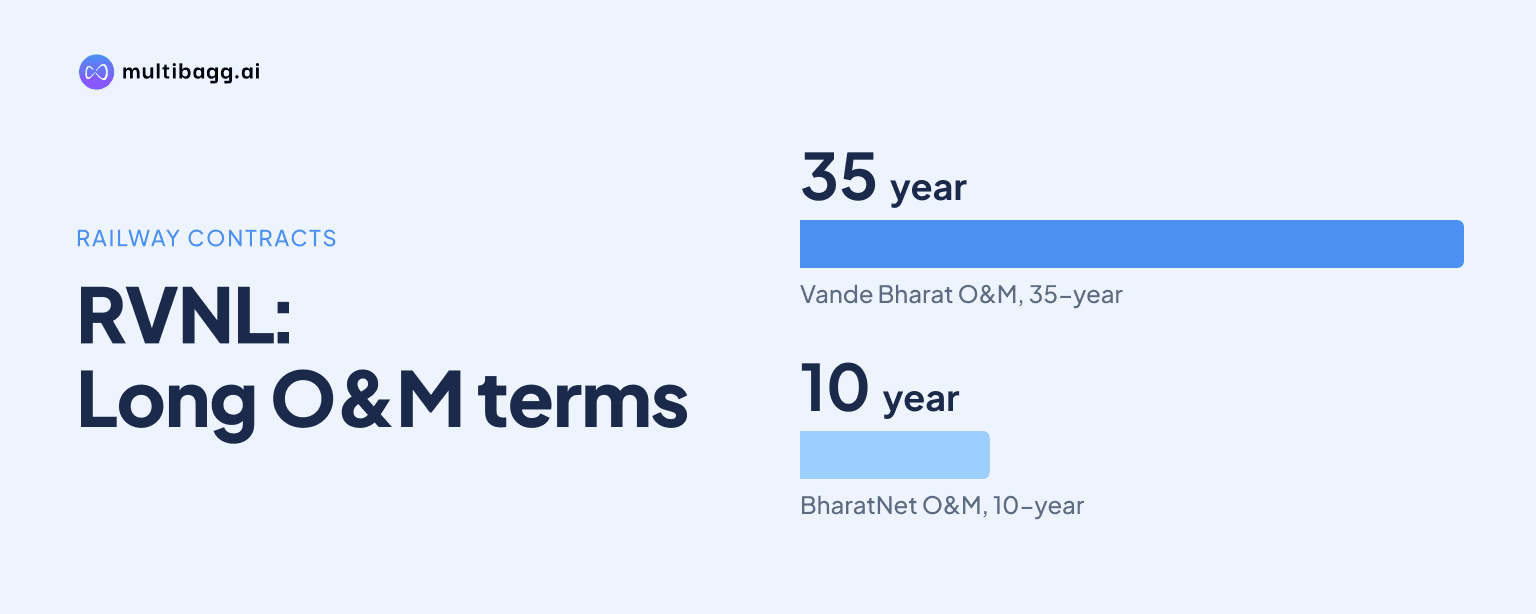
Rail Vikas Nigam Limited (RVNL) has disclosed 35-year operations and maintenance (O&M) commitments for Vande Bharat Sleeper trainsets and a 10-year O&M lifecycle for BharatNet, attached to an Rs 8,640 crore RVNL share in the train programme and an Rs 13,236 crore fibre project. The commitments extend beyond the initial manufacturing and construction phases.
Know Rail Vikas Nigam inside out
Results, valuation, peers and who's buying, in one view.
What long-term O&M commitments has RVNL disclosed?
RVNL has disclosed a 35-year O&M commitment for Vande Bharat Sleeper and a 10-year O&M lifecycle for BharatNet Middle Mile in Uttar Pradesh East and West. The two obligations give the projects operating and maintenance phases after their initial delivery or network-build work, rather than limiting the disclosed scope to one-time construction execution.
The presentation does not disclose a separate rupee allocation for O&M in either contract. It identifies Rs 8,640 crore as RVNL’s share of the Rs 14,400 crore Vande Bharat programme, while BharatNet has a total project value of Rs 13,236 crore. These are therefore disclosed project values, not forecasts of annual maintenance revenue.
How does Vande Bharat Sleeper create a 35-year O&M stream?
RVNL’s Vande Bharat Sleeper programme covers 120 trainsets at Latur through Kinet Railway Solutions Limited, in partnership with Russia’s TMH, and carries a 35-year maintenance commitment. The first prototype is due in December 2026, which is the programme’s next disclosed product-development milestone.
The full programme is valued at Rs 14,400 crore, of which RVNL’s share is Rs 8,640 crore. Planned deliveries begin after approval with 10 trainsets in Year 1, followed by 16 in Year 2, 20 in Year 3, 24 in Year 4, and 25 each in Years 5 and 6. The six-year schedule totals 120 trainsets.
The 35-year maintenance term is longer than the stated six-year delivery schedule. This establishes a disclosed lifecycle beyond train manufacture, but the presentation does not state the O&M payment schedule, annual revenue, margin, start date, escalation mechanism or allocation within the Rs 8,640 crore RVNL share.
What does the BharatNet mandate add to RVNL’s business mix?
BharatNet gives RVNL a 10-year O&M lifecycle on an Rs 13,236 crore project to deploy 8,206 kilometres of optical fibre cable for BSNL’s Middle Mile network in Uttar Pradesh East and West. RVNL describes BharatNet as its largest non-railway order and says the mandate was awarded in FY25.
The contract is a design-build-operate-maintain (DBOM) mandate from BSNL. RVNL states that Rs 20 crore of pre-bid expenditure on consultancy and surveys helped secure what it describes as a decade of annuity-style revenue. The presentation also calls BharatNet RVNL’s first large mandate outside rail and says it was won against established telecom firms.
RVNL says the O&M phase needs less capital and gives steadier margins than engineering, procurement and construction (EPC) work. That is management’s stated rationale for the lifecycle structure, rather than a quantified financial result, because the presentation does not disclose annual O&M revenue, margin, network availability obligations or payment milestones.
Got a follow-up? Ask IRIS
How far have RVNL’s two long-duration projects progressed?
BharatNet had achieved 15% physical progress in FY26, while Vande Bharat Sleeper had a December 2026 first-prototype target rather than a reported physical-completion percentage. BharatNet therefore has a disclosed construction-progress measure, whereas Vande Bharat Sleeper is at a prototype milestone before its planned delivery programme begins.
For BharatNet, RVNL says execution pace is improving across the 8,206-kilometre fibre scope. For Vande Bharat Sleeper, deliveries are planned only after approval, beginning with 10 sets in Year 1 and rising to 25 sets in each of Years 5 and 6. The presentation does not disclose either a BharatNet completion date or a date when either O&M period begins.
The two contracts also differ in their reported scale: BharatNet’s Rs 13,236 crore total project value exceeds RVNL’s Rs 8,640 crore share in Vande Bharat Sleeper. That is not a like-for-like comparison of complete contract economics, however, because the Vande Bharat figure is explicitly RVNL’s share of a Rs 14,400 crore programme while BharatNet is reported as total project value.
How do the commitments change RVNL’s construction-led revenue profile?
RVNL says the 35-year Vande Bharat O&M commitment and 10-year BharatNet lifecycle create recurring revenue that can offset cyclical project-based civil work. The stated mechanism is long-duration maintenance attached to assets and infrastructure initially manufactured or built under the two contracts.
The presentation does not quantify how much of RVNL’s future revenue will arise from maintenance rather than construction, manufacturing or project execution. It also does not provide annual revenue recognition, profitability or cash-flow figures for either O&M arrangement, so the eventual contribution of the two maintenance streams cannot be calculated from the disclosed pages.
BharatNet is the more advanced project by the available execution measure, with 15% physical progress in FY26, while Vande Bharat Sleeper’s first disclosed deadline is the December 2026 prototype. Vande Bharat Sleeper has the longer commitment at 35 years versus 10 years for BharatNet, but the source does not state whether maintenance commences at prototype approval, fleet delivery, commissioning or another contractual point.
Conclusion
RVNL has paired two large project scopes with maintenance obligations that run materially beyond initial execution: 35 years for 120 Vande Bharat Sleeper trainsets and 10 years for the BharatNet fibre network. The Rs 8,640 crore RVNL share in Vande Bharat Sleeper and Rs 13,236 crore BharatNet value show the disclosed project scale, while the absence of separate O&M values leaves the maintenance revenue component unquantified.
The next disclosed Vande Bharat Sleeper event is the first prototype due in December 2026, followed by approval and the six-year trainset delivery plan. For BharatNet, the reported baseline is 15% physical progress in FY26; subsequent execution, commissioning and O&M disclosures would clarify when its 10-year lifecycle shifts from network construction to maintenance.