










Rail Vikas Nigam Limited Q2 PAT Rises 59% on Execution
Key highlights
- RVNL reported Q2 FY27 consolidated revenue of ₹4,700.96 crore, up 8.79% quarter-on-quarter.
- Q2 FY27 consolidated PAT rose 59.05% quarter-on-quarter to ₹253.71 crore.
- RVNL's PAT margin increased 171 basis points to 5.40% in Q2 FY27.
- The order book stood at ₹90,099 crore on September 30, 2026, about 4.1 times FY26 revenue.
powered by IRIS
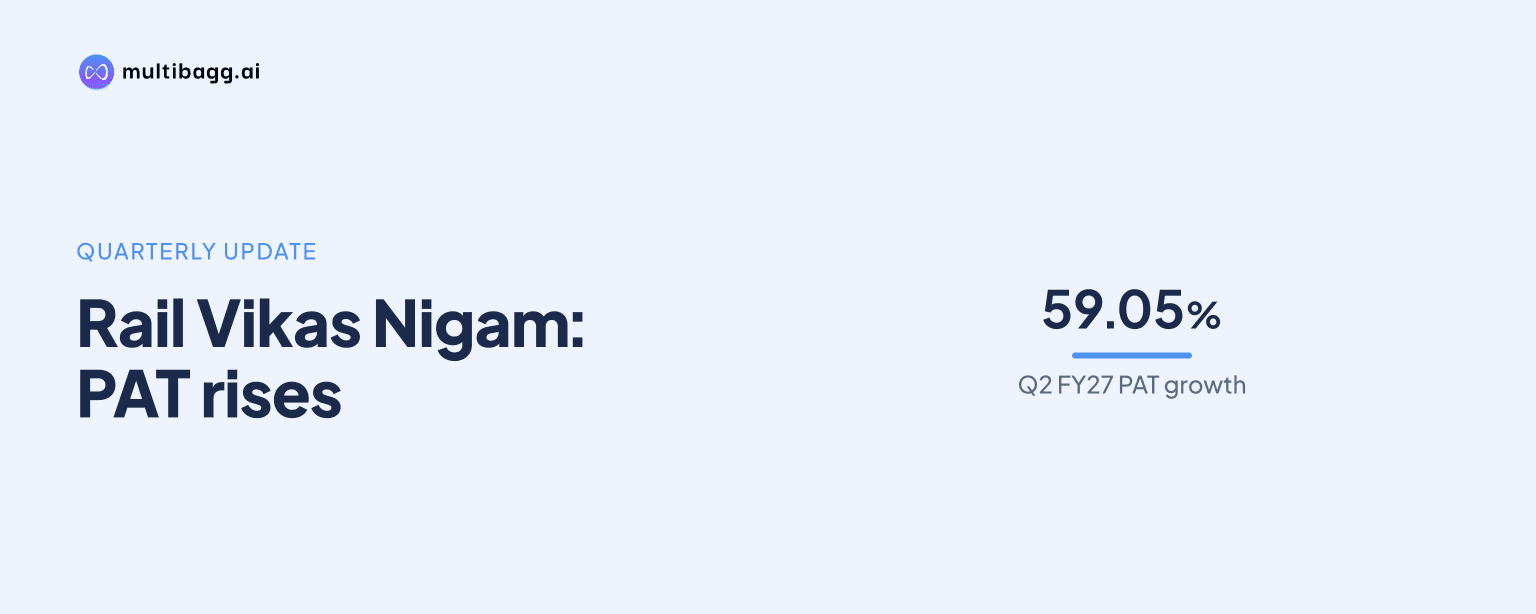
Rail Vikas Nigam Limited reported Q2 FY27 consolidated profit after tax of ₹253.71 crore, up 59.05% quarter-on-quarter, as revenue from operations rose 8.79% sequentially to ₹4,700.96 crore and margins improved. The result matters because RVNL's ₹90,099 crore order book provides significant visibility for project execution across its infrastructure operations.
Know Rail Vikas Nigam inside out
Results, valuation, peers and who's buying, in one view.
What did Rail Vikas Nigam Limited report for Q2 FY27?
Rail Vikas Nigam Limited reported a sharp sequential improvement in profitability in the quarter ended September 2026. Consolidated revenue from operations was ₹4,700.96 crore, compared with ₹4,321.23 crore in Q1 FY27, representing growth of 8.79% quarter-on-quarter. The company reported consolidated PAT of ₹253.71 crore, a 59.05% sequential increase and a 10.06% year-on-year rise.
RVNL's earnings improvement was also visible in operating and pre-tax metrics. EBITDA increased 54% quarter-on-quarter to ₹294.41 crore from ₹190.78 crore in the preceding quarter. Profit before tax rose 45.59% to ₹325.45 crore. PAT margin improved to 5.40% from 3.69%, an expansion of 171 basis points, while the reported EBITDA margin was approximately 6.3%.
Why did RVNL's quarterly profitability improve?
RVNL attributed the sequential improvement to financial momentum and improved project activity during the quarter. Management said the company had maintained operational efficiency and selective bidding strategies, while execution improved across its project portfolio. These factors coincided with a stronger increase in EBITDA and PAT than in quarterly revenue.
During the November 17, 2026 earnings call, Chairman and Managing Director Saleem Ahmad said the second quarter delivered strong sequential profitability improvement and healthy growth in half-year profitability. The management commentary linked the performance to continued business momentum rather than announcing a revision to its existing annual financial guidance.
The improvement is notable because revenue growth alone does not explain the full rise in profit. Revenue increased by about 9% sequentially, whereas EBITDA increased 54% and PAT increased about 59%. The movement in the PAT margin from 3.69% to 5.40% indicates that quarterly profitability rose faster than revenue during the period.
What is RVNL's FY27 revenue and profit outlook?
RVNL retained its full-year revenue guidance of ₹22,000 crore to ₹23,000 crore and expects top-line growth of around 10% to 15% in FY27. Management also expects bottom-line growth of approximately 8% to 10%, based on its stated outlook during the earnings call.
The company expects a substantial portion of execution to occur in the second half of FY27. Management cited new railway works and international opportunities as support for the outlook. RVNL has also targeted work orders of around ₹25,000 crore during the year, in addition to its existing project pipeline.
For the first half of FY27, consolidated revenue from operations stood at ₹9,022 crore on a standalone basis, according to management's call commentary. The full-year revenue guidance therefore places attention on execution progress in the remaining two quarters. The source did not provide a quarterly revenue target for the second half.
Got a follow-up? Ask IRIS
How does the ₹90,099 crore order book support RVNL?
RVNL's order book stood at ₹90,099 crore as of September 30, 2026, equivalent to about 4.1 times its FY26 revenue. This backlog provides multi-year execution visibility, subject to project progress, order conversion and the timing of work execution.
The company is expanding beyond its original railway-focused profile into eight infrastructure verticals and four countries. Its disclosed project portfolio includes the Rishikesh-Karnaprayag Rail Link, a ₹37,000 crore project described in the company material as India's most technically challenging rail project. Such projects underline the scale and complexity of RVNL's execution responsibilities.
RVNL became a Navratna public sector undertaking in FY24, giving it India's highest tier of operational and financial autonomy for PSUs. The Government of India held 72.84% of the company, according to the presentation material. These characteristics remain relevant for investors assessing the company’s ownership profile and role in public infrastructure execution.
What does the Q2 performance mean for investors and operations?
The Q2 figures show that RVNL improved profitability materially on a sequential basis while retaining its annual revenue and profit-growth expectations. The order book adds visibility, and the targeted ₹25,000 crore of work orders could add to the project pipeline if secured. However, the company’s reported guidance still depends on the pace of execution, particularly during the second half of FY27.
For infrastructure operations, the results place emphasis on converting the order book into billed revenue while maintaining the improved margin profile seen in Q2. New railway works and international opportunities are part of management's stated growth plan, but the company has not disclosed financial contributions from individual opportunities. Investors can therefore track subsequent order inflows, execution updates, revenue delivery and margin movement against the FY27 guidance.
Conclusion
RVNL's Q2 FY27 performance was marked by a 59.05% quarter-on-quarter rise in PAT to ₹253.71 crore, supported by revenue growth to ₹4,700.96 crore and a 171-basis-point expansion in PAT margin. The ₹90,099 crore order book strengthens the company’s stated multi-year execution visibility across railway and other infrastructure projects.
The next key measure will be second-half execution against management's ₹22,000 crore to ₹23,000 crore FY27 revenue guidance and its 10% to 15% top-line growth expectation. Investors will also watch progress toward the ₹25,000 crore work-order target, fresh railway and overseas opportunities, and whether quarterly margins remain near Q2 levels.